In a territory where the horizon is often hemmed in by smokestacks, fisheries, and high-voltage towers, a question arises that challenges the logic of extractivism and what is commonly understood as "development": From where can we begin to dream again? Guided by this premise, visual artist Constanza Hermosilla and architect Julio Suárez present their interdisciplinary artistic project: "Detrás de las industrias se esconde el sol" (Behind the Industries, the Sun Hides), an experimental documentary that subverts the narrative of the "sacrifice zone" to propose a speculative exercise through fiction.
As part of the academic dialogue and reflection space "From Territory to Detail," which brings together architecture professors, students, and renowned architects, the spin-off "From Territory to Detail .re"—positioned at the opposite end of a modern paradigm that defined the city through models of growth, expansion, and consumption that are no longer viable or sustainable—explores the thesis that a territory’s richness stems from its capacity to renew itself. It activates disused spaces to serve as future challenges and resources by reusing previous structures and traces, whatever they may be.
The Faculty of Architecture, Design and Digital Arts (FADAD) at Universidad Gabriela Mistral invites you to attend the keynote lecture "New York, New Publics" by Martino Stierli on Tuesday, April 14, at 5:30 PM.
urbicentros 2026 - the historic center as a privileged meeting place to reflect on the complexity that traverses its city, neighborhood, and house scales [poster: xico costa; image: angela carine]
Since its first edition in 2010, URBICENTROS has established itself as an innovative space for meeting and reflecting on the importance of diversity and the tension between the centrality and periphery of our historic centers. In this edition, URBICENTROS specifically seeks to:
Videos
Library Building, Itamaraty Palace - Photo by Nelson Kon
The Ministry of Culture, through the Rouanet Law, the Ministry of Foreign Affairs, the Museum of Afro-Brazilian History and Culture (MUHCAB), and the Instituto Pedra are pleased to present the seminar Between Two Worlds: Africa and Africans in the Historical Archives of the Itamaraty, which will take place on May 15, 2026, from 10:00 AM to 4:30 PM, at the MUHCAB auditorium in Rio de Janeiro.
The Latin American city is built upon fragments: fragments of landscape, memory, construction knowledge, and modes of habitation that remain present, even if they often go unnoticed. In Manizales—a city shaped by its steep terrain, risk, adaptation, and the constant transformation of its territory—these fragments manifest with particular intensity.
The 18th National Meeting on Landscape Architecture Education in Brazilian Schools of Architecture and Urbanism (Enepea) will be held from August 11 to 14, 2026, in Belo Horizonte, Minas Gerais. As the most traditional and established scientific event in the field of landscape architecture, it will bring together researchers, professors, professionals, and undergraduate and graduate students from across the country for four days of lectures, workshops, short courses, and technical visits.
View of the 32nd Museu da Casa Brasileira Design Award
The São Paulo State Secretariat of Culture, Creative Economy and Industry (SCEIC-SP) and the Pinacoteca Arte e Cultura Association (APAC) announce the opening of submissions for the 36th Museu da Casa Brasileira Design Award in the Product and Written Work categories. Participation is free and open to Brazilian citizens and foreign residents living in the country for more than two years. Interested parties may register from December 2, 2025, to January 28, 2026, via the official website: premiodesignmcb.apacsp.org.br.
Thirty years after its founding, SIGraDi and the University of Chile invite the academic, professional, and creative community to participate in the 30th international congress of the Ibero-American Society of Digital Graphics, to be held in Santiago at the University of Chile from November 18 to 20, 2026. This gathering marks a symbolic return to the University of Chile, which hosted SIGraDi 2006 two decades ago under the theme "The Human Factor." At that time, we invited participants to reflect critically on the role humans played in the emerging world of digital design. That critical look at the past—and the future—is more relevant than ever in the face of even more disruptive technologies. In this spirit, we are proposing the concept of "AI_ded Design," a notion that updates the legacy of CAD (Computer-Aided Design) and projects it toward a new horizon where design, architecture, and urbanism are redefined by algorithmic structures, intelligent environments, and autonomous systems mediated by Artificial Intelligence. We invite you to think beyond computer-aided design. We aim to open a space for discussion on a form of design where computation—increasingly transparent, ubiquitous, and autonomous—gives way to new forms of cognition, agency, emergence, distributed processes, and a necessary technological ethics that reconfigures design practices. To stimulate this collective conversation, we propose four open questions: What have we learned in these 30 years? What have we improved in these 30 years? What have we achieved in these 30 years? What challenges are emerging in the relationship between humans, machines, and environments?
"DENISE SCOTT BROWN. CITY, STREET, HOUSE" February 11, 2026 – May 31, 2026 Curators: M. Pia Fontana, Professor of Architectural Design Miguel Mayorga, Professor of Urban Planning ETSAB - UPC Barcelona School of Architecture (ETSAB) - Polytechnic University of Catalonia (UPC) Founding partners of mayorga + fontana arquitectura https://www.mayorga-fontana.com/
Lecture “Eclecticism in continuity: the vitality of Italian architecture today” with Italian professor Stefano Passamonti
The Italian Cultural Institute of São Paulo (IICSP) will host Italian architect and researcher Stefano Passamonti for a lecture reflecting on the relationships and dialogues between contemporary Italian and Brazilian architecture.
Promotional poster for the Professional Qualification Course in Modern Architecture Conservation. Credit: Ascom COC Fiocruz
This professional qualification course aims to enable architects and urban planners to work effectively in the conservation of recent heritage, strengthening professional practice in the preservation of architectural, urban, and landscape heritage. In this edition, the course focuses on reinforced concrete construction systems and their application in modern buildings.
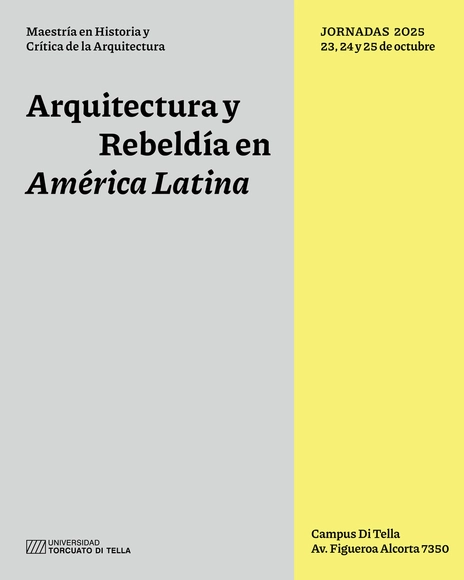
2025 Conference on the History and Criticism of Architecture | ARCHITECTURE AND REBELLION IN LATIN AMERICA. Alternative pedagogical experiences; from "everything is political" to "disciplinary autonomy"; 1963–1983. Organized by: Master’s Program in the History and Criticism of Architecture.
Colors can define atmospheres, shape spatial perception, and translate ways of being, memories, and collective affects. Consequently, understanding them has become an essential part of contemporary creative and constructive processes. Behind every shade lies a field of research that bridges sociology, psychology, aesthetics, and technology, connecting color to broader cultural shifts and revealing how it can serve as a tool for reading and expressing the present.
The ground we walk on is composed of layers of history buried over time: infrastructures, vegetation, animals, and human beings who inhabited these territories form a collection of sedimented layers and historical deposits that combine with geological layers from deep time. This interrelation between the artificial and the geological is especially evident in the forgotten infrastructures buried beneath our cities. How can we unearth both the memory and the material evidence of these? And what does this tell us about what we have collectively forgotten?