
1st International Congress on Architecture and Society - Humanizing the City
1st International Congress on Architecture and Society - Humanizing the City
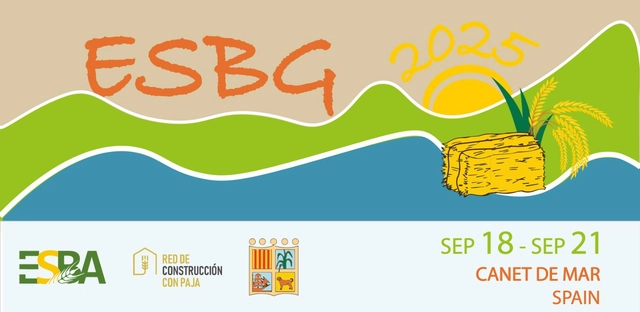
The European Straw Building Gathering (ESBG 2025) will take place from September 18 to 21, 2025, in Canet de Mar (Barcelona). This international event will bring together professionals, collectives, and those interested in bio-construction and sustainability.

The I Ibero-American Biennial of Creation and Territory is a cultural event that invites critical reflection on contemporary creation within the context of Ibero-American regionalism.

The Municipality of Lo Barnechea, in partnership with the Association of Architectural Offices (AOA), invites national architects to participate in a competition for the design of pedestrian bridges in the commune. The competition seeks innovative and sustainable proposals that ensure urban connectivity and integration in the Las Ermitas sector, while promoting local identity.
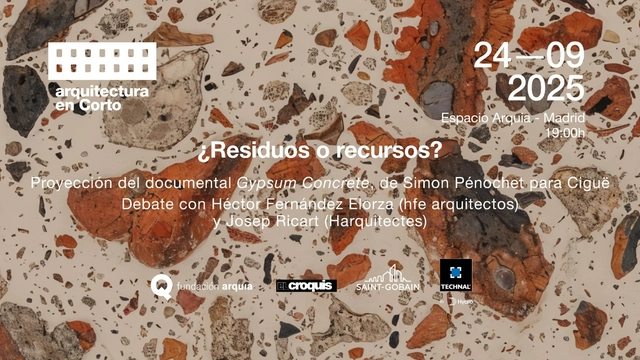
Waste or resources?
Arquitectura en Corto invites you to the screening of Gypsum Concrete, taking place on Wednesday, September 24, at 7:00 PM at Espacio Arquia in Madrid (C/ Tutor, 16). Directed by Simon Pénochet, the short film documents the research conducted by the French architecture firm Ciguë to transform demolition waste from a construction site on the outskirts of Paris into material for a new building being constructed on the same plot. The project proposes manufacturing concrete for floor slabs using recycled aggregates and gypsum as a binder—a material recyclable through urban mining processes that is available in large quantities throughout the Paris region. The film explains how testing validates the material for this application and concludes that using gypsum instead of cement reduces CO2 emissions by up to four times. In Spain, several projects have already been completed where materials found in situ were repurposed as resources for new construction. Following the screening, Héctor Fernández Elorza (hfe arquitectos) and Josep Ricart (HARQUITECTES) will discuss the topic and present examples of their small- and large-scale interventions—ranging from single-family homes to urban public spaces—where material reuse has been a core project strategy.

Fleeing the metropolis: a new rurality? What lies between the shantytown and the gated community? Remote work and sociability.

An inclusive approach to the rehabilitation of self-produced areas is essential to promote more objective and widespread knowledge production for the development of new public policies in times of planetary urbanization. To this end, the ISOB - International Seminar on Outros Bairros aims to systematize the interdisciplinary knowledge produced and experienced during the experimental period of the Outros Bairros Initiative (2019-2022), intersecting it with current urban demands. Over four days of meetings, the event will feature various sessions that will allow us to listen to the perspectives of residents from self-produced areas in Mindelo, as well as students and researchers from diverse fields, policymakers, and other participants.

Some of the most well-known buildings in the São Paulo landscape and in major metropolises around the world bear his signature, even if few can precisely define his architectural style. This difficulty, far from being a problem, is part of the enigma and strength of Isay Weinfeld, a creator whose work escapes easy labels and defies rigid classifications. However, reducing him solely to architecture would be a mistake. Over five decades of intense and coherent production, the São Paulo-based architect has built a trajectory that traverses design, visual arts, and cinema with rare fluidity. These multiple fronts of activity will be brought together in Etcétera, the most comprehensive exhibition dedicated to his career, which will occupy the Instituto Tomie Ohtake from March 5 to May 17.

A transdisciplinary piece constructed from essayistic fragments, cartographic exercises, and affective displacements. The work begins with the following questions: What is a map? What is the "outside" really? Can paths be traced from desire?

On May 30, Jean-Michel Othoniel will inaugurate his first institutional exhibition at the Instituto Bardi – Casa de Vidro. Titled "Poetic Living," the exhibition presents new works by the French artist, created specifically to occupy the house in dialogue with the architecture and body of work of Lina Bo Bardi.

Emotional Archive: The Intriguing MAC Exhibition That Records Disappointment. An uncomfortable—and deeply human—question runs through the new exhibition at the Museum of Contemporary Art: what happens to what disappoints us? Is it forgotten, transformed, or can it be recorded?

The Latin American Master’s in Architecture and the Doctorate in Architecture and Urbanism at the University of Bío-Bío invite you to a tour of three projects designed by Smiljan Radic (and collaborators), recently awarded the Pritzker Architecture Prize. The tour will include the Civic District of Concepción (2001), the Boca Sur Center (2008), and the Bío-Bío Theater (2011)—three projects awarded through public competitions that feature unique architecture and have become significant urban connectors. The tour will begin at the University of Bío-Bío’s Concepción Campus (Avda. Collao 1202), subject to prior registration via form and email confirmation. The event is intended primarily for architects interested in advanced studies. The activity is free of charge and includes local transportation and time for lunch, as well as an interior tour of the Bío-Bío Theater (organized by the TBB Corporation). Space is limited.

Contemporary cities are increasingly facing challenges related to urban loneliness, social fragmentation, and the loss of meaningful spaces for connection. Lima is no exception. These dynamics invite us to rethink how we inhabit our cities and the role that space plays in building our quality of life.

The third GADU International Congress on Gender, Architecture, Design, and Urbanism will take place from November 4 to 6, in both virtual and in-person formats at the Faculty of Architecture, Design, and Urbanism of the University of Buenos Aires, Argentina.
The event is organized as part of the activities of the GADU program, based at the Institute of Human Spatiality at FADU UBA.

The 11th Docomomo North and Northeast Seminar will take place from November 4 to 7, 2026, in Belém (Pará), under the theme "Modernity in Transition: Climatic [Inter]changes." The in-person event will be open to the public and feature the participation of the academic community. The program includes lectures and roundtables, as well as paper presentations covering teaching, research, and outreach.

The Faculty of Architecture, Design and Digital Arts (FADAD) at Universidad Gabriela Mistral invites you to attend the keynote lecture "New York, New Publics" by Martino Stierli on Tuesday, April 14, at 5:30 PM.

Since its first edition in 2010, URBICENTROS has established itself as an innovative space for meeting and reflecting on the importance of diversity and the tension between the centrality and periphery of our historic centers. In this edition, URBICENTROS specifically seeks to:

The Ministry of Culture, through the Rouanet Law, the Ministry of Foreign Affairs, the Museum of Afro-Brazilian History and Culture (MUHCAB), and the Instituto Pedra are pleased to present the seminar Between Two Worlds: Africa and Africans in the Historical Archives of the Itamaraty, which will take place on May 15, 2026, from 10:00 AM to 4:30 PM, at the MUHCAB auditorium in Rio de Janeiro.