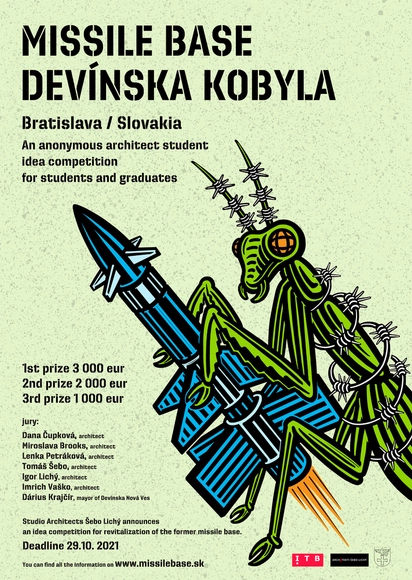
The missile base located above the city of Bratislava on the top of Devínska Kobyla is today an unused and dilapidated memory of history. Concrete silos, bunkers and barracks built in the 1980s attract only a few contemporary witnesses, curious people and passing tourists. The buildings are in poor technical condition and, in many cases, movement in their vicinity is dangerous. In such locality which oozes history and is also surrounded by beautiful countryside, we see the potential for its improvement.
The Lithuanian National Museum of Art (LNMA) has just announced an open international architectural competition for international open architectural project competition of the building complex of Jonušas Radvila Palace and it‘s approaches in Vilnius, Lithuania. The competition calls for a vision for the revitalization and empowerment of the Radvila Palace building complex – museum of art and design: to create a museum of global art and design, showcasing art of different periods from different countries of the world. Visual art and design is the core concept that binds the whole complex of buildings together. It must also become an attractive public cultural space, accessible to all. The Radvilos residency, built in 17th century, is located in Vilnius Old Town. During the centuries, the complex has experienced some alterations, but today it is one of the historic monuments of national importance in Lithuania. Today, the buildings belong to the LNMA, but only a small part of the premises are functioning as spaces, suitable for visitors. The rest of the buildings are in a quite derelict state. The LNMA intends to wake the complex for the new life and to, creating a museum of international visual art, and to open it up to the public through various educational and cultural activities. The competition challenges the architects to create proposals where the heritage values would be preserved, and, at the same time, contemporary additions would highlight the historic values and celebrate innovation. The competition was announced on 17th of May 2021, its terms and documents were published in the Central Public Procurement Information System (CVP IS). How to register to the Central Public Procurement Information System (CVP IS)
Kurula Varkey Design Forum, Call for Entries is NOW OPEN
The Kurula Varkey Design Forum is an international student led forum organised at CEPT University, India. Since its inception in 2000, the forum has strived to critically question the discipline of architecture and its manifestations at the given time through student projects as take-off points. We invite undergraduate student projects from over 100 architecture schools across South Asia, of which a few are selected as generators of the discourse. Over the years, KVDF has had panelists like B.V. Doshi, Juhani Pallasmaa, Suhasini Ayer, Tatiana Bilbao, Gautam Bhan, Kevin Low, Jeremy Till, and more.
Tree House 2021 Architecture Competition invites you to re- imagine their childhood dream of living in a tree house in the wilderness, away from all the restrictions.
We all have always yearned for our personal space, one that takes us far away from our chaotic and stressful lives; our very own Home rooted in Mother Nature, one that reconnects us to our origins, rejuvenating our mind, body and soul. We all aspire for a home that is not just an extension of our persona but is also an expression of our individuality and freedom.
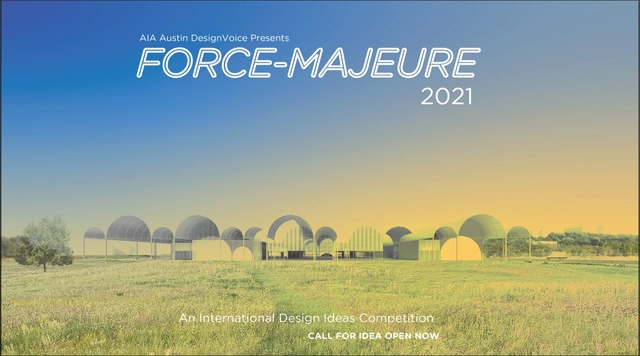
Whether act of God or a superior force, our society responds to and prepares for Force-Majeure scenarios on many different scales. It has become increasingly obvious in the past year that disasters, both natural and human-made, exacerbate inequities in our society by unequally limiting access to healthcare, green spaces, fresh food, transportation, and education for our most vulnerable populations. Strengthening our communities allows us to be more resilient in the face of future Force Majeure scenarios. How can we as design professionals help support and provide care for the most vulnerable groups of people in our society?
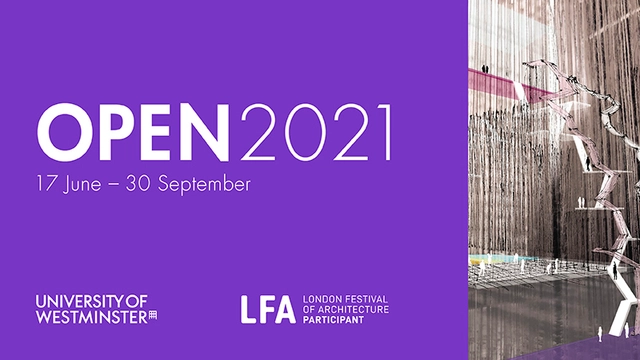
OPEN 2021 is an online exhibition of projects that reflect the varied design approaches of the University of Westminster's School of Architecture + Cities, its diverse students, and their place at the heart of London.
The Media Architecture Biennale is the world’s premier event on media architecture, urban interaction design, and urban informatics. It brings together architects, artists and designers, leading thinkers on urban design, key industry and government representatives as well as community activists. Together, we explore the design and role of media in the built environment and its implications for urban communities and ecosystems.
The world is in dire need of good design that benefits both people and the planet. High school and university students around the world have spent their semesters creating projects that use art, design, and biology to create a more sustainable and equitable future.
Aarhus School of Architecture is moving into Denmark’s first new-built architecture school. We celebrate the move in October by hosting an architecture festival for the entire industry and other architecture enthusiasts.
Kuma. Complete Works 1988–Today (cover). Courtesy of TASCHEN.
After Tadao Ando, Toyo Ito, and Fumihiko Maki, Kengo Kuma has breathed renewed vigor and lightness into Japanese architecture. Departing from the modernist skyscraper of the 20th century, Kuma traveled through his native Japan to develop a truly sustainable approach, translating local craftsmanship and resources into site-specific, timely buildings. Informed by tradition, and with both feet firmly planted in the present, this “materialist” heralds a new tactile architecture marked by its engaging surfaces, innovative structures, and fluid forms, reconnecting people with the physicality of a house. Kuma’s objective, above all else, is “just to respect the culture and environment of the place where I am working.”
Just published and available for purchase online, The Future of Modular Architecture presents an unprecedented proposal for mass-customized mid- and high-rise modular housing that can be manufactured and distributed on a global scale. The book’s thesis springs from the idea that adopting the dimensional standards of the existing intermodal freight transportation system is the key to achieving meaningful economies of scale.
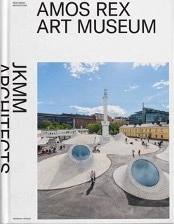
JKMM Architects’ Amos Rex Art Museum set a new standard for what an art museum can be, redefining the museum as a space for both art and social interaction, whilst at the same time presenting an innovative and exciting architectural experience in the centre of Helsinki that actively invites public participation.
Follow photographer Frédéric Chaubin as he embarks on a unique, century-spanning journey through Europe. Featuring images of more than 200 buildings in 21 countries, Stone Age presents the history and architecture of the most dramatic medieval castles of the continent in an unprecedented collection.
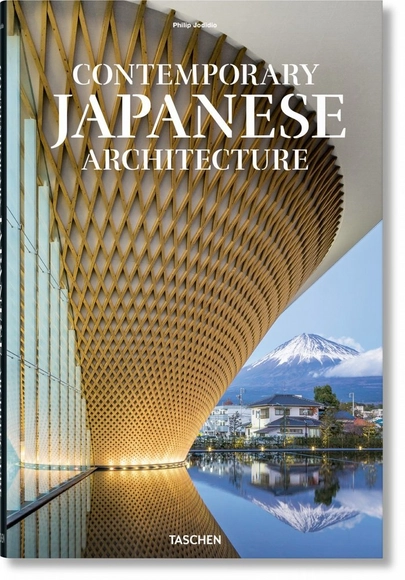
Contemporary Japanese Architecture (cover). Courtesy of TASCHEN.
The contemporary architecture of Japan has long been among the most inventive in the world, recognized for sustainability and infinite creativity. No fewer than seven Japanese architects have won the Pritzker Prize.