Madera: Innovation for Social Architecture in Uruguay is an international architecture competition organized by the Ministry of Housing and Territorial Planning of Uruguay (Ministerio de Vivienda y Ordenamiento Territorial, MVOT) and MEVIR, with the support of the Inter-American Development Bank. The competition is a call for proposals for new low-rise, single family, housing typologies using innovative wood technology. The winning proposal will be built by MEVIR in a demonstration complex of 20 units in the town of Tranqueras, in the Department of Rivera, in the north of Uruguay. The main objective of the competition is to promote and enhance the use of Uruguayan wood as a construction material for social housing, incorporating design and technological innovation, energy efficiency, and sustainability principles.
The Society of Façade Engineering (SFE) and the Chartered Institution of Building Services Engineering (CIBSE) have joined forces with Zak to co-located the SFE Façade Awards and Dinner with the Zak World of Facades London conference for the second year running.
"Communal Space for Social Raise” International Architecture Student of Wiswakharman Expo 2023.
Wiswakharman Expo is an annual architecture event series held by architecture students of Universitas Gadjah Mada. Every year, Wiswakharman Expo brings a fascinating theme. This year we hold an International Architecture Competition with the theme of “Communal Space for Social Raise”
This year's MiG challenge reflects on Moshe Safdie's statement "I want my buildings to take root and look as if they've always been there. It isn't about pastiche or adapting what's already there. It's about trying to blend the future and the past." This difficult task raises the problematics of the site within the framework of the glocal - a term coined in the 1990s to think about globaliזation dialectically, as an interdependent process of integration and diversification, in which the local is shaped by the global, but also that locality becomes ever more important either as resistance or as a motor of innovation. In light of recent developments such as the worldwide pandemic, climate crisis, and the fracturing of the international political order, it is time to reconsider the agency of the local. The 2023 MIG prize challenge is to rethink how the local is redefined by these worldwide challenges through cooperative and confrontational interaction with other localities and scales of reference. The proposed project should make a clear statement in regards to the status of locality in its different material, environmental, cultural and social aspects as it adapts to inflows and outflows of people, ideas, memories, technologies, resources, natures and capital, and test its architectural implications in the design of a building that is both rooted in the place's past and proposes a vision of a possible future. The project must be detailed to the scale of a building (i.e. 1:100 or 1:200) and include an explanation of the ideology behind the design. The design must address the well-being of the users and respect the surrounding environment of the proposed projects.
The basic legal act concerning the reconstruction of the Saski Palace, the Brühl Palace and tenement houses at ul. Królewska in Warsaw is the Act of August 11, 2021 (Journal of Laws of 2021, item 1551) on the preparation and implementation of investments in the reconstruction of the Saski Palace, Brühl Palace and tenement houses at Królewska Street in Warsaw, adopted to "celebrate the jubilee of the 100th anniversary of the rebirth of the independent Republic of Poland, to restore the historic shape of the representative space of Marshal Józef Piłsudski Square in Warsaw, destroyed during World War II, to satisfy the will of Poles and to strengthen the unity of the civic community, symbolized by the rebuilt Saski and Brühl palaces together with the complex of tenement houses at ul. Królewska, and also to complete the work of rebuilding the capital city, destroyed and demolished by the German occupiers, so that those buildings and structures that proudly expressed the sovereignty of the Polish state a hundred years ago would serve Poles both today and in subsequent generations and be a visible sign of the continuity of our history, and at the same time a testimony to a strong and modern Republic of Poland”. Reconstructed facilities must meet the requirements of the Act.
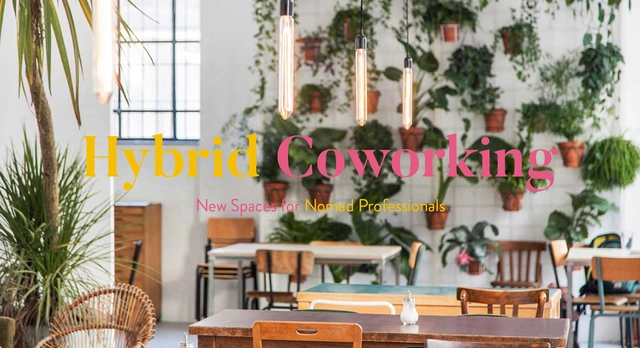
TerraViva Competitions launches HYBRID COWORKING, a new interior design competition that puts the focus on the transformation of existing bars and cafés all over the world. Prizes up to 7.000 € will be awarded to the winners selected by an international jury panel composed by, among others, Fabrizio Vizzi (Rosan Bosch Studio), Jesica B. Orizi (Maris Interiors), Giulio Ubini (Tuc Studio), Nadica Filipovic (ARR&D Interiors);
We are delighted to invite architects, artists, and designers to express their interest in working on a new site-responsive public art project in Somers Town, Central London.
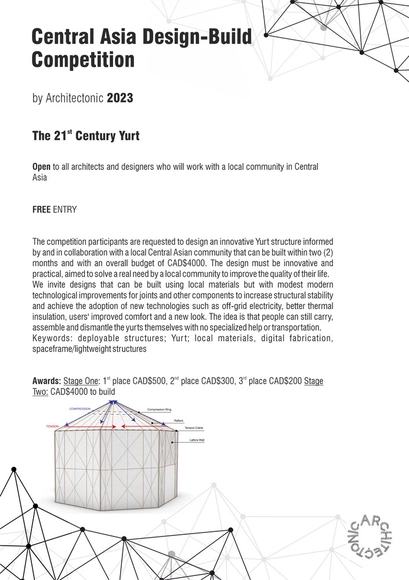
The competition participants are requested to design an innovative Yurt structure informed by and in collaboration with a local Central Asian community that can be built within two (2) months and with an overall budget of CAD$4000. The design must be innovative and practical, aimed to solve a real need by a local community to improve the quality of their life. We invite designs that can be built using local materials but with modest modern technological improvements for joints and other components to increase structural stability and achieve the adoption of new technologies such as off-grid electricity, better thermal insulation, users’ improved comfort and a new look. The idea is that people can still carry, assemble and dismantle the yurts themselves with no specialized help or transportation. Keywords: deployable structures; Yurt; local materials, digital fabrication, spaceframe/lightweight structures. Awards: Stage One: 1st place CAD$500, 2nd place CAD$300, 3rd place CAD$200 Stage Two: CAD$4000 to build Mentorship: The top three projects will receive mentorship from the jury to better develop their design and strategize construction in collaboration with the local community of their choice. Registration: Participants must e-mail info@architectonic.ca to register and receive an entry code. Language: English is the official language of the competition; however, where appropriate, other languages can be incorporated with English translation. Schedule: March 10th- April 30th, 2023. Submissions are open. May 1st -10th, 2023: Jury composition to be confirmed. May 11th -May 15th, 2023: Jury to select the first, second and third place winners. May 16th – June 15th, 2023. Mentoring stage one winners to further develop their designs. June 20th -June 25th, 2023. The jury decides the final winning project to be constructed. July 1st - September 15th, 2023. Construction Period. CAD$4000 will be released for construction in 4 installments.
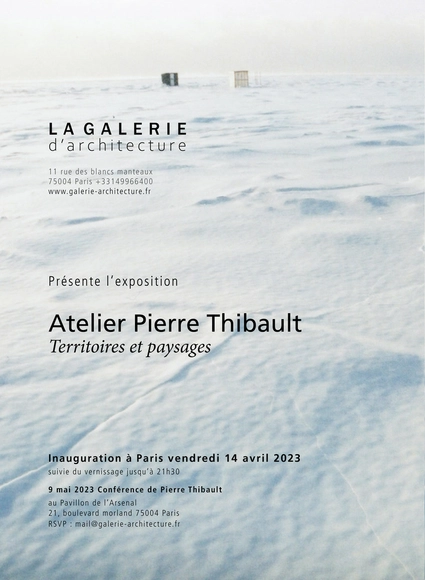
Créé en 1988 et composé d’une dizaine d’architectes, l’Atelier Pierre Thibault place en dialogue constant le territoire québécois, ses paysages, ses saisons et son architecture vernaculaire de manière à créer des projets intimement ancrés dans le milieu naturel et culturel. Fortement influencé par les lieux qui l’entourent, l’Atelier a su se démarquer sur les scènes nationale et internationale grâce à son approche sensible, empirique et intuitive. Cet univers intriqué et poétique de lieux, d’images et de typologies qui l’habitent se matérialise dans le cadre de l’exposition, proposant aux visiteurs une immersion littérale et figurative dans l’imaginaire architectural québécois et des territoires qui le compose. Scénarisée en un archipel composé de plusieurs ilots-territoires, l’exposition utilise le corpus distinctif de Thibault et son équipe pour interroger les différents rapports entre un projet d’architecture, son site d’implantation, son contexte culturel et naturel. En résulte une constellation architecturale distillant l’essence du travail de l’Atelier, brillant à la fois par sa constance et sa capacité de renouvellement, et ce depuis une trentaine d’années. Articulée autour des médiums de prédilection de l’agence - maquettes et croquis - l’exposition s’ancre dans une volonté de construire des ponts entre différentes approches architecturales et paysagères et de stimuler des échanges durables et lumineux entre cette profession, les territoires qu’elle construit et le grand public.
Join us for the opening reception of The Koffler Gallery's latest exhibition, “The Synagogue at Babyn Yar: Turning the Nightmare of Evil into a Shared Dream,” launches on April 17th, Yom HaShoah Eve.
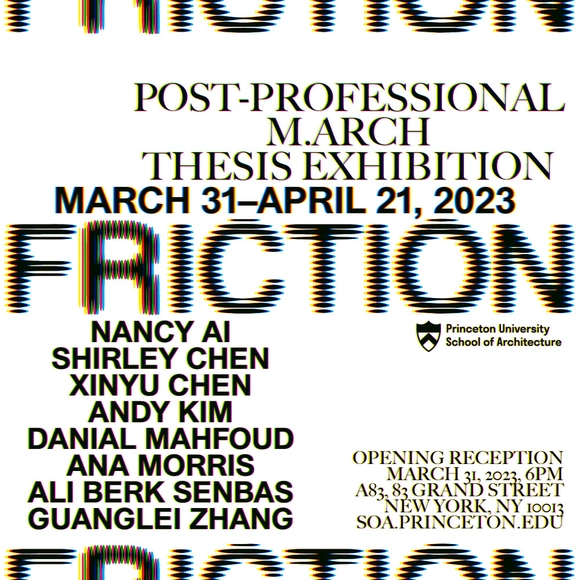
Princeton University School of Architecture is pleased to announce F(r)iction, an exhibition by the 2023 Post-Professional M.Arch Thesis class, opening March 31st at a83 in New York City. The exhibition showcases projects by 8 students—Nancy Ai, Shirley Chen, Xinyu Chen, Andy Kim, Danial Mahfoud, Ana Morris, Ali Berk Senbas, and Guanglei Zhang.
HarvardxDesign is an annual conference launched in 2012 and led by students at the Harvard Graduate School of Design this year. We bring together creative thinkers, industry leaders, professors, and students to engage, debate, and reinterpret the design process across scales and sectors. Our goal is to share knowledge, tools, and resources that can empower creatives to become change agents through design.
29ddm Mourning Station #4, Dominic Di Mare, hawthorn, handmade paper, silk, bone, bird's egg, feathers, gold and wood beads, 13" x 7" x 7", 1981. Photo by Tom Grotta
Acclaim! Work by Award-Winning International Artists, presented by browngrotta arts The exhibition features 45+ artists whose diverse bodies of work, in addition to being acquired into important collections, have achieved formal art recognition — lifetime achievement awards, artist-of-the-year designations, a Legion of Honor award and even an Order of the British Empire. browngrotta arts will produce a catalog for Acclaim! —its 56th.
"Datament", a monumental installation to be presented at the Polish Pavilion for the 18th International Architecture Exhibition of La Biennale di Venezia, will allow visitors to experience data in its ‘physical’ form. The space of the pavilion will be filled with the frames of four life-size houses. These seemingly chaotic and absurd structures faithfully reproduce the source data. The exhibition is intended as a starting point for a discussion about how, while new technologies may not offer us ready-made solutions, they can help us ask better questions.