
The Minimum Pavilion - M4 Competition is a team-based competition for students and recent graduates of Architecture and Urbanism.
The Minimum Pavilion - M4 Competition is a team-based competition for students and recent graduates of Architecture and Urbanism.

The City of Araraquara, through the Executive Coordination of Housing and the Housing Projects Management office, both under the Secretariat of Urban Development, has opened registration for the "National Public Architectural Design Competition for Social Interest Housing." The competition aims to select designs based on pre-established criteria regarding technology, comfort, performance, and sustainability.

Firms not associated with AsBEA/RJ (new talent) must pay a registration fee of R$ 510.00. This is a one-time fee, regardless of the number of projects submitted to the awards. Should a non-associated firm choose to join the organization, the amount paid will be applied as a credit toward their membership dues.
The inaugural WEEFOR ARQ open architecture competition seeks to collaborate with minds that dedicate their talent to people rather than the market.

The COURB Institute invites teams from across Brazil to submit projects for presentation at the 4th COURB - Collaborative Urbanism Meeting, to be held in Belém, Pará, on September 26 and 27, 2019.

The call for entries is now open for independent professionals, teams, collectives, or architecture and urbanism firms to develop a temporary intervention project in the vicinity of Praça Santo Eduardo, Vila Maria – North Zone of São Paulo.
The "Ruas Vivas" project, developed by the Institute of Architects of Brazil – São Paulo Department (IABsp) in partnership with the São Paulo Commercial Association (ACSP), aims to implement temporary interventions on three different streets in São Paulo to transform public space in response to the COVID-19 pandemic.
The Institute of Architects of Brazil (IAB) invites architecture and urban planning professionals across the country to participate in a public call seeking to select specialized technical consultancy to analyze and improve development strategies for urban mobility projects—specifically public transit corridors and active transport modes—and their relationship with public spaces along these routes in the city of Aracaju, Sergipe. The goal is to foster accessible routes for early childhood, ensure support for lingering in squares and parks, facilitate the use of urban furniture, and promote activities aimed at children aged 0 to 6.

Casa Lacerda is a colonial-style building located in the Historic Center of Lapa. It is individually listed by IPHAN and the Paraná Cultural Heritage Coordination and is situated within an urban area that is also protected at both the federal and state levels. Donated to IPHAN in the 1980s, the house now functions as a museum that replicates a typical Lapa residence, while also serving as a "Heritage House" (Casa do Patrimônio) that hosts temporary exhibitions, courses, and activities for the local community.

Carnival, São João festivals, team sports, and birthday parties in public squares are examples of celebrations and gatherings in streets and public spaces that have made a full comeback in 2022, following two years of strict restrictions due to the COVID-19 pandemic.
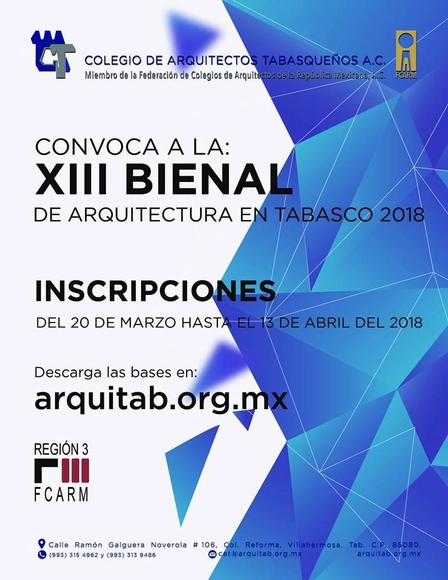
THE TABASCO COLLEGE OF ARCHITECTS (COLEGIO DE ARQUITECTOS TABASQUEÑOS A.C.) INVITES ALL ARCHITECTS RESIDING IN THE STATE OF TABASCO TO PARTICIPATE IN THE XIII TABASCAN ARCHITECTURE BIENNIAL 2018.
I. OBJECTIVES.
To identify the best architectural works by architects from the State of Tabasco, as well as publications, research, and theses. To recognize their authors. To disseminate the most relevant works to allow, through analysis and critique, a reflection on responsible contemporary architecture and sustainable solutions.
II. PARTICIPANTS AND CONDITIONS.
All architects residing in the State of Tabasco who hold a professional degree and license and who practice in the state with national or international work may participate individually or in groups. Eligible entries include built works, research papers, publications, theses, and academic projects (see note in classifications) completed during the biennial period from May 2016 to May 2018. Works that have been presented in previous Biennials are not eligible. A work may compete in only one classification.
In accordance with National Assembly agreements: Only works that have previously participated in their LOCAL AND/OR REGIONAL BIENNIALS may be registered for the FCARM National Biennial.
AGENDA OF THE CITIES, TABASCO: Call for submissions from architects in Tabasco for a compilation of ideas, proposals, and/or studies in the fields of architecture, public space, urban development, and territorial planning.

LA ESCUELA___ invites the student community in Paraguay to participate in an architecture competition that will give rise to our AULA "Aprendizaje al borde" (Learning at the Edge), led by the architecture firm Al Borde and developed in partnership with the Universidad Católica Nuestra Señora de la Asunción, Alto Paraná Campus.
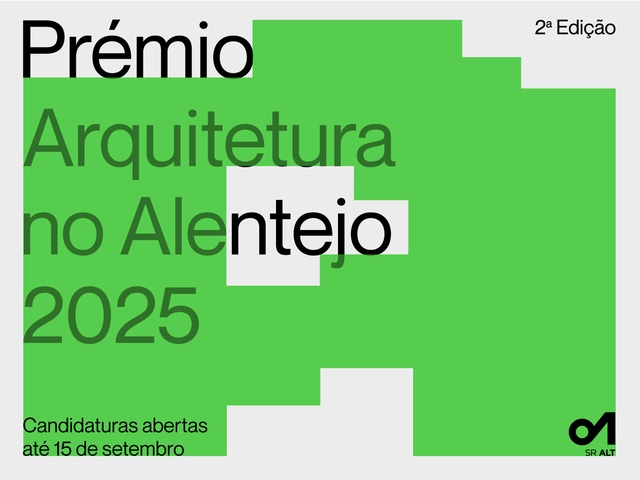
The 2nd edition of the Alentejo Architecture Award has been launched by the Alentejo Regional Section of the Order of Architects (OASRALT).

The Arquia Foundation has announced the curator and theme for the 10th edition of arquia/próxima (2024–2025), a program dedicated to fostering, promoting, and showcasing emerging architecture in Spain and Portugal. This open call, which runs until February 5, 2026, is curated by architect José María Sánchez García. His proposal, "Territory," invites participants to rethink this concept beyond its geographical dimension, incorporating cultural, ecological, social, and virtual aspects.

5th Edition of PNAM: "The best timber constructions by the best Portuguese architects." Submissions are open until July 26 for permanent structures built within mainland Portugal or the islands, completed between January 1, 2017, and December 31, 2018.

The Rafael Manzano Prize for New Traditional Architecture aims to promote the value of traditional architecture as a proven reference for contemporary design in Spain and Portugal. This applies both to the restoration of monuments and urban ensembles of historical and artistic value, and to new construction projects that, rooted in local traditions, are capable of integrating harmoniously into these settings.
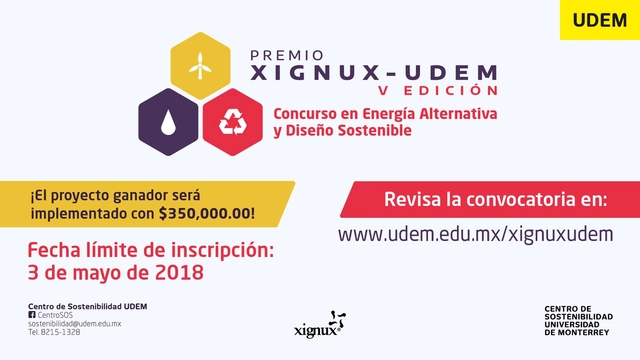
Xignux and the University of Monterrey invite students from universities in the Monterrey metropolitan area to form multidisciplinary teams and participate in the competition.

“Outdoor luminaire design representing a new lighting solution”
“¿Qué luz quiere México?” (What light does Mexico want?) is open to students, as well as established professionals and those early in their careers. Proposals from all disciplines are welcome, including, but not limited to, artists, industrial designers, lighting designers, architects, and engineers.
The theme is open to broad interpretation. This is an opportunity for participants to explore their creativity and present their vision for an outdoor luminaire that offers a new lighting solution.”