Videos
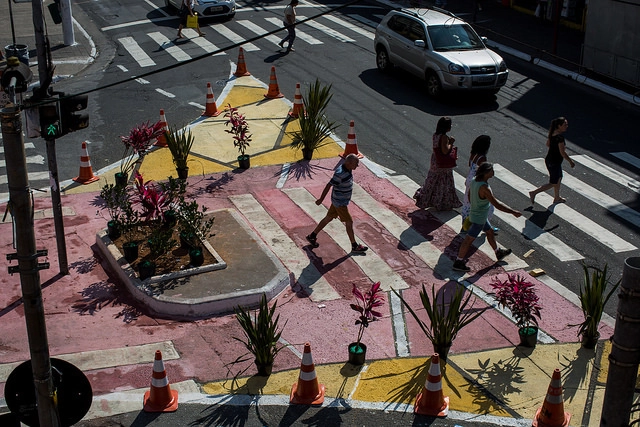
Temporary interventions can transform the landscape and the use of public space (Photo: Victor Moriyama/WRI Brasil)
No one knows a street or a neighborhood as well as the people who live there. Each place has its own peculiarities, potential, and challenges. Consequently, local-scale solutions can be created by citizens themselves, increasing both the efficiency and community buy-in of the project. Cities around the world have been adapting their legal frameworks to establish public policies that facilitate and foster citizen participation in transformative initiatives.
Crucial for ensuring that urban planning fosters prosperity and quality of life for all residents, public participation must be integrated into decision-making processes. Every citizen deserves a space to contribute new ideas, establish priorities, and track the progress of municipal projects. To facilitate this exchange, Consul—a platform developed by the city of Madrid—is being made available free of charge to cities worldwide. In Brazil, a workshop hosted by WRI Brasil introduced the tool to interested municipalities that are already working to implement it.
Books help us grow, tell us things we would never otherwise think of, show us places we would never visit, and teach us. Yet, someone can live their entire life in a city without ever truly seeing or understanding it. That is where books come in. In this post, we have selected 26 titles by Brazilian and international authors—works with diverse aims, but all centering on two main themes: cities and urban mobility. Through books, we can describe every street, building, or public space, reflecting on what life is like in the urban environment, how we move, and how it is all planned (or unplanned).
Projeto visa criar espaço para pais e crianças conviver perto do ambiente escolar. Imagem: Projeto A Rua da Gente. Image Cortesia de TheCityFix Brasil
In just over three months, Érica Oiticica and Sâmyla Souza, students at the School of Architecture and Urbanism (FAU) of the Federal University of Juiz de Fora (UFJF), designed a Complete Street project that earned them an award and the opportunity to present their ideas to a global audience at a conference in Tanzania. The “As Cidades Somos Nós” (Our Cities Ourselves) competition inspired the duo to put their best urban planning ideas onto paper to transform a street in Belo Horizonte.
When faced with a growing population, a city's first response is often to sprawl, expanding its territory. Unfortunately, this expansion is highly costly for the municipality itself and contributes to socio-spatial segregation and inequality. Cities must find a path that establishes them as prosperous places for both people and the economy. A recent study suggests that the key to achieving this may lie in “good density.”
Defining an area as having “good density” goes far beyond having a high number of people living or working in a specific space. Key factors such as mixed-use zoning, connectivity, and sustainable transportation infrastructure are fundamental.
Belo Horizonte. Foto: Mariana Gil/WRI Brasil. Image Cortesia de TheCityFix Brasil
Cities are critical to the functioning of many countries. With the rapid population growth of recent decades, urban centers have had to face a series of challenges, a primary one being mobility planning. In Brazil, with the enactment of the National Urban Mobility Policy (PNMU) in 2012, Brazilian cities received new guidelines to plan and guide policy actions toward establishing more sustainable mobility. To this end, the PNMU requires the development of Urban Mobility Plans for cities with over 20,000 inhabitants as a prerequisite for receiving federal budget allocations. Ultimately, this requirement aims to transform cities and the way Brazilians commute daily.
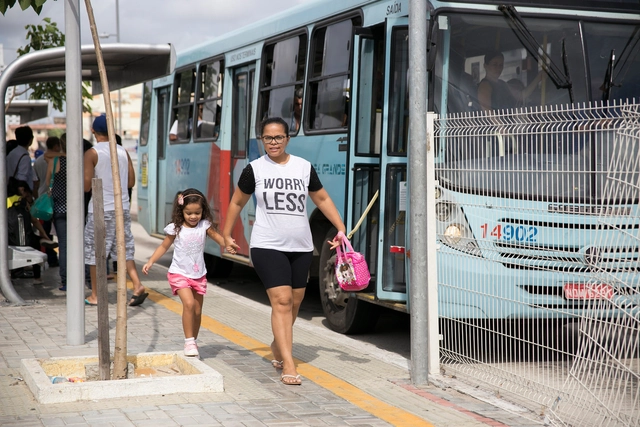
O planejamento urbano deve incluir também projetos e ações pensadas em mães e filhos. Foto: Mariana Gil/WRI Brasil. Image Cortesia de Via TheCityFix Brasil
Women represent the majority on the streets and in public transit. Travel patterns and transport mode usage vary significantly by gender, largely because women still disproportionately shoulder domestic responsibilities, many of which involve caring for children. While gender issues remain overlooked in urban planning, the access of women with children to the city is a topic in even greater need of attention. Through the testimonies of several mothers, the everyday consequences of failures in urban planning and mobility on mothers and children become glaringly clear.
Investing in and promoting active modes of transport benefits public health and safety. Photo: Priscila Pacheco/WRI Brasil
The threat of climate change adds to the multiple challenges of an increasingly urbanized world. Beyond the need for cities to establish themselves as prosperous and sustainable organisms, climate disruptions also jeopardize public health and local economies, threatening to bring about consequences that are difficult to even imagine. Climate action is rooted in cities—the very spaces that will determine the planet's future.
The concept of low-carbon development refers to planning urban growth with lower emission rates of carbon dioxide (CO2), the primary greenhouse gas (GHG). After reviewing 700 studies, a team of researchers from the University of Leeds, in partnership with the Coalition for Urban Transitions, concluded that low-carbon measures can help achieve several urban development priorities, such as job creation, public health, social inclusion, and improved accessibility.
Imagine the scale of effort required to prevent 1.24 million deaths annually. This is the average number of traffic fatalities worldwide. Cities must urgently improve protection for their citizens to ensure that, amidst current urban population growth trends, this figure does not climb even higher. Yet, what if just eight actions were enough to prevent hundreds of deaths and serious injuries?
The publication “Cities Safer by Design” outlines “eight actions to improve road safety,” and we have looked at best practices and research that reflect some of these measures.
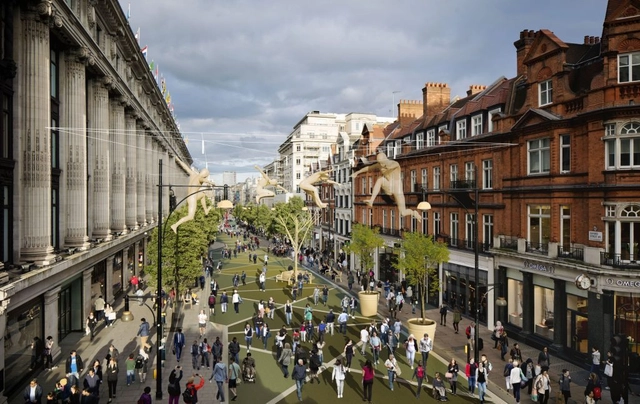
Futura identidade visual da Oxford Street pedestrianizada ainda não está pronta. Imagem: TfL. Image Cortesia de TheCityFix Brasil
This month, Mayor of London Sadiq Khan released the draft of the new plan for the city which, according to him, marks a clean break from previous strategies. And he is not exaggerating, given that the targets to be pursued by 2029 include a near-total ban on new parking spaces and the construction of 650,000 new homes. While the plan is still in its initial draft, the British capital's efforts to curb air pollution are pushing forward the pedestrianization of one of its main central thoroughfares, Oxford Street, and even betting on biofuel derived from coffee to power buses across the country.
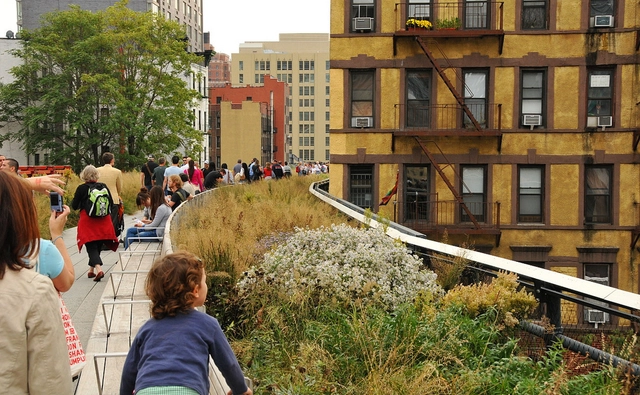
The idea of revitalizing a public space by bringing improvement that brings people together should not generate suspicion or fear. However, specific examples of places that have seen the cost of living greatly increase after their revitalization have been creating paradoxes. After all, does this "new villain" called gentrification have any relation to placemaking?
The answer, unfortunately, is yes. Although it's not a direct relation of cause and effect, it is impossible to deny the tenuous line between the two concepts. By definition, gentrification, or "ennoblement," refers to the social, cultural, and economic improvement of a neighborhood or, on a larger scale, of an entire region. Placemaking is the process of planning quality public spaces that contribute to the well-being of the local community. The concepts may be similar, but the methods and consequences of the two are very different.