
Gallery honors one of the greatest names in international contemporary art
Exhibition recovers drawings produced in the 1960s, 1970s, and 1980s, and brings together prints and objects little known to the public, such as Fiat Lux, a work presented only once by the Rio-born artist in 1979, for just 24 hours
Anita Schwartz Galeria de Arte announces Cildo Meireles: Journey and Presence, a tribute to the greatest exponent of Brazilian conceptual art. The exhibition—opening on June 4 at 7:00 PM—recovers a selection of drawings produced in the 1960s, 1970s, and 1980s, as well as 2009 prints inspired by 1960s drawings. In addition to the graphic works, the exhibition gathers small-scale objects, elements of symbolic installations from the artist's three-dimensional production.
"The exhibition highlights a lesser-known aspect, yet one of great relevance to the artist's creative process. The practice of drawing has permeated Cildo’s work since childhood and has played an important role in their trajectory. And that has been over six decades," observes Cecília Fortes, the gallery's artistic consultant.
Drawing would become a form of expression and reflection, a means for detailing ideas, and also the Rio-born artist's primary source of income until nearly 1990. Selling drawings to friends and collectors allowed Cildo to dedicate themselves to an artistic career and execute more complex projects, for which they would become world-renowned.
"Drawing is the first visual perception. In a second stage, it is necessary to return to the drawing, to detail it. It accompanies this process of detailing an idea. But its function is to capture that thing that passed like a flash of lightning, which does not yet have form, color, or size." (Cildo Meireles, in an interview published in the exhibition catalog Algum desenho [1963-2005], edited by CCBB-RJ in 2005)
In an interview with critic Frederico Morais, the artist recounts that at nine years old, while living in Belém do Pará, they earned a few coins at school by selling drawings. After moving to Brasília, while in secondary school, they continued practicing. It was the way they found to be closer to reality and to show peers their way of thinking. In 1963, at 15, they began attending the Free Studio of the Cultural Foundation of the Federal District, directed by Peruvian artist Felix Alejandro Barrenechea. There, they practiced observational drawing and drawing from live models. At the same time, they enrolled in the film course at CIEM, an experimental school linked to the University of Brasília.
It was during this time that an exhibition of the African art collection from the University of Dakar, in Senegal, passed through the city, bringing together sculptures and masks. The exhibition exerted a strong influence on the artist's development, who felt encouraged to face any surface with the intention of solving the problem of representation—the figure transported to another plane. In 1964, a moment of great adversity in the country with the beginning of the military dictatorship, the art course at the Cultural Foundation was closed, but Cildo continued attending Barrenechea's studio. Since then, the practice of drawing has accompanied them, and that has been over six decades.
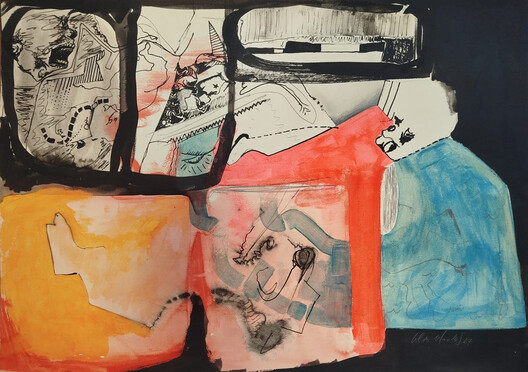
Among the works selected for the exhibition at Anita Schwartz are free drawings of different themes and formats: some inspired by the aforementioned African masks; others following a narrative language with niches alluding to comic strips, with situations that develop arbitrarily. There are also abstract compositions with a predominance of color, drawings that mix rounded brushstrokes and hatching evoking situations of pain and violence, and even specific scenes stored in the artist's memory.
The gallery relied on the collaboration of Antônio Carlos Barreto in acquiring works such as the emblematic series Virtual Spaces: Corners, which began as a drawing in 1967 and is exhibited here in the form of a print. In it, the artist analyzes the phenomenon of perspective and virtuality through the Euclidean module of space (three planes of frontal, lateral, and horizontal projection), and its developments Virtual Volumes and Occupations, composed of lines and two or three support planes that, starting from the wall, create spatial ambiguities. In addition to the drawings and prints, collectible multiples are presented—many alluding to their grand installations.
Camelô (Street Vendor) refers to the childhood memories of the artist, who used to frequent downtown Rio de Janeiro with their father. At the time, they observed the presence of street vendors selling very simple objects like pins, shirt stays, and cardboard and plastic puppets. That situation intrigued them: how could those people survive by selling such insignificant items? Years later, from that memory, the multiple Camelô would emerge, featuring a street vendor selling collar stays on one table and pins marked with the artist's initials on the other.
Dados (Dice/Data) is the first work in the Semantic Objects series from 1970, in which the artist presents works where the object and title establish a relationship of meanings and re-meanings, playing with paradoxes, ironies, and contradictions. The different meanings of the word confront the object, creating friction between what was imagined to be understood and what is presented.
Invisible Sphere deals with an existence constituted of non-existences and suggests the presence of a form that occurs through the absence of matter. In the interior space of an apparently solid aluminum cube, two concave hemispheres of equal measure meet, creating an empty space in the shape of a sphere. The idea of a sphere that only exists in the spectator's imagination is thus configured. Such cut-out faces can only be seen when the cube is opened, at which moment the parts separate and the invisible sphere ceases to exist.
Fiat Lux refers to the installation The Sermon on the Mount: Fiat Lux, presented by Cildo only once in 1979, for just 24 hours, at the Galeria Candido Mendes in Rio de Janeiro. The work, which evoked the atmosphere of fear and violence of the military dictatorship period, consisted of a large block composed of 126,000 matchboxes of the brand Fiat Lux, installed in the center of the room, surrounded by eight mirrors with phrases taken from the biblical text of the Sermon on the Mount: chapter 5, Gospel of Saint Matthew, verses 3 to 12. Around the central block, hired actors simulating plainclothes police officers circulated through the space, guarding the work. The floor of the room was covered with black sandpaper that amplified the sound of the footsteps of those circulating, contributing to the atmosphere of tension generated by the possibility of the installation exploding.
The multiple Glove Trotter, a digital print on a stainless steel plate, provides a record of the original work of the same name: the installation Glove Trotter (1991), in which spheres of different sizes, colors, and materials, collected by the artist over the years, are arranged on a platform and covered by a metallic mesh, like those that protected bodies in medieval battles, unifying the set into a lunar landscape. The title creates a play on words between the expression "globe trotter" and the word "glove," a reference to the material that covers the spheres and prevents their displacement. The conception of the work starts from classic questions of sculpture, such as volume, weight, and gravity, also incorporating references from other contexts, such as geography and astronomy.
OVOS (Eggs) – Version I – 1st edition (1970-2018) is a multiple produced for the celebration of the 70th anniversary of the Museum of Modern Art of São Paulo. Since the late 1970s, Cildo Meireles has appropriated measurement systems to subvert them. The artist realized that measurement systems create identity among members of large collectives, who use them as a common standard. By subverting such systems and standards, they incite reflection on the conventions that unite us as a community. In OVOS, six objects that imitate eggs are given different weights, creating a sense of estrangement for those who handle them, as one expects similar eggs to have similar weights. This is the same estrangement elicited by the large installation Eureka/Blindhotland (1970-75), in which Cildo plays with questions such as the weight and volume of objects, distorting the observer's senses.
Finally, a clock and a set of four wooden tape measures are exhibited, objects that are components of the grand installation Fontes (Sources/Fountains), 1989-1992, which subverts human conventions of time and space measurement. In the complete work, wooden tape measures with different units of measurement are juxtaposed in the center of the room, some following the decimal metric system and others the inch system, while clocks of equal size, but with irregular positioning and intervals of the algorithms indicating the hours, occupy the walls, with numbers fallen to the floor, creating a paradoxical grouping of objects of equal size and format that present different measurements.
More about the artist
Cildo Meireles was born in Rio de Janeiro in 1948, where they live and work. They studied with Peruvian artist Félix Barrenechea in Brasília (1963) and at the Escola Nacional de Belas-Artes (1968) in Rio de Janeiro.
They held their first solo exhibition (1967) at the Museum of Modern Art of Bahia. From 1971 to 1973, they lived in New York, where they had participated in the Information exhibition at MoMA in 1970. In 1975, they were one of the founders of Malasartes magazine.
Among others, they have held exhibitions at the Museum of Modern Art of Rio de Janeiro (Brazil), 1975; Pinacoteca de São Paulo (Brazil), 1978/2006; Magiciens de la Terre, Pompidou/La Villette (France), 1989; Institut Valencià D'Art Modern – IVAM (Spain), 1995; New Museum, NY (USA), 1999; Institute of Contemporary Art, Boston (USA); Museum of Modern Art of São Paulo and Museum of Modern Art of Rio de Janeiro (Brazil), 2000; Tate Modern in London (England), 2008, later presented at MACBA, Barcelona (Spain) and MUAC, Mexico City (Mexico), 2009. Centro de Arte Reina Sofia, Palacio de Velazquez, Madrid (Spain), 2013, later presented at the Serralves Museum of Contemporary Art, Porto (Portugal) 2013-2014, Pirelli Hangar Bicocca, in Milan (Italy), 2014; National Center for Contemporary Art Cerrillos, Santiago (Chile), 2019; SESC Pompéia, São Paulo (Brazil). They have participated in several biennials, including: Venice (Italy) in 1976/2003/2005 and 2009; Sydney (Australia), 1984; São Paulo (Brazil), 1981/1998 and 2010; and Documenta in Kassel (Germany), 1992 and 2002.
In 2008, they received the 7th Velázquez Prize for Plastic Arts in recognition of their artistic trajectory.
About Anita Schwartz Galeria de Arte
Since the mid-80s, Anita Schwartz has actively participated in building and consolidating the careers of artists with timeless productions, supporting their professional development and the projection and recognition of their poetics through partnerships with international galleries, museums, and cultural institutions, and participation in major contemporary art fairs.
In 1998, Anita Schwartz inaugurated the contemporary art gallery that would bear their name. In 2008, it was moved to a new space with a project signed by the firm Cadas Arquitetura, becoming the pioneering gallery in Brazil with a specially planned headquarters building. With approximately 700 m² of area distributed over three floors, it offers a main hall of 110 m² and a ceiling height of 7.2 m to host large exhibitions, installations, and special projects. On the second floor, there is a 60 m² exhibition room and a terrace with a container intended for video installations, which can accommodate up to 20 spectators.
