
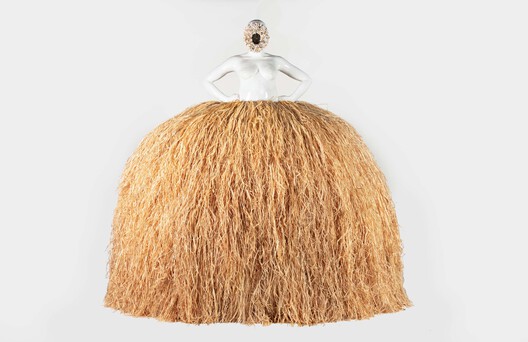
Bringing together approximately 160 works by renowned Black artists from Brazil and the United States, the exhibition "Ancestral: Afro-Americas" arrives at the Centro Cultural Banco do Brasil Rio de Janeiro on June 4, 2025. Under the artistic direction of Marcello Dantas and curated by Ana Beatriz Almeida, the exhibition celebrates the shared heritage and bonds between Afro-descendant peoples in Brazil and the United States within the field of visual arts, promoting a critical reflection on the African diaspora. The show also features a collection of adornments commonly known as "joias de crioula"—attire worn by Black women who achieved freedom in colonial Brazil, particularly in Bahia, as a way to express their ancestry—and a selection of African art from the Ivani and Jorge Yunes Collection, curated by Renato Araújo da Silva. These segments seek to identify, on one hand, the spaces where African ancestry was present during colonial Brazil and, on the other, its elements in art produced in its territory of origin.
"The word 'ancestral' is common in both English and Portuguese. It is this shared origin that we seek to highlight in contemporary art, something that transcends geographic, linguistic, and cultural barriers. The 'Ancestral' exhibition demonstrates that, even in the face of such pain, suffering, and the distance of centuries of the African diaspora, its art persists in its ability to keep a flame alive over time," notes the exhibition's artistic director, Marcello Dantas.
The exhibition will occupy all eight rooms on the first floor of CCBB RJ, featuring works by artists such as Abdias Nascimento, Simone Leigh, Emanuel Araújo, Sonia Gomes, Leonardo Drew, Mestre Didi, Melvin Edwards, Lorna Simpson, Kara Walker, Arthur Bispo do Rosário, Carrie Mae Weems, Monica Venturi, and Julie Mehretu, among others. "We allowed ourselves to be guided by the groups and communities of the African diaspora who reimagined the concept of servitude in these colonial nations to which they were brought, contributing significantly to the construction of the national identity of these places. Starting from the idea of human beings who reinvent their existence in a hostile environment, we selected artists who evoke this invention, this transformation, and this process of 'becoming' as a powerful poetic and aesthetic tool," emphasizes curator Ana Beatriz Almeida.
