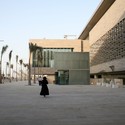
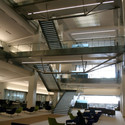
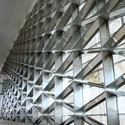
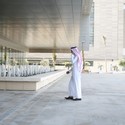
King Abdullah University of Science and Technology / HOK

As we told you on a previous post, last week we were in Saudi Arabia visiting the King Abdullah University of Science and Technology (KAUST). We showed you some renderings and the construction process, and now we bring you more details on this 6.5 million sqf LEED Platinum project, including a video with Bill Odell, design partner at HOK.
The project consists of two parts, the campus and the university town with facilities and accommodations for students, faculty and staff.
The main area of the campus consists of 10 volumes facing the Red Sea, housing the administrative offices, student services, library, a mosque, labs, research centers and an auditorium. A Costal Studies Center is still under construction and will be opened next January.

The first building we visited was the Library, the main volume overlooking the Red Sea.
KAUST University, Saudi Arabia

Yesterday, after a very long flight, we arrived to Jeddah, Saudi Arabia, one of the most important cities in the region. Why? We are attending the opening of the King Abdullah University of Science and Technology, an international, graduate-level research institution. The mission if this academic institution is to dedicated to advancing science and technology of regional and global impact, with a fellowship program that provides full tuition to graduate students pursuing the M.S., M.S. to Ph.D., or Ph.D. degrees (more info here).
The University is located on a new campus designed by HOK, 80km north of Jeddah (aerial view of the site). The campus is part of a larger master plan, also designed by HOK: A new town of 10,000 to 12,000 people, surrounding and supporting the University, living in over 6.5 million sqf on a 3,200 acre site along the Red Sea.

The project started in fall 2006, and it was finished in just 3 years. To achieve this, the HOK Planning Group accelerated the process with a “Racing the Sun” design charrette in which planners from 10 offices across multiple time zones contributed to the plan over one 24-hour period. Each HOK office had a two-hour window to create its ideas and post them on a server. In the end, each contributed an idea that ultimately found its way into the final plan.