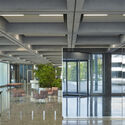
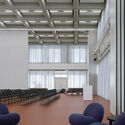
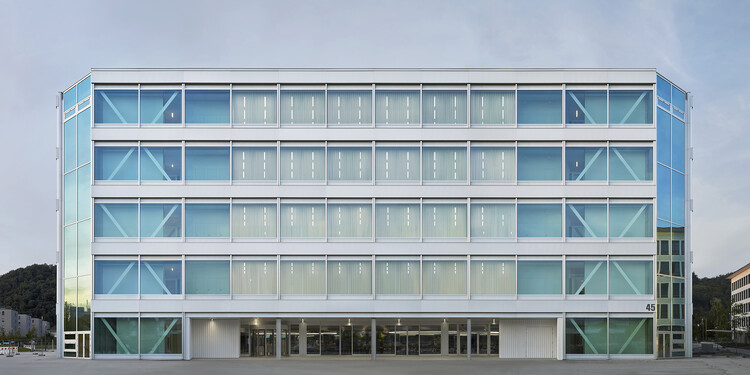
Mercedes Benz Museum / UN Studio, photos by Michael Schnell

© Michael Schnell

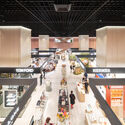
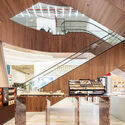
Ten kilometer south from the Porsche Museum we featured last week, we find the Mercedes Benz Museum, designed by dutch architects UN Studio and photographed by Michael Schnell.

The 35,000sqm project designed by between 2001-2006, includes also a restaurants, stores, offices and an auditorium.

The design is based on the geometry of a clover, with the spaces connected between two helical ascending ramps, around a central atrium.

According to Ben van Berkel, joint founder and director of UNStudio “The Mercedes‑Benz Museum sets up an interface for a series of radical spatial principles in order to create a completely new typology”.

And by this, he refers to how visitors experience the museum: They do not begin their visit to the exhibition at a conventional entrance at the base of the building. They are transported by lift to the top floor. Here they have the choice of two tours, during which they descend through the building. The paths of each tour meet on each floor, enabling visitors to switch between tours – the Collections tour and Legend tour – should they wish to do so.

After this project was completed, several tried to imitate it and these kind of circulations became a cliché among architects (and students).

You can see more details of the lift system at NotCot.
More photos by Michael Schnell after the break:

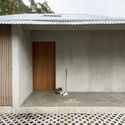
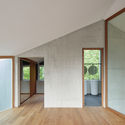
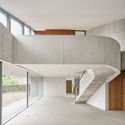
Poolhouse / Philipp Baumhauer

© Julien Lanoo

Architects: Philipp Baumhauer
Location: Munich,
Project Year: 2010
Photographs: Julien Lanoo

Berlin Laboratory International Workshop

Post-wall has emerged as a major player in contemporary cultural production. As a laboratory of lifestyles and modes of production, it attracts an influential community of highly creative people from around the globe. The AA Berlin Laboratory explores the role of experimentation, harvesting this exceptional energy. This intense workshop organised by the Architectural Association School of Architecture explores tools and systems of experimentation, focusing on the idea of dwelling.

No other city has been as enthusiastic as Berlin in experimenting with modes of living. From mass housing to highly individualistic visions of living and extreme communal regimes, Berlin has long pushed the boundaries of what it means to live together. New organisational forms of dwelling, combined with alternative implementation methods, are currently challenging the roles of both architect and local authority in the process of delivering dwellings for the city.

During this intense workshop participants will work both in the laboratory/studio and the field/city, revisiting existing experiments in dwelling and the social ideals that shape them. In search of new logics of living, students will use emerging computational and rule-based design systems to develop prototypical forms of dwelling relevant to the city of Berlin. The workshop will be led by AA and Berlin-based tutors and hosted by Aedes Network Campus Berlin (ANCB). In addition, a public programme of visits, lectures and seminars with speakers from different disciplines will provide a stage for debate.

The workshop will take place between September 3-12. For more information, click here.

Kolumba Museum / Peter Zumthor

© Jose Fernando Vazquez

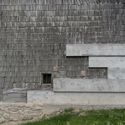
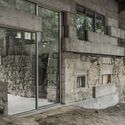
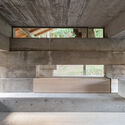
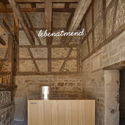
Special thanks to our reader Jose Fernando Vazquez from Urbana Arquitectura (view his work previously featured on AD) who has shared these images of Zumthor’s amazing Kolumba Museum with us.   Situated in Cologne, , a city that was almost completely destroyed in World War II, the museum  houses the Roman Catholic Archdiocese’s collection of art which spans more than a thousand years.   Zumthor’s design delicately rises from the ruins of a late-Gothic church, respecting the site’s history and preserving its essence.  ”They [the Archdiocese] believe in the inner values of art, its ability to make us think and feel, its spiritual values. This project emerged from the inside out, and from the place,” explained Zumthor at the museum’s opening.

More about the project and more of Vazquez’s images after the break.

Folly / Philipp Baumhauer

© Julien Lanoo

Architects: Philipp Baumhauer with Karoline Markus
Location: Southern
Project Year: 2010
Photographs: Julien Lanoo

The Unbuilt Berlin

Hans and Wassili Luckhardt's Concert Hall 1948 © The Unbuilt

An exhibit on display at Café Moskau in Berlin, a historic building from the early 1960s, is currently showing hundreds of unbuilt past visions for the city.  Collected by architect Carsten Krohn, the unbuilt Berlin projects showcase architects’ relentless fascination with the city that has such a rich history.  The projects, which were designed between 1907 and 1997, exemplify different theories and design approaches of the era.  The proposals, although all different, share the common desire to re-conceptualize and challenge the accepted architectural ways of the time.  The projects were a way for the architects to create a new identity for the city with dramatically cutting edge ideas – such as Mies van der Rohe’s plans for a skyscraper on Friedrich Strasse in 1921.

autoR / Carsten Nicolai / Temporäre Kunsthalle

Photo by Benjamin Pritzkuleit © , Berlin

In the center of Berlin, an amazing institution known as the Temporäre Kunsthalle is a great venue for contemporary art as exhibits are housed not only within Adolf  Krischanitz’s free plan interior, but also on the exterior.   As each new artist brings his own personality to the building’s exterior, the 11 meter high building, which covers a ground surface of 20 by 56.25 meters, becomes the artist’s blank canvas, patiently waiting for its new treatment.  The most recent exterior exhibition, autoR by Carsten Nicolai, is the third project to be realized on the façade.
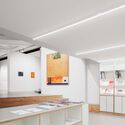
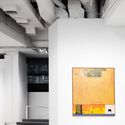
More images and more about the exhibit after the break.

Porsche Museum / Delugan Meissl, photos by Michael Schnell

©

Architecture photographer Michael Schnell shared with us his interior photos of the  Porsche Museum in Stuttgart, , designed by Austrian architects Delugan Meissl. The project was completed in 2008, after being awarded with the 1st prize in a 2-stage competition back in 2005.

The exhibition space we see on these photos in contained by a monolothic volume supported by a steel structure, which spans 5,600sqm to a dramatic effect as you can see on the above photo.

More photos after the break:

German Pavilion / Shanghai 2010 Expo

Here’s another great time lapse video from Seppe, this time walking us through the in designed by Schmidhuber + Kaindl GmbH (more Shanghai coverage here).  Entitled Balancity, the pavilion is designed by Lennart Wiechell and at 6,000 m2, it is the country’s largest structure at any exposition.  The building’s geometric mass was conceived as a three dimensional sculpture and the form wraps certain spaces which showcase different aspects of Germany.  As you can see in the video, the pavilion includes a  central energy source, a  factory-like section, an opera and cultural section, and even a park.   The areas show Germany’s technological progressions and products meant to help solve urbanization problems, and visitors slowly glide past certain installations on moving walkways.    Unlike other countries’ pavilions that seem to work off of one cohesive theme, the German pavilion seems much more “busy” – it is a conglomeration of many different ideas and products with lots to see at each turning corner.   What do you think of Balancity?

Check out other videos Seppe has shared with us like his British Pavilion time lapse or his Denmark Pavilion video.  Full list of credits after the break.

AD Round Up Special: Germany vs. Spain

© Jens Weber & Orla Conolly

The second semifinal of South Africa’s World Cup has kicked off. and are fighting to play The Netherlands in Sunday’s final game. So we decided to choose a few amazing projects from both sides for you to realize that as in soccer, both countries have excellent teams. Check them all after the break.

Haus M / Titus Bernhard Architects
The distinctive feature of the property lies in its north-facing slope, which has to be negotiated over two storeys to reach the almost flat garden level. This gives rise to the leitmotiv of a “house winding up the slope”, with a quarry-stone façade which is corresponding to the ultrathin Frames of the façade (read more…)

© Courtesy of Iñaqui Carnicero

Pitch House / Iñaqui Carnicero
The house is located in a small neighbourhood on the west boundaries of Madrid in a place called “los Peñascales”, that mean something as well as great stones. The plot is characterized to have a great slope oriented to the south and have two great granite rocks partially covered by moss. The structure of the house at a functional level as formal is explained perfectly in section. The underground level is used to solve the encounter with the slope of the land (read more…)

Between the Waters: The Emscher Community Garden / Marjetica Potrc and Ooze

© Courtesy of Potrc and Ooze

Architects: Marjetica Potrc and Eva Pfannes & Sylvain Hartenberg, Ooze (Paris & Rotterdam)
Location: Sturmshfo, Essen-Altenessen, ‘Emscherinsel’ at the previous ‘Mathias Stinnes Hafen’,
Team: Florian de Visser, Shilesh Hariharan
Areas: 1000 m2
Budget: 200,000 EUR
For the event: Emscherkunst.2010
Use: Art installation: Autonomous water treatment
Client: Emschergenossenschaft
Design Period: 8 months system & community gardens
Construction Period: 2 months
Completion Construction: May 2010
Photos: Roman Mensing, Ooze, Florian de Visser

Schierle House / Matthias Benz

© Rathschek Schiefer

Architect: Matthias Benz architecture & design
Location: Gerzen (Niederbayern),
Site Surface: 2076 sqm
Built-up Surface: 304 sqm
Start time: 2006
Finish time: 2008
Interiors: Josef Eibl GmbH
Photographs: Thomas Benz; Rathschek Schiefer

Spiral Housing / OBRA Architects

OBRA Architects shared with us their project Spiral Housing: IBA Smart Price Houses, a 3000 m2 residential apartment complex with community outdoor space. See more images and architect’s description after the break.

Herzog & de Meuron’s VitraHaus Video

Earlier this year we featured Herzog & de Meuron’s VitraHaus in Weil am Rhein, . Now, we share with you this amazing video by , a brazilian architectural photographer whose incredible photos can be seen in our Flickr pool.

Haus D / Clemens Bachmann Architekten

© Courtesy of

Architects: Clemens Bachmann Architekten
Location: München,
Client: Allgemeine Suedboden Grundbesitz Verwaltung
Project Area: 100 sqm
Project Year: 2008
Photographs: Courtesy of Clemens Bachmann Architekten

RE.FLECKS exhibition

The RE.FLECKS exhibition presents panels J. MAYER H. has derived from data-protection patterns. Developed by chance in print shops around 1900, the patterns were used as an envelope lining to protect the confidential content inside.

One of these many patterns was selected and interpreted spatially in the form of various art objects. Like the inkblot pictures by Rorschach, an early 20th century psychoanalyst, the RE.FLECKS panels support the viewer’s own interpretation and reading.

Exhibition will open June 11 at 6pm at Magnusmuller, Weydingerstrasse 10/12, 10178 .

In Progress: Elbe Philharmonic Hall / Herzog and de Meuron


Oliver Heissner

Herzog and de Meuron’s Elbe Philharmonic Concert Hall in is in the midst of construction, and we just received some photos from the firm.  The 17th century factory, which the new hall rests upon, will maintain its traditional identity while housing new programmatic activities.  The Grand Hall seems to float above the distinctive factory, clothed in a tent-like glass facade.  The highly articulated facade is designed in different sections to provide appropriate sun protection depending upon function and orientation.  Once complete in 2012, the building will include a 250 room five-star hotel, and 47 apartments, in addition to a philharmonic hall of 2,150-seats and a chamber music hall of 550 seats.

See early renderings as well as recent construction photos after the break.

Transatlantic Program: Sustainable Architecture & Urban Planning

The German American Chamber of Commerce of the Midwest (GACCoM) is pleased to introduce the successor to the prestigious Transatlantic Program, “Transatlantic Program – Young Technology Leaders” (TAP-YTL). The program will bring together 12 young leaders with technical backgrounds for an intensive 8-day visit to that will be focused on a specific theme. The first delegation, “Sustainable Architecture & Urban Planning” will take place September 19-27, 2010. Future programs will feature topics such as “Logistics & Transportation” and “Water Management.”

Information and application form online at www.transatlanticprogram.org.

Instant Kiez / Felix Yaparsidi + Valentin Ott

The proposal created by German duo Felix Yaparsidi + Valentin Ott was awarded first by the cultural department of the Federation of German Industry.  Entitled , the idea is an instant neighborhood that would create a kind of ‘sociocultural social’ to support the new urban base.

More images, drawings and information after the break.

Schindler Award 2010 Competition

Competition Site

The Schindler Award has the goal of improving access and overall mobility for all city dwellers, irrespective of their age, status or physical capabilities. To that end, it challenges young architects to think beyond form, light and materials and to focus on the needs of the people who will eventually inhabit the structures and spaces that they design.

The task this year is aimed at transforming a somewhat neglected area of the 1936 Olympic grounds into a pleasing, functional and fully accessible sport and leisure compound. Projects must be submitted by July 30. For more information visit the competition’s official website. Seen at bdonline.

Haus mit Atelier / C18 Architekten

© Brigida Gonzalez

Architects: C18 Architekten
Location: Waldstetten-Wißgoldingen,
Client: Georg Spreng
Project Area: 615 sqm
Project Year: 2008
Photographs: Brigida Gonzalez