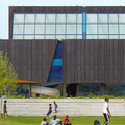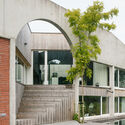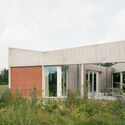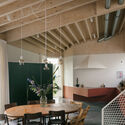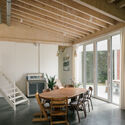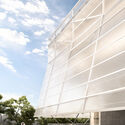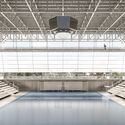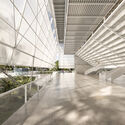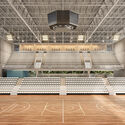
Air Traffic Control Centre / SADAR + VUGA Architects
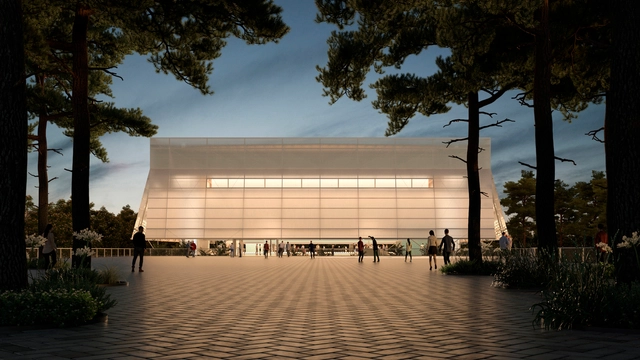
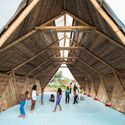
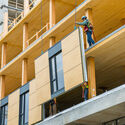
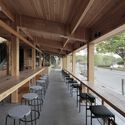
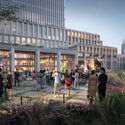
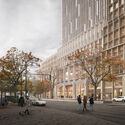
Sadar Vuga Architects have shared with us their design for the air traffic control centre for the Brnik Airport in Slovenia. The centre is conceived so as to provide security and enable high operativeness, 24-hour work comfort as well as comfort for the employees and visitors to the Centre. Furthermore, the Centre is designed according to all strict requirements of safety, operation and efficient functioning, but it is also envisaged as a special, memorable and symbolic building of the arrival in Slovenia.
The Centre is designed as a compact shell that uncloses where natural lighting is needed in the interior. The compact building with a pentagonal ‘head’ of the Centre, which is tied to two administration ‘wings’ by the vertical hall in the central area of the Centre, is situated, for safety reasons, in the centre of a plot along the central boulevard of the future Airport City. The Centre is separated from the edge of the plot in the north by a parking platform and in the south by the tall greenery of the Centre’s garden. The Centre’s interior is organized into zones of various safety degrees. The more we move from the perimeter with administration offices and resting areas towards the free centre of the building, the higher the safety level.
More images after the break.
Contemporary Design in Detail: Sustainable Environments

The Contemporary Design Details series takes a highly visual look at architectural design details that are more often dealt with in a technical textbook format. The books take readers on a tour of the best details designed by great architects around the world. The series provides a powerful presentation of the most challenging and evolving architectural and design categories.
Sustainable Environments focuses on the type of architectural details in distinctive, sustainable residential spaces. It includes sections on components such as cooling or shading devices, building techniques that create minimal impact on the land, active systems, and the use of new sustainable materials as well as those that are salvaged or recyclable. The book presents recent work by architects from around the globe in color photographs and architectural drawings, and is structured according to categories of architectural detail.
Author: Yenna Chen, Alicia Kennedy
Publisher: Rockport Publishers
Cover: Hardcover
Pages: 192
Index
Introduction
Response to Place
Site Specificity
Site Conservation
Connection to Habitat
Bioregionalism
Environmental Interface
Conservation of Resources
Alternative Energy Sources
Hydrological Systems
Use of Building Materials
Elemental and Experimental Materials
Salvaged and Recycled Materials
Directory of Architects and Designers
Photographer Credits
Acknowledgements
About the Author
Buy this book
Merry go Round / Ira Koers
Architects: Bureau Ira Koers
Location: Bungalowpark Lanka, Anholt 11, Ruinen, The Netherlands
Client: Stichting Arthouses
Program: Rentable holiday home on the Dutch heath
Contractor: Bouwbedrijf Geerts
Engineers: Kr8 architecten
Constructed area: 55 sqm
Budget: $100,000 Euro
Project year: 2005-2009
Photographs: Bureau Ira Koers
SUM La Candida / Adamo-Faiden

Architects: Adamo-Faiden
Location: La Plata, Buenos Aires, Argentina
Project team: Sebastián Adamo, Marcelo Faiden, Luciano Intile, Hans Rinshofer, Federique Paillard, Giuliana Nieva
Constructor: Administradora Club de Campo La Candida SA
Project year: 2009
Photographs: Cristóbal Palma
Google World Builder
The recent release of Google Sketchup 7.1 gave us powerful tools to easily create accurate models of urban contexts, with the integration of Street View for textures and better geo location of models.
And yersterday, Google released World Builder, a web based tool that enables users to easily model the buildings of 50 cities.
As you can see on the video it is very simple: you choose a regular volume to start with, and you adjust the width and height in views of the terrain from different angles, and voilá! you just modeled a part of the city, available for everyone at Google Earth and 3D Warehouse.
You can see the latest buildings modeled by users at 3D Warehouse… and if you refresh the page you will see how fast this is being populated.
Thank you Google :)
mySurface iPhone/iPod App by DuPont
Dupont sent us an iPod Touch to try their mySurface app (available as a free download at the iTunes Store). Basically, the application is a catalog of the colors and finishes available for Corian and Zodiaq, two of their products for surfaces.
I already knew Corian, as it is one of the best surface solutions for countertops and furniture. Zodiaq is a product with more resistance, as it incorporates pure quartz crystal, making it more durable and scratch resistant.
What I like about this is that you no longer have to carry the big physical samples, and it becomes very useful when you are on site with the client discussing the finishes.
As you can see on the screenshots below, you can easily navigate through the color/finishes palette, and save your favorites for easy access. For a more accurate comparison, you can see the texture at full screen and place the iPhone/iPod over the desired surface. It also includes some sample images of projects using these products.
What do you think?
More screenshots and my vision on how this app could be improved after the break:
Emerging Landscapes / KLab Architecture
The flexible mixed use design of KLab architecture’s Emerging Landscapes allows the project’s function to change as the seasons progress. The project is a small convention center for the winter months, and switches to become a summer camp for children during the second half of the year.
More about the project after the break.
Dallas Cowboys Stadium / HKS
The new Dallas Cowboys Stadium, designed by the HKS Sports & Entertainment Group opened June 6 for it’s first public event. The new venue, located in Arlington, Texas, is the home of the Dallas Cowboys, one of the National Football League’s (NFL) most watched teams in the USA.
At over 3 million-square-foot and a capacity of up to 100,000 fans it is the largest NFL venue ever built, and maybe one of the most spectacular stadiums worldwide. You can read more key highlights after the break and more images of the stadium.
Akmani Botique Hotel / TWS & Partners
Architects: TWS & Partners
Location: Jakarta, Indonesia
Principal in charge: Tonny W Suriadjaja
Project team: Arianto, Budi Setiawan, Grace Dian, Gery, Misbah
Structural engineers: Purwa
Interior design: TWS & Partners
Lighting design: TWS & Partners
Landscape design: TWS & Partners
Main civil contractor: KMY
Main interior contractor: BMKK
Site area: 1,500 sqm
Constructed area: 10,000 sqm
Design year: 2007
Construction year: 2008-2009
Photographs: Fernando Gomulya
Armann Sports Club / PK Arkitektar
Architects: PK Arkitektar ehf
Location: Reykjavík, Iceland
Client: Reykjavík City / Ármann
Design team: Pálmar kristmundsson and Andrew Burgess
Consultants: Conis Engineers / VGK Engineers / RTLS Engineers / Línuhönnun Engineers
Constructed area: 7,725 sqm
Project year: 2007
Photographs: Rafael Pinho
Bruggen de President / Drost + van Veen architecten
Architects: Drost + van Veen architecten
Location: Haarlemmermeer, The Netherlands
Project Architects: Evelien van Veen, Simone Drost
Client: Gemeente Haarlemmermeer
Structural Engineer: ABT Delft
Project year: 2006
Photographs: Jeroen Musch
BIG seeks Russian-speaking Project Leader for Kazakhstan Presidential Library
BIG is looking for a Project Leader to head up the BIG team responsible for developing the new Presidential Library in Astana, Kazakhstan, which we previoulsy featured in ArchDaily and got many comments from our readers.
The new library, named after the first President of the Republic of Kazakhstan, encompasses an estimated 33.000m2. Being one of the future cornerstones of Kazakh nation-building, and a leading institution that will represent the Kazakh national identity, the library goes beyond a mere architectural challenge.
The new Presidential Library in Astana, Kazakhstan’s new capital since 1997, shall not only accumulate history but also provide a foundation for new futures. It will serve as an intellectual, multifunctional and cultural center with the primary goal to reflect the establishment and development of Kazakhstan, its political history, and the Head of the State’s activities and roles in the development of the country.
Requirements after the break.
CASSA / TEN Arquitectos
Renowned mexican architect Enrique Norten (TEN Arquitectos) has been working in NY since a few years ago, with One York already built at SOHO & Tribeca. And with CASSA, his new 43-stories tall residential tower, he joins the city’s skyline.
The project includes 57 luxury residences and 166 hotel rooms, with interiors by Cetra/Ruddy, along with a 5 star restaurant, a spa, a private terrace and lounge, and other additional services.
The tower doesn´t look to find its place at the NY skyline with any “fireworks”, just a rigorous orthogonal volume with a character given by the punctured rhythm of its windows.
More images after the break.
NORD Architects wins new healthcare center competition

The young office NORD Architects has won the competition for a new healthcare center for cancer patients in Copenhagen, Denmark. The winning design is founded by principles of healing architecture and at the same time it suggests aesthetics which are in contrast with that of a conventional health institution.
The design is an elaboration on the recognizable contour and scale of a house. At the same time the design becomes an iconographic building, as the small individual houses are interconnected by a sculptural roof structure. The building is enriched by the close relation to the surrounding landscape consisting of an inner courtyard, several terraces and themed gardens.
The design will be realised in collaboration with Hellerup Byg, Bravida Danmark, Wessberg Ingeniører and Metopos Landscape. More images after the break.
Songzhuang Art Museum / DnA
Architects:DnA
Location:Songzhuang town,Tongzhou distant,Beijing, China
Program:Museum
Project year:2005-2006
Photographs:Savoye/Ruogu Zhou
Fishermen warehouses in the port of Cangas / Irisarri + Piñera
Architects: Irisarri + Piñera / Jesús Irisarri Castro & Guadalupe Piñera
Location: Cangas, Pontevedra, Spain
Client: Portos de Galicia
Engineer: Juan Antonio Rodríguez Pardo
Builder: C&C
Master Builder: Eva Fernández
Project area: 897 sqm
Urbanization area: 3,920 sqm
Design year: 2003
Construction year: 2005-2007
Photographs: Manuel Gonzalez Vicente
Slit House / EASTERN Design Office

Designed for an 80 year old woman, EASTERN Design Office’s Slit House, a reinforced concrete residential project, “presents her both a life space with a soft light and an interesting experience of scale unlikely in a house.” Situated in an old Japanese city on a site 50 meters by 7.5 meters, the home has long slits that run along a 22 centimeter thick wall, making the interior space open, while providing enough privacy.
More about the home and more images after the break.
CCA + SCU win 2009 Solar Decathlon, Architecture Contest

I just saw that the house designed by Team California, a multidisciplinary team from CCA + SCU, that we featured a few months won the Architecture Contest (1 out of 10 contests) at the US Department of Energy Solar Decathlon 2009.
By reading the jury’s comments, the project was highly acclaimed by two aspects: the inside/outside integration and the high quality of the project documentation.
On this integration, the house offers 700 square feet of decking that includes a large central courtyard and strategically placed openings which extend each living space to the outside, contributing to the overall feeling of spaciousness.
Clerestory windows and large sliding doors contribute to this integration, and is also part of the energy strategy, by bringing a high amount of natural daylight inside the house, minimizing the electric load. The interiors incorporates materials and products from individuals and companies that have demonstrated their dedication to sustainable practices, and others such as a lamp made from plastic drinking straws. Reclaimed California redwood rainscreen covers the house’s exterior, providing a warm hue and varied texture.
You can see more photos of the house at their CCA + SCU Refract House Flickr page, and read the full description of the project on our previous feature.
Low2No Competition: Helsinki’s sustainable future
City as Living Factory of Ecology, winning entry by ARUP, Sauerbruch Hutton, Experientia and Galley Eco Capital.
In my opinion, the best sustainable projects have been in small scales. Urban scale projects have been more difficult to get going, due to the their inherent complexity.
But I am confident that recent initiatives are about to make the step forward, specially the ones that are being produced on countries that have the have their governments focused on this.
On of this examples is the recently awarded Low2No design competition, organized by Sitra (Finnish Innovation Fund) and the City of Helsinki, to find a on design a large building complex on a reclaimed harbour at the western edge of Helsinki’s central business district.
Given that the repertoire of sustainable urban development models is still in its infancy, the question of “who & how” is our question of first order. WHO: We believe that identifying the best team and approach is the key factor impacting the robustness of the final solution. HOW: Our competition is designed to seek approaches for four central objectives applied at the scale of a city block:
- low- and one day no- carbon emissions
- energy efficiency
- high architectural, spatial and social value
- sustainable materials and methods
The finalists included top practices and consultants such as ARUP, Sauerbrunch Hutton, Space Syntax, Transsolar, ARO, REX, Front, BIG, among others. The award went to C_Life by ARUP, Sauerbruch Hutton, Experientia and Galley Eco Capital.
Videos and boards for the winning and finalists entries after the break.
Vertical Village / Graft Lab
Graft Lab’s latest addition to Dubai, entitled Vertical Village, is a cluster of mix-use buildings that emphasize reducing solar gain and maximizing solar production. The buildings are self-shaded on the northern side and on the east-west axis to reduce long-angle sun penetration. Solar collectors on the south end automatically pivot to maximize solar-energy aggregation. The multi-use building, which is expected to earn a LEED Gold Certificate, offers an appealing aesthetic which will easily make its mark 0n Dubai’s dynamic skyline. The “futuristic” angular forms create a shared central space with large pools, while the compositional assemblage of the individual buildings form a cohesive whole.
More images after the break.