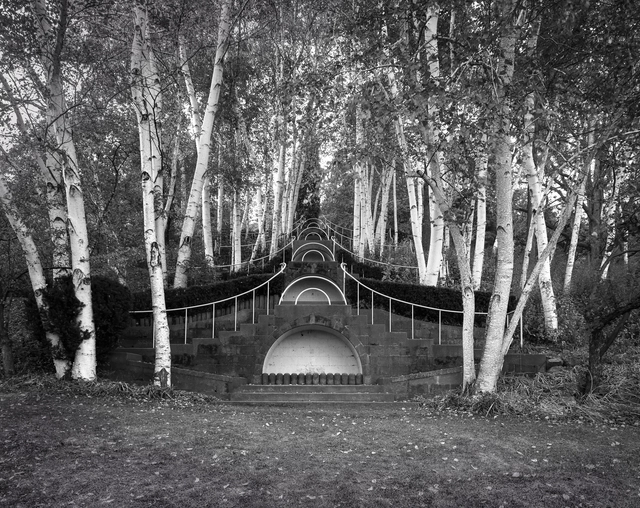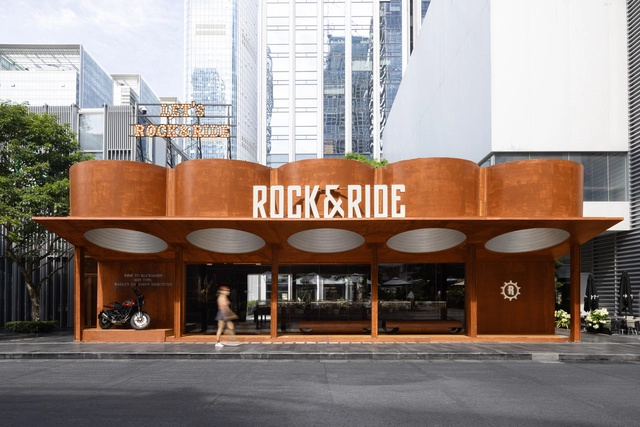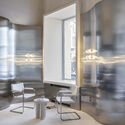
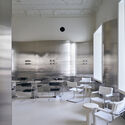
Russian Pavilion for the Venice Biennale

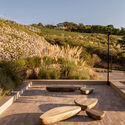
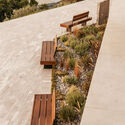
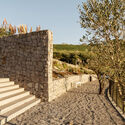
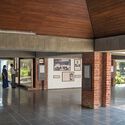
Photographer Patricia Parinejad shared with us this photographs of the Russian Pavilion designed by nps tchoban voss for the Venice Biennale. Check them all after the break.
Concrete Water Tower / Giuseppe Occhipinti

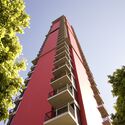
Giuseppe Occhipinti, an Italian structural engineer and the co-founder of Engineering Seismic Consulting (ESC), has shared his seismic water tower design with us. While ESC amends structural problems for projects on a variety of scales, the firm also develops conceptual projects. Their latest conceptual project is a reuse for a typical tall water tank to aid urban needs. The seismic addition not only adds a functional entity but also adds an aesthetic touch to the tower.
More images and more about the tower after the break.
Residence in Sussex / Conran & Partners

Architects: Conran & Partners
Location: East Sussex, United Kingdom
Project Area: 425 sqm
Budget: £1.8million
Project Year: 2009
Photographs: Jim Stephenson
Ferrovie dello Stato Pavilion

Uros Novakovic and Renato Pucci, students of the Università di Firenze in Florence, Italy shared with us their temporary pavilion for the Italian national rail-transport company. You can see more images and architect’s description after the break.
West Kowloon Cultural District Authority Unveils 3 Plans

On Monday, we shared OMA’s master plan proposal (a series of 3 villages that re-think traditional arts components) for the West Kowloon new arts district. As we mentioned, OMA’s plan is competing with two other master plans – Foster + Partners and Rocco Design Architects Limited. We’re excited to share these two master plans with you this week and get your feedback for the plan that you feel is most successful.
The West Kowloon Cultural District Authority is beginning the Stage 2 Public Engagement exercise which will last for three months in order to provide the public with the opportunity to review all three plans. The plans will be judged upon their creativity, accessibility, connectivity, integration, vibrancy, uniqueness and sustainability.
A questionnaire will be distributed to each person viewing the plans asking for his/her opinion. The Panel is very interested to hear the public’s opinion and the views from the exercise will have significant bearings on the Conceptual Plan Option eventually selected by the Authority. It makes perfect sense for the public to have a strong voice in this new arts district, and we’re looking forward to hearing yours as we share the plans with you.
via Bustler
Croatian Pavilion at the Venice Biennale

Based on the idea of Mirage, described at the wikipedia as a naturally occurring optical phenomenon in which light rays are bent to produce a displaced image of distant objects or the sky, the team that designed the Croatian Pavilion for the Venice Biennale decided to create a floating pavilion to present arts and architecture of Croatia at the Venice Biennale.
Following the same principles of a Fata Morgana, which is an unusual and very complex form of Mirage that can be seen in a narrow band right above the horizon, the Floating Pavilion is constructed on an existing barge with dimensions of 10m x 20m x 3m. It is designed by a group of 14 leading Croatian architects, who have made the recent Croatian architecture visible on the global scene. Instead of working in the usual formats of their practices and presenting speculative projects, they decided to work together on a single proposal and to have it constructed and towed toward its final destination in Venice right away. The pavilion structure is the barge’ cargo, welded from 30 tons of Q385 wire mesh in more than 40 layers of varying contours. The cargo presented here maps the process of intense interaction between architects working on the common project, their collaboration with the Croatian maritime industry, and the extraordinary act of architecture it produced. Please follow the pavilion’s maiden voyage across the Adriatic over here

Battle over Midtown’s Skyline


New York City’s Empire State Building has dominated its portion of Manhattan’s skyline ever since it was constructed back in 1931. Now, as Charles V. Bagli reported for the New York Times, a proposed tower just two avenues west on 34th Street across from Pennsylvania Station will be infringing on the Empire State Building as it is slated to rise 1,216 ft – almost reaching the Empire State Building’s 1,250 ft (with its antenna, the ESB measures 1,453 ft). So, it has become the battle of the skyscrapers as the new building claims it will benefit Manhattan by providing jobs and improve the quality of life for New Yorkers and the Empire State Building is worried about losing its iconic presence in the skyline.
Guangzhou Opera House / Zaha Hadid

Our chinese reader Sharwe shared with us some actual photographs of the construction process of this 70,000 sqm Opera House designed by Zaha Hadid in Guangzhou, China. With this building, which includes 1,800 seats in the Grand theatre, entrance lobby & lounge, Multifunction hall, other auxiliary facilities & support premises, Zaha is trying to confirm this city as one of Asia’s cultural centres.
More images after the break.
Lisbon Cruise Terminal / Carrilho da Graça Architects

Competing against Aires Mateus and Gonçalo Byrne, William Consuegra, ARX and Zaha Hadid, Carrilho da Graça Architects were awarded first prize for their proposal for the Lisbon Cruise Terminal. The creation of the terminal provides the opportunity to address the interstitial space between the city and river. Designed as a simple volume that responds to the “desire of liberating the surrounding area”, the terminal will create a new public realm providing green spaces that can support varying activities for the city and adjacent neighborhoods.
More images and more about the winning design after the break.
The HuB Design Competition
Architecture for Humanity Charleston invites you to participate in Charleston’s continuing legacy of preservation and sustainability. As a basis for exploration, the HuB Design Competition proposes that a new light rail system has been established that will provide a connection between Charleston’s downtown peninsula and its surrounding communities. Entrants to the competition are challenged to design the two major components of the new transit system:
The Downtown Transit Hub: The new downtown transit hub is a mixed-use building that will be located within the heart of the Charleston peninsula. The building will provide services for light rail, bus riders, cyclists, pedestrians and will also address the growing need for community meeting space, affordable retail and office space. We have chosen an underused site in a prominent location adjacent to the Charleston City Visitor Center on Meeting Street.
The Node Transit Station: The node transit station is a prototypical design that will be located at various locations throughout the Charleston Lowcountry. It is a modestly scaled structure that will serve the new light rail system and the existing bus system. The two designs should collaborate to create a system of cohesive recognizable nodes for tourists and residents. For more information, go to the competition’s official website. Seen at Death by Architecture.
PARA-SITE Call for Entries
In the constraints of today ’s urbanity,architects have striven to construct new spaces upon existing ones.Such parasitic architecture has paved new trends in developing and reshaping the way we play,live and work;transforming communities within urban habitats.
By generating symbiotic relationships between host buildings and its parasite attachments,an interdependence emerges through overlapping resources and space with both parties feeding off each other ’s attributes.
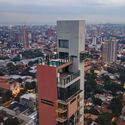
In an upcoming publication,international art and design book publisher Page One intends to showcase the most mind-blowingly innovative, even bewildering,built and conceptual parasitic architecture.Send us your projects and challenge perspectives of architecture for sustainable and urban living. For more information, download the Call For Entries PDF.
Unit 4906 / Studio IDE
What do you think of this interior renovation by Studio IDE? The 550 sq ft studio is designed as an overlapping of space, incorporating the client’s Pop Art lithographs as well as more private living areas. The swinging frames add a nice touch to the art display, and their arrangement makes one feel he is walking into “a gallery space wired for living rather an apartment space equipped to display art.” As the apartment opens toward Chicago’s Lake Shore Drive and Lake Michigan, Studio IDE wanted the space to conceptually become an “interweaving of form and space…of the incidental voids amidst the City’s oscillating texture below.” In this way, the art becomes a “spectacle of tranquility, a moment of pause similar to the calm found in looking onto the lake.” The video is arranged in an interesting style, as the independent sounds follow the shots of each space. The crisp detailing and materiality create a sophisticated space, both in terms of a gallery and living area.
Seen at Studio IDE’s Vimeo Studio IDE.
Egans Juice Bar & Roof Terrace / Architecture 53seven

Architects: Architecture 53seven
Location: Laois, Ireland
Project Year: 2007
Photographs: Joseph Burns
Affordable Housing for the Future Competition entry

Architects Mohammad Jabi and Liyan Jabi shared with is their proposal for the Affordable Housing for the Future Competition in Abu Alanda, Jordan. See more images and architect’s description after the break.
Greenway Self-Park / HOK

HOK has infused green strategies into Chicago’s Greenway Self-Park facility – a not so typical place to find sustainable ideas. While the 11 story energy efficient parking garage features a naturally ventilated exterior wall, a cistern rain water collection system, a green roof, and electric car plug-in stations, we can’t get over the dozen wind turbines made by Helix Wind that attach to the external structure.
More about the self-park and more images after the break.
Update: Broad Museum / DS + R

Back in May, when American philanthropist, Eli Broad, announced his plans to build a new museum in downtown Los Angeles, six invited top architects competed for the commission ( Rem Koolhaas, Herzog and de Meuron, Christian de Portzamparc, Ryue Nishizawa and Kazuyo Sejima, Diller Scofidio + Renfro and Foreign Office Architects). Yesterday, Broad confirmed that Diller Scofidio + Renfro (one of just two invited firms who have not been awarded the Pritzker) will design the 120,000 sqf downtown museum.
Posh Cafe / Jassim AlShehab

Architect: Jassim AlShehab
Location: 360 Degree Mall- South Surra, Kuwait
Project Year: 2009
Photographs: Courtesy of Jassim AlShehab
Doyle Hall / Specht Harpman

Architects: Specht Harpman
Location: Austin, Texas, USA
Project Team: Scott Specht, Louise Harpman, Sarah Gamble, Erica Quinones, Brett Wolfe
MEP Engineering: Energy Engineering Associates
Structural Engineering: Architectural Engineers Collaborative
Civil Engineering: Urban Design Group
Landscape Architecture: Sasaki Associates, Inc. in association with RVI Inc.
Contractor: VRW Construction Company
Project Area: 33,250 sq ft
Project Year: 2009
Photographs: Taggart Sorensen
Horizontal Skyscraper / Steven Holl / Matthias Wolff

In June, we featured Steven Holl’s latest Horizontal Skyscraper which hovers above a landscaped park in Shenzhen, China. Matthias Wolff, an ArchDaily reader and also a contributor to our Flickr roundups, shared some of his photographs of Holl’s building with us. Wolff, aka d.teil, shot these images at the complex’s opening this past December, when some of the complex’s components – such as the hotel – were still under construction. Since the grounds are open to the public, the project will truly affect a large scope of people, both natives and visitors of the area. Wolff’s photos provide a clear understanding of the building’s varying materiality, as well as its situation within the designed terrain. What do you think of Holl’s project?
Check out more photos after the break.