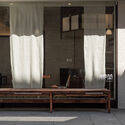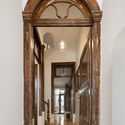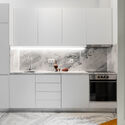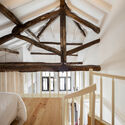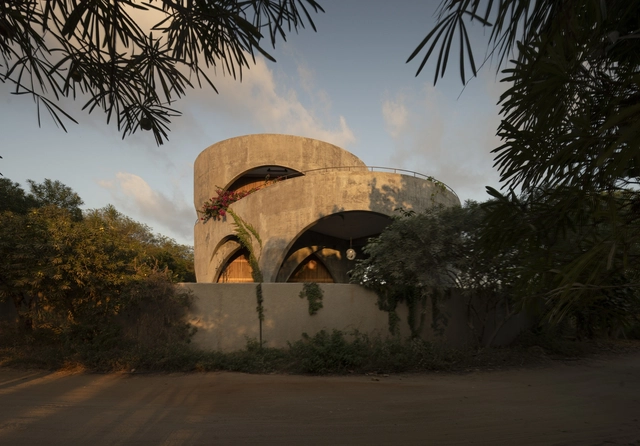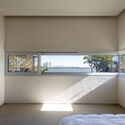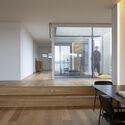
Architects: Hoogte Twee Architecten – Arnhem
Location: Arnhem, The Netherlands
Client: GB family
Project team: Peter Groot, Martin-Paul Neys
Contractor: Kuijpers Bouw Heteren bv.
Structural Engineer: Krekon bv
Project year: 2004-2005
Photographs: Hoogte Twee Architecten
Sander Architects shared their Grace Restaurant design with us. Located in the rectory of the decommissioned St. Vibiana’s cathedral, the project includes an addition on a triangular piece of property adjoining the rectory. The addition includes a new kitchen on the first floor with additional cooking facilities and a private chef’s table on the upper floors. Putting a new spin on restaurant design, the building itself will provide great food. Working with the idea “the building you can eat”, the project becomes an edible form that is sheathed in a vertical garden, covered with tasty plants. Passers-by will be free to pick fruits, vegetable and herbs from the building as they walk along. An open street-side counter will also cater to walk-up orders. With this edible idea, the building become both environmentally and people friendly.
Images and drawings after the break. read more »
The first film festival celebrating the creative spirit of architecture and design will be held in Waitsfield, Vermont during the height of fall colors. An exciting selection of films, including feature-length films, documentaries and shorts will engage the audience with how architects and designers think, work and create. The films profile visionary architects, the creative design process, environmental issues and the brilliant designs that we see and use every day. The program includes conversations with filmmakers, architects and designers.
The Architecture & Design Film Festival will benefit the Yestermorrow Design/Build School. Yestermorrow inspires students to create a better and more sustainable world by providing an architectural education that integrates design and building into one continuous process.
More information and the complete list of films on the festival on the official website.
Recent Facebook activity
Architects: INNOCAD Planung und Projektmanagement GmbH
Location: Graz, Austria
Project Architect: DI Oliver Kupfner
Project team: DI Martin Lesjak, DI Roland List, Reinhard Schütz, DI Margit Spreitzer, DI Bernd Steinhuber
Site area: 509 sqm
Constructed area: 1,085 sqm
Budget: 980,000 Euro
Project year: 2005-2008
Project year: 2007-2008
Photographs: Paul Ott
Architects: Blank Studio
Location: Gilbert, AZ, USA
Architect in Charge: Matthew G Trzebiatowski, AIA
Electrical Engineer: Don Witt Engineering
Mechanical + Plumbing: Kunka Engineering
General Contractor: Stokum Construction
Clients: Shosh + Billy Vergara
Project Area: 260 sqm
Project year: 2008
Photography: Bill Timmerman
One of the most incredible cities in the world, New York is full of all kinds of architecture. So to finish this week’s Round Up, we bring you previousy featured projects from New York City.
Two residences in New York / Gage Clemenceau
While visiting Gage Clemenceau Architects we learned about their design process and research on building new forms through diverse design strategies that range from the use of automotive design software to a heavy reliance on robotic digital fabrication tools. This time we bring you two residences in New York (read more…)
Metal Shutter Houses / Shigeru Ban
Starchitects are all over New York, giving an extra value to new condos in Manhattan. A few months ago i visted the Herzog & de Meuron and Bernard Tschumi projects on the lower east side, and they looked quite impressive. While most people didn’t liked the Tschumi’s Blu Condo (read more…)
DVF Studio Headquarters / Work AC
Work AC shared with us another project built in Manhattan, the Diane von Furstenberg HQ in TriBeca. An amazing renewal of an historic building. The light use is accented by the use of hanging crystals. I personally like the landscaping on the rooftop, wich reminds me of the High Line passing nearby (read more…)
Switch Building / nArchitects
Switch Building, by nArchitects, is a 7 storey apartment and art gallery building at 109 Norfolk Street in the Lower East Side, New York City. The building consists of four floor-through apartments, a duplex penthouse, and a double height art gallery on the ground and cellar levels (read more…)
56 Leonard Street, New York / Herzog & de Meuron
This 57-story residential in the Tribeca area will house 145 residences, each one with its own unique floor plan and private outdoor space. This typology makes the building look like a stack of houses, away from the traditional skyscraper form. I wonder how the concrete structure works on this building (read more…)
A year and a half ago, OMA unveiled the first images for a residential project in Singapore, on schematic design phase. Basically it was a set of stacked low-rise blocks.
Today OMA sent us an update on this project, The Interlace, and more details appear.
The project is located on a green belt outside the capital city, and consists on 31 stacked apartment blocks, each six-stories tall and identical in length, resulting in 170,000sqm of gross floor area for 1,040 apartments.
What is interesting about the project is how these stacked volumes achieve a high density, while still maintaining privacy and long-range views as you can see on the renderings.
The second result of this “stacked” strategy, are the common spaces filled with tropical green. By looking at the plan view of the complex, a series of inner courtyards appear on the empty spaces between the blocks. The project turns then into a rich vertical community, apart from the single tower projects seen in the area. Extensive residential amenities and facilities are interwoven into the lush vegetation and offer opportunities for social interaction, leisure, and recreation.
Architect: Jorge Sousa Santos
Location: Arelho, Óbidos, Portugal
Client: Telmo Faria
Project year: 2003
Construction year: 2006
Photographs: FG + SG – Fernando Guerra, Sergio Guerra
The Institute for Advanced Architecture of Catalonia and HP are pleased to announce the 3rd Advanced Architecture Contest, on the theme of THE SELF-SUFFICIENT CITY: Envisioning the habitat of the future.
The aim of the competition is to promote online discussion and research through which to generate insights and visions, ideas and proposals that help us envisage what the city and the habitat of the 21st century will be like.
The competition is open to architects, planners, designers and artists who want to contribute to progress in making the world more habitable by developing a proposal capable of responding to emerging challenges in areas such as ecology, information technology, socialization and globalization, with a view to enhancing the connected self-sufficiency of our cities.
The competition prizes will consist of three scholarships for the IaaC Masters in Advanced Architecture for academic year 2010-11, cash prizes, and the latest generation of large-format HP printers. The selected projects will go on show in a major exhibition, due to open in Barcelona in May 2010, which will then travel to key cities around the world. The best projects will also be featured in a book to be published by Actar. The project is supported by the Spanish Ministry of Housing, the Generalitat de Catalunya, Barcelona City Council, and the publishing house Actar.
For more information on submission, calendar, rules and registration go to the official website.
Architects: Ezzo
Location: Felgueiras, Portugal
Architect in Charge: César Machado Moreira
Collaborators: Fátima Barroso, Hugo Torres, Carla Barbosa
Project year: 2008
Constructed Area: 200 sqm
Photographs: Joao Ferrand
Architects: PK Arkitektar ehf
Location: Garðabær, Iceland
Design team: pálmar kristmundsson
Consultants: Tæknivangur Engineers / Lumex
Constructed area: 450 sqm
Project year: 2004
Photographs: Åke E:son Lindman
A few months ago, we shared the University of Melbourne’s six short-listed finalists for their new Faculty of Architecture, Building and Planning building (short list can be read here). Of the six finalists, the team of Melbourne-based John Wardle Architects and Boston-based Office dA have been named the winners. Professor Tom Kvan, Dean of the Faculty of Architecture, Building and Planning, stated, “The winning design showed a detailed understanding of the teaching and research activities of the Faculty and the potential for contribution to research across the campus.”
More images and more about the winning project after the break. read more »
The Chinese Pavillion for the Shanghai World Expo 2010 is already in construction. Being the country that hosts the World Expo, the pavillion designed by Chinese architect He Jingtang stands in the central location of the Expo site at 63 meters tall, which triple the height of any other pavillion.
The main structure of the China Pavillion, “The Crown of the East,” has a distinctive roof, made of traditional dougong or brackets, which has a history dating back more than 2,000 years.
Below the main structure, there will be a 45,000-square-meter joint pavilion featuring the displays from local provinces, cities and regions. For more information, click here. More images after the break. read more »
Architects: Arquitectos Anónimos® and Paulo Teodósio
Location: Vila Nova Gaia, Portugal
Client: Fernando Afonso and Fátima Cardoso
Structural consultant: Paulo Lima and Manuel Branco Leite
Floor area: 90 sqm
Site area: 320 sqm
Built-up area: 270 sqm
Start of planning: 2004
Start of construction: 2005
Completion: 2006
Photographs: Abel Andrade
In a previous post I told you about the competition held by the City of Rotterdam for a mixed used building to accommodate public services and a residential program, and we presented OMA’s entry.
After the break, find the entries by the five finalists: Claus en Kaan Architecten, Mecanoo Architecten, Meyer en van Schooten Architecten, OMA and SeARCH.
The winners for the Woodstock Museum design competition for deck and promenade have been announced with the first place going to Takeshi Okada from Forest Hills, NY.
Architects from around the world were invited to design a new promenade for improved wheelchair access, deck and performance stage. Designs had to include a hundred odd pieces of used battleship decking made of teak and steel spelling PEACE which the museum will supply. Sustainable building products including hemp brick/concrete were encouraged.
Seen at Bustler. All the winners and more images after the break. read more »

© OMA
The City of Rotterdam held a competition for a mixed-use extension for the City Hall, accommodating public and administrative facilities and a residential program. The competition requests that the mixed-use building becomes “the most sustainable in the Netherlands”.
Five designs were presented by the City, and they will be on public display at the NAI until Sept 13th to receive public feedback, which can also be made through the website. The teams will present to the jury on Septh 23th, and the winner will be announced sometime in October.
The 5 finalists are: Claus en Kaan Architecten, Mecanoo Architecten, Meyer en van Schooten Architecten, OMA and SeARCH.
OMA shared with us their finalist entry, in collaboration with ABT and Werner Sobek Green Technolgies. The project adheres to the highest energy efficiency requirements, and it also considers a sustainable approach in terms of speed of construction and future flexibility of the building through a repeated and flexible structural system.
Images from the other proposals will be featured on another article. Rem Koolhaas’ statement and more images after the break.
Architects: Sinato – Chikara Ohno
Location: Tokyo, Japan
Use: Shop
Project year: 2009
Constructed area: 79 sqm
Photographs: Toshiyuki Yano
Architects: Bjørbekk & Lindheim
Location: Oslo, Norway
Client: Statsbygg and the city of Oslo
Water artist and consultant: Atelier Dreiseitl
Technical consultant: Norconsult
Constructed Area: 200,000 sqm
Project year: 2008
Photographs: Bjørbekk & Lindheim
Designed by LAR + Fernando Romero, the Soumaya Museum, slated for completion in 2010, will house a diverse collection of international painting, sculpture, and object art from the 14th century to the present, including the world’s second largest collection of Rodin sculptures. Conceived as a sculpture, the museum’s amorphous form will be a contemporary icon for Mexico City that is also a functional curatorial space.
More about the museum, including images and videos, after the break. read more »