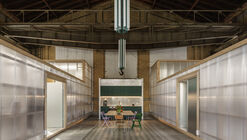
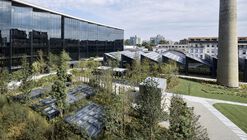
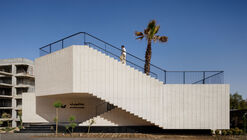
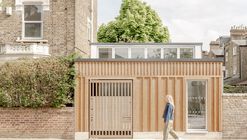
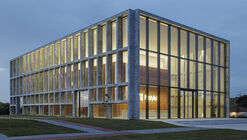
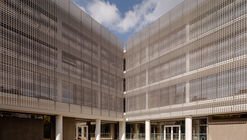
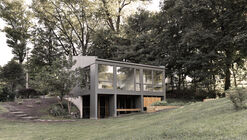
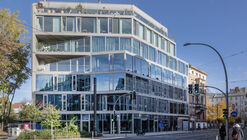
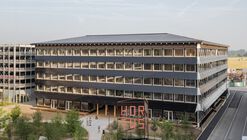
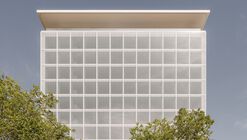
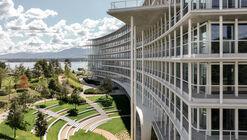
When commissioned to design the Bank of China Tower on an intricate inland site, I.M. Pei was requested to create an unavoidably tall unique headquarters in a typhoon-prone region that would represent the aspirations of the Chinese people yet also symbolize good will toward the British Colony. The solution assimilates architecture and engineering simultaneously, involving an asymmetrical tower that informs both skyline and street. The Bank of China Tower stands 70 stories tall, reaching a height of 1,209 feet. At the time of its opening in May 1990, it was the tallest building in Asia and still remains one of the tallest in Hong Kong.
Offices
Architects: Studio AUTORI
Location: Svetog Save 25, Mokrin, Kikinda, Serbia
Project Team: Dijana Novaković, Dipl.Ing.Arch.; Maja Trbović, Dipl.Ing.Arch.; Aleksandra Nikitin, Dipl.Ing.Arch.; Dušan Nenadović, M.Arch.
Collaborators: Ljiljana Rodić – Bodrožić
Structural: Mega Plus
Project Area: 250 sqm
Project Year: 2010
Photographs: Vladimir Sretenović
This project is located in the Gebze/Kocaeli Tübitak MAM (Marmara Research Center) area. The fact that the present operational structure of the company demanded a campus style layout which relies on the coalescence of office space, recreational areas and meeting and service facilities, led us to a more diverse design concept rather than a conventional office building.
Architect: CM Mimarlık
Location: TÜBİTAK MAM / Gebze – Kocaeli, Turkey
Project Team: Cem Sorguç (Lead Architect), Çağrı Küçükay, Barış Kıldiş, Ceylan Elgin, Zeynep Onuktav
Client: IBTECH / Finansbank
Construction Contractor: Tefirom Group
General Contractor: Diem
Statics: İmar İnşaat Yapı Mühendisliği
Electrical: ERK Proje Mühendislik Ltd.Şti.
Mechanics: OMS Tesisat İnşaat Taahhüt Tic. ve San. Ltd. Şti.
Project Year: 2009
Project Area: 8,274 sqm
Photographs: Cemal Emden
Balkrishna Doshi‘s own studio, Sangath, features a series of sunken vaults sheathed in china mosaic as well as a small grassy terraced amphitheater and flowing water details. Having been considered the building that fully describes himself, Sangath is a complete combination of Doshi‘s architectural themes from his previous work including complex interiors and structures, ambiguous edges, vaults and terraces. More about Sangath after the break. read more »
San Francisco-based IwamotoScott Architecture has just shared their latest project with us – a renavoted 1940s warehouse that holds media company Obscura Digital as well as the architects’ new office space. Upgrading from an unorganized and dimly lit timber warehouse, Obscura looked to Lisa Iwamoto and Craig Scott to outfit the 36,000 sqf building in Dogpatch to suite their needs, while extending the invitation for the firm to set up its practice in the building, as well. “It wasn’t a formalized agreement but a pretty casual thing,” Iwamoto told Lydia Lee for Metropolis. “Obscura by nature is collaborative. The hope is that by sharing space, we’ll have the advantage of seeing their process and what can be done with digital media, and they’ll get an idea of the architectural possibilities.”
In addition to this great refurbishment, we are fascinated by the architects’ dividing wall entitled BookCaseScreenWall, an amazing hybrid of surface projection technologies with a “traditional” bookcase which sits between their office space and Obscura Digital’s.
Be sure to view our comprehensive photo set of construction photos, finished work, and of course, the BookCaseScreenWall after the break. read more »
Architects: A+I Design Corp
Location: New York City, New York, USA
Project Year: 2011
Photographs: Magda Biernat
Architects: Madland Estudio & Espacio Papel Arquitectos
Location: León, Spain
Project Area: 887.55 sqm
Project Year: 2010
Photographs: Elena Almagro
The idea for the Chilehaus came when Henry B. Sloman left Hamburg for Chile a poor man and returned to the city decades later with his newfound fortune. Upon his return, he decided that he wanted to give something back to his hometown, and so he commissioned architect Fritz Höger to design the Chilehaus, named for Sloman’s success in Chile. Completed in 1924, the Chilehaus quickly became a symbol of both Brick Expressionism architecture and Hamburg’s economic revival post World War I. More on the design of the Chilehaus after the break. read more »

Courtesy of LYCS Architecture
The new office of LYCS Architecture is a renovation design of a tower penthouse in downtown Hangzhou, with a panorama view of the West Lake World Heritage. The original space with is an non-professional add-on storage room to the tower roof composed of elevator mechanical room, fire escape doors and slanted drainage surfaces. The idea of this design is to create the juxtaposition of this abandoned storage space and the new office, through the material homogeneity to heterogeneity and temporal attenuation of space.
Architect: LYCS Architecture
Location: Hangzhou, China
Project Team: Hao Ruan, Xu Li, Peng Wang
Project Year: 2011
Project Area: 350 sqm
Photographs: Courtesy of LYCS Architecture
Architects: tiarstudio / Federico Florena, RMA / Roberto Murgia
Location: Milan, Italy
Client: Effetti Digitali Italiani
Structural Engineer: EncoCrema
Light Design: Rossi Bianchi Lighting Design
Project Year: 2010
Project Area: 950 sqm
Photographs: Francesco Jodice
The 20th Street Offices serve as creative working studios for three design firms in Santa Monica, California. They consist of approximately 6,800 sf of studio space in a two story, plus mezzanine, building. They are located on a 7,500 square foot lot in one of the United States top ‘green’ cities. Santa Monica earned this ranking with its extensive Green Building Program and public policies. However, the prominence of sustainable initiatives in Santa Monica doesn’t end with policy; an extensive network of environmentally conscious citizens and business owners, of which the architects of the 20th Street Offices are a member, propels it forward. It is the firm’s desire, along side of its latest trajectories in architectural design and theory, to responsibly lead its fellow citizens, colleagues, and clients in green building initiatives and made no exception when designing their own offices as they pursued a LEED-NC Gold rating.
Architect: Belzberg Architects
Location: 1507 20th Street, Santa Monica, California, USA
Project Area: 2009
Project Year: 5,000 sqf
Photographs: Fotoworks/Benny Chan
Architects: Fiedler Marciano Architecture LLP
Location: Syracuse, New York, USA
Project Year: 2011
Project Area: 18,300 sqf
Photographs: Chris Cooper Photographer
Architects: Franco Piccini, Carlos A. Piccini
Location: Pergamino, Argentina
Project Year: 2011
Project Area: 365 sqm
Photographs: Arq. Walter G. Salcedo
Architects: Loos Architects
Location: Schoten, Belgium
Project Year: 2006
Project Area: 2,375 sqm
Photographs: Allard van der Hoek
Architects: Elisa Valero Ramos
Location: Granada, Spain
Collaborating Architect: Leonardo Tapiz Buzarra
Client: Elisa Valero Ramos
Constructor: Botarel Obras S.A.
Project Year: 2009
Project Area: 198,60 sqm
Photographs: Fernando Alda
This space houses the corporate headquarters for a young company that is developing new technology for concrete. The objective was to design a think tank that would encourage interaction and reflect the innovative green products that they are developing.
Architect: The Felderman Keatinge + Associates (FKA)
Location: Los Angeles, California, USA
Photographs: Courtesy of FKA
Architects: Synn Architekten
Location: Hainfeld, Austria
Project area: 489 sqm
Project year: 2007 – 2011
Photographs: Hertha Hurnaus

© Courtesy of Wolveridge Architects
Architects: Wolveridge Architects
Location: Victoria, Australia
Project Year: 2006
Photographs: Courtesy of Wolveridge Architects
Architects: Marc&Co in collaboration with Coarchitecture
Location: Brisbane, Australia
Project Year: 2010
Project Area: 1,000 sqm
Photographs: Scott Burrows