Architect: Zaha Hadid Architects
Location: Station Court Imperial Wharf, London, England
Client: ROCA
Project Area: 1,100 sqm
Project Year: 2011
Photographs: Courtesy of ROCA
Cultural
Architects: Arquitetos Associados / Alexandre Brasil, André Prado, Bruno Santa Cecília, Carlos Alberto Maciel, Paula Zasnicoff
Location: Brumadinho, MG, Brazil
Collaboration: Manoela Campolina
Project Year: 2010
Project Area: 1,540 sqm
Photographs: Leonardo Finotti

Courtesy of SO-IL
Architects: SO-IL
Location: Seoul, South Korea
Client: Kukje Gallery
Project Area: 1,500 sqm
Photographs: Courtesy of SO-IL
Architects: Wood/Marsh PTY LTD Architecture
Location: Victoria, Australia
Project Year: 2002
Photographs: Gollings Photography, Derek Swalwell, Peter Bennetts

Courtesy of Chi Wai Chan
As the winning entry for a competition to design an arts and cultural square at Lake Sanyon in Daqing, China, the project by Chi Wai Chan examines the relationships between the elements of the water, the sky and the earth. A waterfront promenade that ensues the formal attributes and fluidity of the water, a 1,394 m long canopy with LED display that transpires the form of the clouds and a ground condition of self-similar marine lifeform that establishes the view corridors to the lake; these three design elements serve as the organizing apparatus for the design of the square. More images and project description after the break. read more »
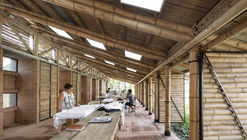
Between 1989 and 2003, Liberia was ravaged by two civil wars. The fighting killed 300,000 – young and old alike. Currently, Liberia is 162nd in the Human Development Index and is still recovering from the devastation. The Bamboo School Project in Fendell on the outskirts of Monorovia, Liberia, led by Brazilian architect André Dal’Bó da Costa and film maker Vinícius Zanotti, seeks to establish one of the most important social and architectural programs for future development: education.
Follow us after the break for more. read more »

Courtesy of Tao Lei Architect Studio
Architect: Tao Lei Architect Studio
Location: North Street of East Imperial City of Beijing, China
Project Area: 600 sqm
Project Year: 2006
Photographs: Courtesy of Tao Lei Architect Studio
Architect: Cerrejon Arquitectos
Location: University Campus of “El Carmen”, Huelva, Spain
Lead Architect: Sebastián Cerrejón Hidalgo
Metal Structure: S. L. P., Joaquín Gracia Barberán
Foundation: José Sainz Sopeña
Agricultural Engineer: Carlos Enviz
Archaeologist: Juan Manuel Campos Carrasco
Facilities: Grupo JG
Sponsors: Municipal Management of Urbanism Town Hall of Huelva
Construction: Terracivíl, S.A., Vicente Cantalapiedra (Chief of Work)
Project Area: 21,489.68 sqm
Project Year: 2010
Photographs: Roland Halbe
Solid Objectives – Idenburg Liu (SO – IL), the architectural practice of Florian Idenburg and Jing Liu in New York, was awarded the first prize in an open call by the Flemish Government Architect to design an 500 m2 community center for a small village in Flemish-speaking Belgium. Out of 5 designs, SO – IL’s solution was considered the most appropriate. More images and architects’ description after the break. read more »
Architect: Krüger Schuberth Vandreike (KSV)
Location: Berlin, Germany
Project Team: Bertram Vandreike, Christiane Schuberth, Torsten Krüger, Markus Reinhardt, Emanuel Weu, Silke Jänicke, Annemike Banniza, Philipp Stachat,Philipp Janke, Karena Filter
Client: Megaposter GmbH, Neuss
Project Year: 2011
Photographs: Nelson Garrido
Slowly, but surely, Hamburg’s beautiful Elbe Philharmonic Hall is nearing completion (according to the Philharmonic’s construction website, the roof construction that seals the large concert hall has just been completed!). We shared some photos of the concert hall’s innovative and iconic skin system when we visited Hamburg earlier this year, and recently, Jose Campos shared his latest set with us.
Check out Campos’ photos and learn more about the completed ceiling construction after the break. read more »
Architects: Provencher Roy + Associés Architects
Location: Montreal, Canada
Project Year: 2011
Project Area: 59,000 sqf
Photographs: Tom Arban
The Montreal Museum of Fine Arts (MMFA), which celebrated its 150th anniversary in 2010, is pleased to announce that its new 59,000-gsf. Claire and Marc Bourgie Pavilion of Quebec and Canadian Art and Bourgie Concert Hall will open to the public on October 14, 2011. Increasing the MMFA’s total exhibition space by 20%, the new Pavilion features 18,953 nsf. of gallery space, which doubles the previous display area dedicated for the presentation of the Museum’s collection of historical and contemporary Quebec and Canadian art.

Courtesy of David Chipperfield Architects
Architect: David Chipperfield Architects
Location: Essen, Germany
Photographs: Courtesy of David Chipperfield Architects
Door & Window Hardware: FSB

Courtesy of Dürig AG
Architects: Dürig AG
Location: Fribourg, Switzerland
Photographs: Courtesy of Dürig AG
The project is the result of a competition won in 2001 for a new theater in the city center of Fribourg. The project will be completed at the end of 2011 and its auditorium is going to provide 700 seats for spectators.

© Herzog and de Meuron. Rendering for exterior expression.
Built in 1861, the Park Avenue Armory Park functioned as both a military facility and a social club for the prestigious Seventh Regiment of the National Guard of President Lincoln’s volunteer militia. Now, the 210,000 sqf five story building (which occupies an entire city block) serves as the home for a not-for-profit cultural institution where visual and performing arts can take place within a not so traditional setting. In 2007, the building began a comprehensive revitalization project as it had fallen into a state of disrepair with Herzog & de Meuron as the lead designers (by the way, have you seen their new website?). Herzog & de Meuron have embraced the history, craftsmanship, and the inherent contrast of the Armory’s spaces to restore the interiors to their original elegance. “Park Avenue Armory is a richly layered building of outstanding historical significance that we are treating like a monument, revealing the physical traces produced over time, preserving it for the future and above all reinventing it,” explained Herzog & de Meuron.
More about the restoration after the break.
Architects: Weinstein A|U
Location: Seattle, Washington, USA
Design Team: Rob Kiker, Ed Weinstein, Kirsten Wild
Project Size: 97,909 sqf
Project Year: 2010
Photographs: Lara Swimmer
An extension of the 200-acre desert retreat of publisher, diplomat and philanthropist Walter Annenberg, the Sunnylands Center and Gardens is an interpretive center that celebrates the architectural and cultural legacy of the historic estate. Inspired by the Annenberg’s extensive collection of impressionist artwork, the landscape architect painted a living landscape that respects the character of the Sonoran Desert and demonstrates a new ecological aesthetic for landscapes in the arid southwest.
Landscape Architect: The Office of James Burnett (OJB)
Project Location: Rancho Mirage, California, USA
Architect: Frederick Fisher + Partners
Client: The Annenberg Foundation Trust at Sunnylands
Photographs: Hester + Hardaway, Dillon Diers/The Office of James Burnett, Kerun Ip, The Office of James Burnett

Courtesy of Barbotin + Gresham Architects
Architects: Barbotin + Gresham Architects – Paul Gresham
Location: Lisses, France
Associate architect: Stéphane Barbotin-Larrieu
Project team: Michaël Neri, Benjamin Legrand
Project manager: Michaël Neri
Project area: 1,420 sqm
Project year: 2005 – 2010
Photographs: Courtesy of Barbotin + Gresham Architects
Saemangum is the name for the newly reclaimed area on the west coast of Korea by the architecture and urbanism firm poly.m.ur. It has been the country’s most anticipated reclamation project of recent years and promises enormous new opportunities for cultural commercial developments in the region. The brief was to provide an exhibition space to commemorate the completion of the work and showcase the visions and plans for this new land. The concept of the design was inspired by the lost mud flat in the area as the result of reclamation. Analogous to the mud flat, the building was designed to act as a ‘living field’, which breathe environment, programs, and activities.