Mowing to Growing: A Design Competition for Creating Productive Green Space in Cities

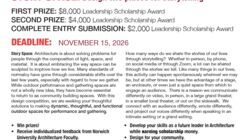
One Prize is launching this competition in the context of larger issues concerning the environment, global food production and the imperative to generate a sense of community in our urban and suburban neighborhoods.

From Mowing to Growing is not meant to transform each lawn into a garden, but to open us up to the possibilities of self-sustenance, organic growth, and perpetual change. In particular, they seek specific technical, urbanistic, and architectural strategies not simply for the food production required to feed the cities and suburbs, but the possibilities of diet, agriculture, and retrofitted facilities that could achieve that level within the constraints of the local climate.

Calling all future-forward architects, urban designers, planners, engineers, scientists, artists, students and individuals of all backgrounds. For more information click here. Seen at Death By Architecture.

Capture the Rain / H3AR

The duo of and Agnieszka Nowak, of H3AR, was awarded a special mention for their proposal in the 2010 eVolo skyscraper competition (see the winners on our previous article).  The competition attracts innovative designers and receives hundreds of eccentric proposals.  For this project, designed by 4th year student, the skyscraper is comprised of a system of gutters to catch as much rainfall as possible.  The water captured and processed by the building may be used for flushing toilets, feeding washing machines, watering plants, cleaning floors and other domestic applications.

More about the skyscrapper after the break. (more…)

BCN 2000 Urban Sustainable Transport Center Competition

The goal of this assignment is to achieve an architectural ensemble that responds to the multiple scales that these kind of projects require. The project to develop must not only attend to the specific function it’s designed for but also to its urban insertion and impact.

Because of the hundred and fiftieth anniversary of Cerda’s master plan for the expansion of the project takes place on a site located in a consolidated sector of this rectangular grid that is considered one of the first examples of modern urbanism. As many of the master plans that followed after Cerda’s the expansion is based on a rectangular abstract grid that is only interrupted by important avenues, topography or landmark buildings.

Submission deadline is April 15. For complete information click here. Seen at Death By Architecture.

Museum of the Second World War Design Competition

This Competition concerns the development of the architectural conceptual design of the building to house the Museum of the Second World War in , intended to become a new identity landmark of the City of , and the conceptual site landscape design commensurate with the nature, status, and location of the site.

The purpose of this Competition is to arrive at the architectural concept of the building to house the Museum of the Second World War in Gdansk, appended with the site landscape design, that will be best in terms of its city-planning, architectural, functional, aesthetic, and operational aspects, and recognise the site’s nature, status, and location, and to obtain recommendations from the Competition Jury with respect to awarding the public contract to the winner of the Competition.

Registration deadline is March 26, submission deadline is August 13. For information on the requirements, go to the competition’s official website. Seen at Death by Architecture.

Designing the Absent Competition

Designing absence aims to create an international brainstorm generated by an absence, and invites entrants to design a new tower for the Cathedral of . ‘By playing with the idea of the absence, we generate a focus.’ Keeping this in mind, every participant comes up with an idea for the unfinished tower. The competition can be seen as an international brainstorm, which means everybody can join. The result doesn’t need to be functional, it can be an inflatable tower or a high tech amusement park attraction. Your entry can be a 3d render, a paper model, a collage, a black marker drawing or anything else you think fits your concept the best.

On the website you can find a picture of the Cathedral with the missing tower. Your tower must be placed on this picture, the way how is completely free. Together with the picture of the Cathedral completed with your ‘new tower’, you should write a short explanation about your concept and submit it on the ‘Submit Entry’ page.

Seen at Architecture Week.

Leading Edge Student Design Competition

The Leading Edge Student Design Competition seeks to support and enhance the study of sustainable and energy-efficient building practices in Architectural Education. We invite students and instructors of Architecture and Design to use the competition as a framework to explore the use of new materials and strategies for building and the integration of aesthetics and technology for high-performing, cutting edge architecture.

This year the competition focuses on the coastal city of Long Beach, . Students entering Challenge 1 will design a zero-net energy Workforce Training Center; students entering Challenge 2 will design a zero-net energy Student Residence. A zero-net energy building generates enough on-site renewable energy to equal or exceed the amount of energy needed to operate the building.

More information on submission and requirements on the competition’s official website. Seen at Architecture Week.

Taipei Performing Arts Center / Kokkugia

We have featured several designs for the Taipei Performing Arts Center (such as the winning proposal by OMA previously featured on AD), and our latest project is from Kokkugia, a  and based architecture firm.  Kokkugia’s form, which is based on the location’s unique geography, is a compelling composition that attempts to create “a dynamic venue and a public space of spectacle.”   The slight slope of the site in emphasized in the form, as visitors enter from under the building.  The interior aims to create the best possible acoustics.  The roof is a network of semi-autonomous agents that reorganize to adjust so that the roof maintains some of its original geometry and other parts shift freely.

More images after the break. (more…)

A House in Luanda: Patio and Pavillion International Competition

The Lisbon Architecture Triennale, which is going to happen from the 14 October to the 16 January 2011, launchs now an International Competition: “A House in Luana: Patio and Pavillion”.

The aim of this architecture competition is to design a single family dwelling that is radically cheap to build for Luanda, a city which is under extreme demographic pressure and is undergoing an intense process of transformation, and that is suited to the cultural, economic and social circumstances of the area.

The objective is to select the best proposal for the design of a prototype of a family unit which leads to a patio, with a low construction cost, aimed at severely deprived families, typically consisting of 7-9 people (Parents, 3 children and 2 grandparents or Parents, 5 children, 2 grandparents), in an area of flat topography, located within the city limits of Luanda.

Deadline for submission is May 3. For more details, click here (updated link, Apr 27th).

“Safe Trestles”: Coalition Launches Two-Stage Design Competition

Access to Trestles, one of North America’s most celebrated waves, is under threat due to safety and environmental concerns. Currently, over 100,000 people each year follow informal trails through marshlands and over active train tracks to gain access to the surf breaks at Trestles. These impromptu manmade paths present a safety hazard with passing trains and threaten the fragile ecosystem of Trestles.

In response, a coalition of concerned groups organized by the volunteer non-profit organization Architecture for Humanity, are launching “Safe Trestles,” an open-to-all, two-stage design competition to create a safe pathway to serve surfers, the local coastal community and day visitors to San Onofre State Beach.

For more information on submission and requirements, click here. Watch a video after the break. (more…)

2010 Chicago Prize Competition: MINE THE GAP

The Chicago Architectural Club is pleased to announce the 2010 Chicago Prize Competition: MINE THE GAP, a single-stage international design ideas competition dedicated to examining one of the most visible scars left after the collapse of the real estate market in Chicago: the massive hole along the Lake Michigan shore that was to have been—and may yet be—the foundation for a singular 150-story condominium tower designed by an internationally-renowned Spanish architect, a tower which was to have become a new icon for the city and region.

What to do with the gap? Whether or not the project is resuscitated, what else can we do with this strategic and highly-charged site? Once the motor of real-estate speculation has stalled, what can we use to propel ourselves, and the discipline, forward? You can register here.

TownShift: Suburb into City Competition Shortlist

The international ideas competition “TownShift: Suburb into City” recently announced the list of finalists. The competition seeks innovative ideas for five established town centers of Surrey, : Guildford, Fleetwood, Cloverdale, Newton and Semiahmoo. The aim of the competition is to “Shift” thinking and opportunities for each of these “Town” hubs towards more intense, public-minded and productive urban futures.

Seen at Bustler. For the complete list of finalists, click here. (more…)

Western Red Cedar Architectural Design Awards Call For Entries

The Western Red Cedar Lumber Association (WRCLA) is calling for entries in the 2010 Architectural Design Awards program. The awards recognize innovative design using one of the world’s most unique building materials, .

All entries must be submitted by July 30, 2010. Submissions must be made online at www.construction.com/community/WRCLA. Winners will be chosen by a panel of notable architects, and the results announced at the AIA 2010 National Convention.

Check the winners of last year’s competition here.

SuperOcean / Ginseng Chicken

Ginseng Chicken‘s latest competition entry for the thematic pavilion of the 2012 Yeosu World Expo in explores the relationship between land, coast, ocean and people.  Entitled SuperOcean, the project features a sampling of the ocean, as if a section was lifted above the surface as a way to allow viewers to explore the secrets the deep sea has to offer.  ”When exploring the question of what type of form best represents the identity of the ocean, we realized that the ocean has very objective and quantitative factors such as depth, surface level and area, but at the same time is a very abstract, even spiritual entity to others,” explained the architects.

More images, diagrams and more about the project after the break. (more…)

P.S.1 2010 entry: P.S. 1 out of 7295 by BIG

Pool lounge ©

To close our coverage of this years YAP competition we present you BIG‘s proposal.

BIG’s invitation to the P.S.1 is not only rare for not being based in NY or in the US (they are based in Denmark), as it has been the common denominator over the years, but also because they have built several small-medium-large scale projects.

But personally, this was the proposal I wanted to see the most: BIG’s P.S.1 out of 7295 is a “cloudscape” formed by
translucent recycled PVC “bubbles”, with a cradle to cradle life-cycle design on which 7,295 bags will be made out of the ballons after the installation, completing the cycle that started as recycled truck bed covers and bags.

Check our P.S.1 coverage (2008 until 2010!) here.

More on BIG’s proposal after the break:

(more…)

Spontaneous Architecture Challenge: Rebuild Haiti

GOOD has teamed up with PRE and Studio X to inspire designers through the monthly Spontaneous Architecture competition. This month, they want you to come up with creative solutions to help in its rebuilding efforts.

Submissions are due February 15, and the entry fee is $5. Fifty percent of the entry fees will go to the winner, and the other half will be donated to the Haitian relief effort. For more details, go to the competition’s official website.

P.S.1 2010 entry: LUX NOVA by EASTON+COMBS

©

We continue featuring the proposals for this years summer installation competition (awarded to SO-IL, read our full coverage of the PS1 competitions here).

This time we introduce you EASTON+COMBS, a practice ran by partners Rona Easton and Lonn Combs.

The firm has a focus on material innovation, which could be seen at LUX NOVA, their proposal for the P.S.1, which includes “Strong Light”, a 100 percent recyclable and exceptionally strong featherweight building component.

© EASTON+COMBS

The initial system is developed as a permeable featherlight structural skin that engages an environmental play of translucent and polychromatic effect. The system offers an 80% weight reduction over an equivalent glass system with no compromise in strength and stability at a significantly lower cost.

More about LUX NOVA after the break:
(more…)

Concrete Geometries Spatial Form in Social and Aesthetic Processes

The ‘Concrete Geometries’ Research Cluster at the Architectural Association School of Architecture in is seeking submissions of work from the fields of art, architecture, sciences and humanities that explore the relationship between spatial form and social or aesthetic processes.

For more information go to the competition’s official website.

P.S.1 2010 entry: Weathers Permitting by William O’Brien Jr

As I told you on our previous post, the summer installation competition held by the MoMA and the is a platform for young architects, and that’s why we are presenting you all the entries for this year. You can read our whole competition coverage here.

We continue with William O’Brien Jr, who has been very related to the academy and is currently a professor at the MIT School of Architecture and Planning and he also runs his own practice in Cambridge, MA.

© William O'Brien Jr

His proposal for the summer installation, Weathers Permitting, constructs an elevated boardwalk with a topology which collects water, which varies or evaporates depending on the current weather at the location. The action of the weather over the boardwalk reminds me of the weathering effect described by Mohsen Mostafavi on his book On Weathering: The Life of Buildings in Time.

More about William’s proposal after the break:

(more…)

Habitat Nomades International Competition

The international architectural competition “Habitats Nomades” invites students, architects and designers to design a home  for a nomadic family.

It’s objective is to promote nomadic cultures, their diversity, their know-how in term of construction of nomadic settlements, and the value of the nomads cultural heritage. You can find more information on the competition’s official website (it’s in French). Seen at Abitare.

Open Source House Design Competition

The creators of Sustainable Dance Club and Hybrid Tuktuk present a new Wow! project – Open Source House. The design competition starts on January 15th, 2010 and is open for team or individual participation. The challenge is to design a sustainable, flexible and locally embedded one family house for a specific location in . The modular construction should be suitable for local implementation and affordable for its future owners. The winning design(s) will be built in .

For more information on timeline and submission, go to the competition’s official website.

YouTube Preview Image

Hong Kong Boundary Crossing Facilities International Competition

The Boundary Crossing Facilities International Design Ideas Competition invites qualified professionals in the fields of architecture, engineering, landscape architecture, planning and surveying and the general public to contribute ideas and concepts on the design for the -Zhuhai-Macao Bridge (HZMB) Boundary Crossing Facilities (HKBCF) for reference and future implementation by the Government of the Special Administrative Region (HKSARG).

Registrations closes ends February 8. For more information on submission and schedule, go to the competition’s official website.