M house / Architecture W

Uploaded by — Filed under: Houses ,Selected , , ,
 

Architects: Architecture W
Location: Nagoya,
Project Team: Michel Weenick, Yukiko Iwanaga, Brian White
Client: Michel Weenick
Project Year: 2005
Constructed Area: 320 sqm
Structural Engineer: Structure NANA
Photographer: Andy Boone


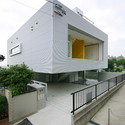
Located in one of Nagoya’s more attractive residential neighborhoods, but with only 2.5 meters of dead end street access and set on a difficult site that steps down from this access level a total of 7 meters, M-House is designed to both address the site conditions that rendered the site “unbuildable” by the local real estate community and provide for a simple, modern lifestyle for the American owner/architect and his family.

In addition to the challenge provided by the site itself, the house also addresses the conceptual challenges of planning for a multi generational/multi national family, as well the even bigger challenge of securing precious views, sunlight, and breezes in the context of a cramped traditional Japanese neighborhood. Despite the difficulty in accessing and actually building on the site, it was the property’s one redeeming feature – its location at the edge of a cliff that hovers over the northern part of Nagoya – that inspired the design of the house.

A hybrid structural system made up of simple reinforced , incased steel, and a pair of 3 meter tall steel trusses – all running inside the east and west walls of the house – allow the design to accommodate a variety of site and program conditions while also allowing for the north and south elevations to be composed entirely of sliding glass walls that capture the views, sunlight, and breezes(essential to surviving the smog & humidity present during Nagoya’s summer months) that make this building site so special.

At the lowest level, this structure is tied into additional retaining walls to carve out an independent apartment that is a modern take on the Japanese notion of looking after one’s parents as they get old.

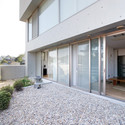
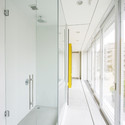
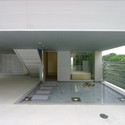
At the entry level, column free space is provided for both parking and turning the owner’s automobiles, as well as for the house’s entry, bedrooms and main bathing area. A small pool is situated underneath the cantilevered top level to reflect sunlight into the bathing area where a single glass wall is all that separates this center of Japanese family life – complete with its wooden soaking bath -from the entry area.

The top level of the house is virtually a single open space that serves as the house’s main living space. The steel trusses that allow for the 5+ meter cantilever are buried behind 2 walls of storage and kitchen cabinetry so that the remaining 2 sides of the steel box – the north and south elevations – can be composed entirely of sliding glass walls. These 2 walls slide into pockets and allow the entire room to become an “outdoor” family room from which spectacular views and pleasant breezes can be enjoyed.

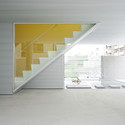
A roof deck caps off the house and accommodates another large outdoor gathering space for entertaining. The main stair well, with its yellow wall slices through the residence to visually tie the different levels together and to allow sunlight down into the main entry level of the house.

The project’s simple architecture – exposed concrete walls & floors, galvanized metal siding, plasterboard infill walls and white laminate cabinetry – provide a neutrality that is animated as much by the Japanese and Western influences of the the client’s family as it is animated by the site’s vistas, breezes, and passing sunlight.


Thumb up Thumb down 0
aankun says:

i love the color combination its so simple. is that a huge window on the side???

 
# January 29, 2009 at 06:19
Thumb up Thumb down 0
Ashwin kumar says:

Builiding is really awsum..i lyk the most..since that minimalism attracts me.It would be rather gud if u might have put some night views even….

 
# July 8, 2009 at 01:38
Thumb up Thumb down 0

If this site was so difficult to build, where’s the site map and plan and section drawings that show both exiting conditions and solutions?

 
# July 5, 2010 at 22:27
Thumb up Thumb down 0
rangkep says:

thank you for your articles. this is beautiful

 
# July 30, 2010 at 09:15
Thumb up Thumb down 0
Leone Gareau says:

I don’t feel I’ve ever noticed any blog with this particular many responses in it!

 
# November 29, 2010 at 10:33
Thumb up Thumb down 0
kitchen says:

we glad to find this site, we need inspiration to me need in design, thanks i hope to keep posting

 
# January 21, 2011 at 19:38
Thumb up Thumb down 0
alessio says:

can anyone find this on google maps? i looked everywhere on google and still cant find it. if any of you can, please put also coordinates of google maps, thanks to everyone.
what a pure architecture :D

 
# February 5, 2011 at 14:14
Thumb up Thumb down 0

5:48 PM Jul 9th

Morar aqui. http://is.gd/dm2Zp #arquitetura

Thumb up Thumb down 0

5:21 PM Dec 15th

หลังเล็กๆสไตล์บ้านเดี่ยวญี่ปุ่น M house / Architecture W | ArchDaily http://t.co/GhFwnWbe via @archdaily

Leave a Reply »


Latest Comments »

epipla saloniou on Openhouse / XTEN Architecture
You are in point of fact a excellent webmaster. The web site loading speed...[+]
hi[+]
In gally office[+]
...[+]
They must call that the “Towering Inferno law”, their code is a...[+]

Upcoming Architecture Events »

got events? invite us! click here

Architecture Books & Magazines »

Construction Manual for Polymers + Membranes / Knippers, Cremers, Gabler, Lienhard

Construction Manual for Polymers + Membranes / Knippers, Cremers, Gabler, Lienhard

From the history of plastics and membranes in architecture to their material properties and requirements in construction and design, the Construction Manual for Polymers + Membranes cuts to the chase, providing the kind of solid and comprehensive overview of


Louis Vuitton Architecture and Interiors / Frederic Edelmann, Ian Luna, Rafael Magrou and Mohsen Mostafavi

Louis Vuitton Architecture and Interiors / Frederic Edelmann, Ian Luna, Rafael Magrou and Mohsen Mostafavi

“In the more recent past, it is the architecture of minimalism that has provided the most explicit and significant contribution to the reciprocal relationship between fashion and architecture. In many ways the abstraction and literal emptiness of minimalism has…


KieranTimberlake: Inquiry

KieranTimberlake: Inquiry

We recently received KieranTimberlake’s newest book, Inquiry. Instead of listing one project after the next, as in most monographs, this book is organized around ten gerunds: bending, coupling, filtering, inserting, offsetting, outlining, overlapping, puncturing, reflecting, and tuning. This is…


Our partners »

AD on iPad via Pulse

Browse by date »

Browse by category »

Friends »