
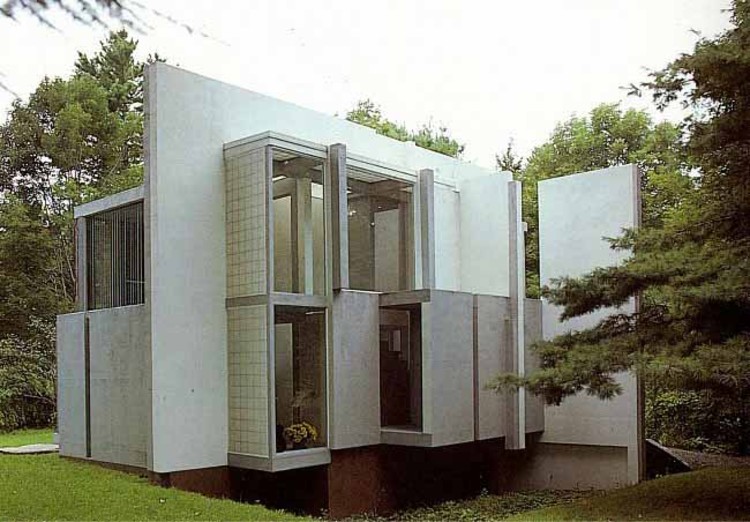
AD Classics: House VI / Peter Eisenman

By — Filed under: AD Architecture Classics ,Houses ,Residential , , , , ,


© madrid2008-09.blogspot.com

Unlike the previously featured Vanna Venturi House, ’s House VI includes disorientation in the work without the concept of relating it to the traditional home. The house is, in fact, anything but what one would consider a conventional house. Eisenman, one of the New York Five, designed the house for Mr. and Mrs. Richard Frank between 1972-1975 who found great admiration for the architect’s work despite previously being known as a “paper architect” and theorist. By giving Eisenman a chance to put his theories to practice, one of the most famous, and difficult, houses emerged in the United States.

More on House VI after the break.

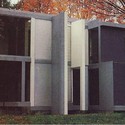
Situated on a flat site in Cornwall, House VI stands its own ground as a sculpture in its surroundings. The design emerged from a conceptual process that began with a grid. Eisenman manipulated the grid in a way so that the house was divided into four sections and when completed the building itself could be a “record of the design process.” Therefore structural elements, were revealed so that the construction process was evident, but not always understood.

© NJIT

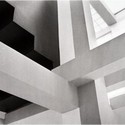
Thus, the house became a study between the actual structure and architectural theory. The house was effeciently constructed using a simple post and beam system. However some columns or beams play no structural role and are incorporated to enhance the conceptual design. For example one column in the kitchen hovers over the kitchen table, not even touching the ground! In other spaces, beams meet but do not intersect, creating a cluster of supports. Robert Gutman wrote on the house saying, “most of these columns have no role in supporting the building planes, but are there, like the planes and the slits in the walls and ceilings that represent planes, to mark the geometry and rhythm of Eisenman’s notational system.”

© NJIT

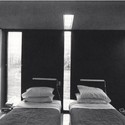
The structure was incorporated into Eisenman’s grid to convey the module that created the interior spaces with a series of planes that slipped through each other. Purposely ignoring the idea of form following function, Eisenman created spaces that were quirky and well-lit, but rather unconventional to live with. He made it difficult for the users so that they would have to grow accustom to the architecture and constantly be aware of it. For instance, in the bedroom there is a glass slot in the center of the wall continuing through the floor that divides the room in half, forcing there to be separate beds on either side of the room so that the couple was forced to sleep apart from each other.

© NJIT

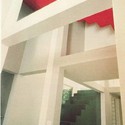
Another curious aspect is an upside down staircase, the element which portrays the axis of the house and is painted red to draw attention. There are also many other difficult aspects that disrupt conventional living, such as the column hanging over the dinner table that separates diners and the single bathroom that is only accessible through a bedroom.

© NJIT

As annoying as the house was to inhabit, Eisenman was able to constantly remind the users of the architecture around them and how it affects their lives. He succeeded in building a structure that functioned both as a house and a work of art, but changing the priority of both so that function followed the art. He built a home where man was forced to live in a work of art, a sculpture, and according to the clients who enjoyed inhabiting Eisenman’s artwork and poetry, the house was very successful.

Architect: Peter Eisenman
Location: Cornwall, Connecticut
Client: Mr. and Mrs. Richard Frank
Project Year: 1972-1975
Photographs: Depending on the photograph: sketchygrid.com or New Jersey Institute of Technology (Architecture History Department)
References: Peter Eisenman, Houses of Cards. New York: Oxford University Press, 1987., and
Frank, Suzanne. Peter Eisenman’s House VI: The Client’s Response. New York: Watson-Guptil Publications, 1994., and University of Oregon


Thumb up Thumb down 0

【archi info】 AD Classics: House VI / Peter Eisenman http://dlvr.it/1RRzV #AD_Classics (archdaily) #rental_archiinfo

 
# June 4, 2010 at 13:20
Thumb up Thumb down 0

AD Classics: House VI / Peter Eisenman: © NJIT
Unlike the previously featured Vanna Venturi House, Peter Eisenman’… http://bit.ly/9RNqOX

 
# June 4, 2010 at 13:28
Thumb up Thumb down 0

AD Classics: House VI / Peter Eisenman: © NJIT Unlike the previously featured Vanna Venturi House, Peter Eisenm.. http://tinyurl.com/35ovzof

 
# June 4, 2010 at 13:37
Thumb up Thumb down 0

AD Classics: House VI / Peter Eisenman via ArchDaily – © NJIT Unlike the previously featured Vanna … http://tinyurl.com/35ac47f

 
# June 4, 2010 at 13:46
Thumb up Thumb down 0
Jakov says:

a dead end street.

 
# June 4, 2010 at 14:09
Thumb up Thumb down 0
philip says:

A stunningly piece of art. Such a profoundly work would not have a chance to day

 
# June 4, 2010 at 16:44
Thumb up Thumb down 0
MLiam says:

Eisenman’s architecture wasn’t art, it was an expression of process. This formalist process ,which involved dividing the house into four quadrants and then following a set of rules, was sort of a architectural Conway’s game of life. Many of the moments within the house are extremely functional as architectural devices. An example is the upside-down staircase which serves to both show the division within the house(the axis of the house). It is also an example of the Müller-Lyer illusion. This was the architectural argument of his time, does function have to relate solely to what people do, or can it also involve the poetry of how they live?

 
# June 4, 2010 at 16:53
Thumb up Thumb down 0
alex says:

it’s hard to comment on AD classics. How many countless books and journals have had this house featured? Nothing I say about it will be unique!

 
# June 4, 2010 at 17:04
Thumb up Thumb down 0

House VI / Peter Eisenman http://bit.ly/95YeM8
Cleverness and Architecture do not go well together. Some should keep designing paper arch.

 
# June 4, 2010 at 18:48
Thumb up Thumb down 0
Anonymous says:

Whether the work is worthy of praise or not, it is extremely hard to praise an architect who has such an egotistical attitude, and such little respect for his own profession, as can be seen here (link below) and in other places for a more enquiring mind.

http://archinect.com/news/article.php?id=72590_0_24_15_M

 
# June 4, 2010 at 18:58
Thumb up Thumb down 0

AD Classics: House VI. http://bit.ly/baQxTE

 
# June 5, 2010 at 05:31
Thumb up Thumb down 0
spasmody says:

definitely in the spirit of Bauhaus

 
# June 5, 2010 at 06:40
    Thumb up Thumb down 0
    hans says:

    haha, what? EISENMANN-spirit of Bauhauss, were you commenting on the wrong thread?

     
    # October 17, 2010 at 07:59
Thumb up Thumb down 0
#17 says:

Not to be snarky….but the opening (black & white) picture is not House VI. It is the perspective model of House X (for the Aronoff family in Bloomfield Hills, Michigan, USA). It was never built.

 
# June 5, 2010 at 07:34
Thumb up Thumb down 0
Kwangbae Lee says:

"AD Classics: House VI / Peter Eisenman" http://bit.ly/cc8D3s 요즘 Archi Daily의 AD Classics 보는 재미.

 
# June 5, 2010 at 08:59
Thumb up Thumb down 0
Hans says:

not many descendants of that type of clients with such beds

 
# June 5, 2010 at 09:48
Thumb up Thumb down 0
Rodrigo Tello says:

It has nothing to do with the bauhaus.

 
# June 5, 2010 at 23:10
Thumb up Thumb down 0
sluggo says:

I’m surprised how many good moments the house has. The real art would have been leaving what seems like an arbitrary structural system behind and making actual decisions. This way of working seems like a “dead end street”.

 
# June 6, 2010 at 08:09
Thumb up Thumb down 0

1:29 AM Jul 29th

@giambastiani O que o Mahfuz acha dessa merda? http://www.archdaily.com/63267/ad-classics-house-vi-peter-eisenman/

Thumb up Thumb down 0

8:57 AM Aug 26th

vale a pena conferir, galerê…. AD Classics: House VI / Peter Eisenman | ArchDaily http://t.co/ewfMMae via @archdaily

Thumb up Thumb down 0

3:05 PM Aug 28th

apaixone-seAD Classics: House VI / Peter Eisenman | ArchDaily http://t.co/ewfMMae via @archdaily acho que eu vou colecionar casas!

Thumb up Thumb down 0

6:22 PM Oct 19th

AD Classics: House VI / Peter Eisenman | ArchDaily http://t.co/RsLEuhQ via @archdaily

Leave a Reply »


Latest Comments »

I really like split levels AND penne.[+]
beautiful and raw. I feel like it could not have been done anywhere else. the US...[+]
reading again the same ol’ simplifications is not funny. reading a...[+]
aaaaaaaaaaaaand I’m done.[+]
Now GO decorate some wall.[+]

Upcoming Architecture Events »

got events? invite us! click here

Architecture Books & Magazines »

Combinatory Urbanism: The Complex Behavior of Collective Form

Combinatory Urbanism: The Complex Behavior of Collective Form

Thom Mayne recently sent us his latest book, Combinatory Urbanism: The Complex Behavior of Collective Form.  MIT Professor of Urban Design and Landscape Architecture, Alan Berger, hails this book as “nothing short of a tour de force and should be…


Construction Manual for Polymers + Membranes / Knippers, Cremers, Gabler, Lienhard

Construction Manual for Polymers + Membranes / Knippers, Cremers, Gabler, Lienhard

From the history of plastics and membranes in architecture to their material properties and requirements in construction and design, the Construction Manual for Polymers + Membranes cuts to the chase, providing the kind of solid and comprehensive overview of


Strategy Space / a+t: Landscape Urbanism Strategies

Strategy Space / a+t: Landscape Urbanism Strategies

Landscape Urbanism is the new black in architecture and this magazine, part of a+t strategy series, has heads turning. There are a dozen projects and hundreds of ideas in this edition. A recurring them is the manipulation of time…


Our partners »

AD on iPad via Pulse

Browse by date »

Browse by category »

Friends »