




-
Architects: HGA (Hayashi – Grossschmidt Arhitektuur)
- Area: 9002 m²
- Year: 2009
-
Photographs:Martin Siplane, Arne Maasik, Sven Soome, Tomomi Hayashi, Reio Avaste

Text description provided by the architects. The 1,5 century-old Rotermann Quarter, a former industrial area for food production, is located between the Tallinn's old town and the port, where stands still historically-valuable limestone buildings under heritage protection. The approved detail planning calls for adoptive re-use of existing buildings as well as insertion of new volumes amongst in order to create “live-work” and pedestrian-friendly environment right at the city center, supported by 400 parking lots underground.

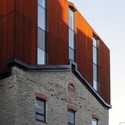
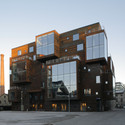
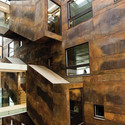
On-going redevelopment takes place between the existing historical limestone buildings, including the Old Flour Storage from 1904. The New Flour Storage was aimed to form a plaza as a new focal point of the quarter. The project consists of three volumes; the Old Flour Storage with 2 additional stories, the New Flour Storage and the Atrium connecting the two. Ground floor is for retail and all upstairs are for offices.

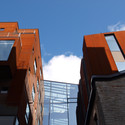
Our approach was to relate and strengthen the character of historical quarter through finding and adopting the character of the surroundings. For facade articulation we have abstracted proportion of wall versus window openings as a character of old industrial buildings. For main facade material cor-ten steel was chosen for its property fitting to the existing surroundings of rough surfaces; limestone walls, brick lintels and rusted steel details. It pays homage to the area's industrial past.

The New Flour Storage is to be a ' Communication Wall' between offices and the plaza. The windows consists of three sizes; 75cm x 75cm, 2m x 2m, larger ones over floor height. The small ones are to frame the views as well as to bring fresh air, the middle ones are to relate to the human scale, and the biggest is to provide the panorama view of the plaza and the Old Town. The cantilevered bigger windows breaks the homogeneous rectangular outline of the building and offers special place among office space for meeting room or communal area with panorama views.


