
We made it to the top 5 contenders! support and vote us for Best Online Magazine at the Open Web Awards! [close]
Follow us on twitter! twitter.com/archdaily

Omena House / Danny Forster

By Nico Saieh — Filed under: Houses , Selected , , ,
 

1250865395-81

Architects: Danny Forster
Location: Lake Omena, Michigan, USA
Project year: 2009
Project area: 250 sqm
Photographs: Danny Forster

1250865374-45 1250865387-61 1250865412-115 1250865426-s7

http://www.vimeo.com/6210192

Danny Forster Design Studio’s philosophy is that through a blend of intuitive design decisions and technologically enabled design strategies, it is possible to make beautiful sustainable architecture accessible at a reasonable cost.

“While we are well-versed in latest high-tech gadgetry, we see sustainability largely as a matter of careful logic and inventive planning. In other words, why pay for air conditioning if mother nature if dolling it out on the cheap?”

diagrams

stereographic diagram

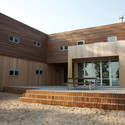
Their vision is exemplified in this 2700.sq ft lake house, the first private residence in northern Michigan to achieve LEED gold status, (there are 7 total in the state). The Omena Lake house is a project that combines sophisticated energy modeling software, never-before attempted active systems, and basic common sense design strategies that create a contemporary sustainable home whose goal is to connect its residents to the dynamic site on which it sits. Although flat roofed and geometrically abstract, the house is very much a part of the history of Northern Michigan Lake homes—it’s a modern, sustainable interpretation of the a Lake-side cottage.

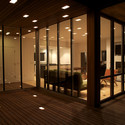
The main living area has a 15 ft long thermally broken, fully operable ‘Nano-Wall’, which acts as the main wind intake to passively cool the entire house. The interior floors are made of rapidly renewable, locally harvested bamboo. The counter-tops are richlite, made from recycled newspaper. The house is equipped with compact fluorescents, low-flow fixtures, two button toilets, and energy star rated appliances. The façade of the building is clad in vertical cedar. 60% of the home is wrapped in an Ipe-clad rain-screen, used both for solar deflection as well as passive cooling.

section

section

The house is one of the country’s first to use an in-ceiling hydronic radiant heating AND cooling system – there’s no traditional forced air HVAC, just the geo-thermal powered, thermally-active ceiling that can both heat and cool the house. Also 100 % of the roof surface is covered in a unique vegetative roof, used for both solar deflection and storm water filtration. The house was designed using the energy modeling software Eco-tech, to leverage and calibrate both passive cooling, passive solar, as well as basic site orientation.


17 comments »

DA says:

at first glance i though the project looked interesting.
The more i look however, it seems the energy modelling has taken over and bullied the design. The remaining spaces seem cold and uptight in a way – and far too sealed off from the surrounding nature.
Has LEED and the almighty R-Value really left us with no other option?

 
# October 24, 2009 at 00:20
    Daniel says:

    I’d suggest that a great many houses (both traditional, and those displayed on this site) have interiors that are “cold and uptight”. Northern homes are often compact with small windows. Additionally, I’ve seen a great many houses that are very similar (aesthetically) to this one, that make no mention of environmental planning. All of that makes be believe that the environmental modeling, however instrumental, actually played very little part in the volumetric/spatial design of this house. Thats approximately the converse of what you are saying – but interestingly I think we have a point of agreement: Many a modern designer will defend their LEED modeling as if it translated directly into a formal design solution, whereas I believe such study does not so much tell you what to design as provide analysis of what you have designed.

     
    # October 24, 2009 at 16:16
matiss says:

What software did they use for data modelling?

 
# October 24, 2009 at 05:37
Dariusz says:

The video is useless. Why did you bother putting up the ecotect analysis.. Achitecture in principle is supposed to consider the sun, wind, site and all environmental factors. Let’s show the beauty of materials, joints and spaces.

 
# October 24, 2009 at 06:56
    Stephen says:

    It appears that the video shows the interesting idea of completely opening up the wall of windows to allow fresh air and breezes to penetrate the space while keeping nasty bugs out of the space while also enlarging the space. I don’t find the video useless, I find it helpful to illustrate the opportunity of allowing the outside air, in.

    Beauty may be in the details as I agree, but the project must be looked at as a whole in order to be successful. I feel the designer did a nice job on the particular items the editor gave us to review.

     
    # October 24, 2009 at 10:17
Will says:

You would get ripped if you just simply posted up ecotect graphs like that at my school.

 
# October 24, 2009 at 12:14
    ygogolak says:

    Great, you will be a great designer some day b/c of that fact.

     
    # October 26, 2009 at 16:55
jwc3 says:

This project is described as a lake house. Where is the lake? Is it visible from any of the rooms in the house?

 
# October 24, 2009 at 16:13
CROFTdesign says:

Firstly, this house in in Michigan, not NY as archdaily posts. Second, this home hardly has any attention to detail. Looks as if much decision-making was left up to the contractor… sheesh…

 
# October 24, 2009 at 21:16
The Hawk says:

Would love to know more about this, what is it and how does it cool? Can anyone tell me?

‘an in-ceiling hydronic radiant heating AND cooling system – there’s no traditional forced air HVAC, just the geo-thermal powered, thermally-active ceiling that can both heat and cool the house’

 
# October 24, 2009 at 23:46
jszetroui says:

first.. great that such houses with such great sensiblity are built and planned!

@The hawk: It will cool about the tempreature of earth..?

 
# October 25, 2009 at 11:13
ryan knock says:

nice enough house, but the siting is horrible … it looks as if it dropped out of the sky.

 
# October 25, 2009 at 20:07
Fernando Deprit says:

Cuantos cedros se han cortado para forrar la casa…?

 
# October 26, 2009 at 03:48
Patent Police says:

I grew up in northern Michigan and I’ve never heard of a “Lake Omena”. Google maps says There is an Omena Lake on the Indiana border, and the lake’s about a quarter mile wide – much smaller than the photos here suggest.

Anyone who’s from Michigan knows there is a dramatic difference in climate between the south and north in the state. Maybe this is in northern Michigan, somewhere, but there’s something weird here.

I’m also confused about how “the house is very much a part of the history of Northern Michigan Lake homes.” Truth be told, there isn’t much of a vernacular of northern Michigan homes, aside from wooden Victorian cottages built around the turn of the (last) century.

There’s something weird here…

 
# October 27, 2009 at 09:42
    freshH2O says:

    To the Patent Po-po, Omena is a small town on the East side of the Leelanau Peninsula. The Lake is a body of water called Lake Michigan or more specifically on West Grand Traverse Bay. It is wise for any newer construction on the sandy shores of Lake Michigan to be set back. Water and shoreline protection are a part of the life in N. MI.

     
    # November 23, 2009 at 07:56
Branden Collins says:

is this by the dude from build it bigger and extreme engineering?

 
# October 30, 2009 at 23:56

Leave a Reply »

Want to have your own avatar? Get yours at Gravatar.

Latest Comments »

awesomeness!!![+]
What about the interior?[+]
Sleeper[+]
Very nice, it seems to be a small...[+]
Do you really think these guys were the first ? what about Future...[+]
This dude is pure genius..[+]
NL-architects RRROCK! This kind of urban solution has been done waaay...[+]
this just seems lazy… it is neither complex (...[+]
Nice design but i think they have too...[+]
I could get lost in a...[+]
Bana Alkahteeb on Waiuku Church / Jasmax:
Using simple geometric forms and a touch of colored glass is...[+]
“simplicity is complexity” quoted from...[+]

Browse by category »

Our partners »

Browse by date »

Friends »

Proudly hosted at »