





-
Architects: Johnsen Schmaling Architects
- Area: 372 m²
- Year: 2008
Text description provided by the architects. As the harbinger of a large-scale development slated for LEED certification, the Palomar Welcome Center utilizes an abandoned one-story warehouse building on the edge of Milwaukee's Park East redevelopment corridor. The area, an urban desert formerly occupied by an underused freeway spur, is slated to be transformed into the Palomar District, a series of mixed-use projects that will connect downtown to the adjacent neighborhoods. The Welcome Center itself includes a public lounge, offices, a gallery, and a model residence - an interactive hub to connect investors, business owners and residents with each other and present the urban vision for the area to the general public.

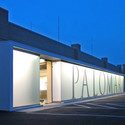
A long translucent glass scrim with supergraphic etching wraps the windowless face of the existing brick building, creating an elegant, immaterial facade that transcends the distinction between building and signage. Illuminated from behind with off-the-shelf fluorescent strip lights, the scrim transforms the building into an urban Laterna Magica, a beacon projecting its message of change into the neighborhood poised for a renaissance. The south-facing scrim also creates a thermal buffer for the building, reducing the solar impact on the building envelope during the summer while providing an additional protective layer in colder months.

The Palomar Welcome Center was designed around a palette of sustainable and recyclable materials, including bamboo flooring, locally quarried stone and locally harvested woods as well as low-VOC paints. More importantly, the project presents a sustainable alternative to the resource-intensive tabula rasa approach that still dominates contemporary architectural production, demonstrating how the bones of an obsolete structure can be recycled into an exciting new urban constituent.

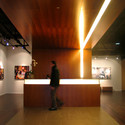
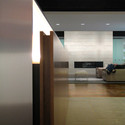
Visitors enter the Welcome Center through a frameless glass vestibule and walk into a public gallery, an open space with three zones defined by ceiling bands suspended from the exposed roof trusses. The first one, an illuminated wood ribbon, leads from the entry into the gallery, where it turns down to transform into the backdrop for the information desk. The second band marks a seating zone for informal gatherings, taking advantage of the linear masonry fireplace that anchors the open space. The third band defines a conference room that can be closed off from the gallery by a set of large sliding glass panels; when the panels are completely retracted behind the masonry hearth, the meeting room becomes an integral part of the gallery space. The gallery also offers access to a model apartment to demonstrate the sustainable features of the development's residential portion. All offices are organized along the building's east wall, where they have access to natural light and air. The rest of the original building is used as a warehouse and staging area for contractors involved in the construction of the project.


