
Holocaust Memorial / Sergio Kopinski Ekerman

Uploaded by — Filed under: Monuments and Memorials ,Selected , , ,
 

Architect: Ekerman
Location: Salvador, Bahia, Brazil
Contractor: Eng Construções
Project year: 2005-2006
Construction year: 2007
Photographs: Léo Azevedo

The Jewish Cemetery in Salvador, Bahia, Brazil is situated on the northeast side of the Baixa de Quintas Hill. It has an elliptical form and measures approximately 5,600 sqm.

In approximately eighty years of existence, the Cemetery had half of its space occupied and the only change in relation to its original infrastructure was the construction of a specific pavilion for the obituary services, twenty years ago.

site plan

Considering the lack of space for new burials in the first used section of land and the bad shape of the infrastructure, the Jewish Society in Salvador decided in 2006 to draw a new plan, regarding the future.
Part of the plan consisted also in building a Holocaust Memorial, a space capable of filling some programmatic blanks. First, creating a landmark to the new occupation; second, providing the visitors with a place to pray, think and meditate, giving the cemetery a useful liturgical space; third, remembering one of the most important events in the Jewish history, playing an educational role as well.

The first part of the project was finished in July 2007, and consisted in the construction of a new entry gate, the ampliation and refurbishment of the obituary pavilion, improvements in the access to the older part of the field, new floors, infrastructure services, the construction of a new sink for the netilat iadaim , besides the realization of the Holocaust Memorial itself.

The new building respected the goal to organize the Cemetery towards its growing, connecting to a new gate and a small plaza beside the obituary pavilion, thus becoming an element of composition to the basic core of reception and permanence of the users during religious services.

The main wall is oriented towards Jerusalem, absorbing a tradition brought from the synagogue. Its forms are inspired from the word “chai” – “life” in Hebrew, understanding that the remembrance from those that had gone and from those who survived is made of their legacy and their acts in life.

From this point, the project seeks to create a space formed by light and shadow, using apparent , brutal and non perfect, suggesting the bitterness of the experience lived by the ones who died or survived the shoah.

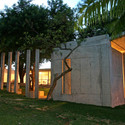
The main volume is a cube measuring 4x4x4 meters, partially closed on three sides and open to the Cemetery on the west façade, through a portico that emphasizes the relation among form and symbol.

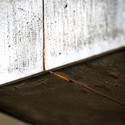
It is covered by a concrete slab with a tilted, curvy profile, which looks for an ascendance gesture in search for sacred.

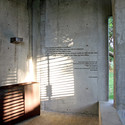
On the interior, the space is outlined by a bench and a steel box, for candle lightning, a costume that represents remembrance in Judaism. Besides this elements, the main wall holds a ner tamid, a permanently bright light, which symbolizes the ties among Jews and god, also a customized piece of locksmith.

The goal was creating a space that has a controlled relationship among interior and exterior, allowing the visitor to isolate himself for a moment of meditation, although connected to the trees and the breeze, very pleasant on the top of the hill and important to deal with Salvador’s hot weather. One of the features used to reach this goal is the set of pre-shaped brise-soleils.

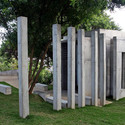
The floor, a washed concrete, is made in loco and sets a unique surface that tries to create a solid bond between interior and exterior, a dialogue also put by the grass, the existent trees and the six benches and pillars representing the six million Jews killed during the Second World War. Thus, the concrete garden created in the Memorial entrance is a space that will connect the old and the new part of the Cemetery, configuring a better space for people visiting or taking part in a religious moment.

Second construction of its kind in Brazil, the Holocaust Memorial in Salvador is born from Jewish values, trying to translate into architectonical creation the expectations of renovation of the community and the religion itself. Sixty years after the war, we believe that it’s a need to remember the Holocaust. It is necessary, however, that memory comes together with reflection, in a process capable of promoting tolerance and peace. In this way, we hope future can be less gray and rough.

 
 
Thumb up Thumb down 0
mart says:

i’m torn on this. there are some really excellent little details & moments in it. but something about it also strikes me as resembling so much student work i’ve seen and done. as if a particularly good student project got built…

 
# June 14, 2009 at 09:46
Thumb up Thumb down 0
zach says:

did the architect intend the concrete to be so rough? is it a sub-par casting or did they wash it with acid to give it the extreme utilitarian look?

 
# June 14, 2009 at 09:47
Thumb up Thumb down 0
Saulo Coelho says:

It’s very nice to see you here, in archdaily, man! It’s a beautiful project. It looks a peaceful, calm and quiet place who needs to be visited. Congratulation for publishing all details, and plans as well.

 
# June 14, 2009 at 10:09
Thumb up Thumb down 0

what he did was a poor and small version of Libeskind and Eisenman did before.

As mart said, a good student project.

 
# June 14, 2009 at 11:13
Thumb up Thumb down 0
Robert says:

What a horrid little building. Is this really for the living to pray in as it is more like a mausoleum. Maybe the effect is lost ihn the photos and it is actually more powerful when you are within.

 
# June 14, 2009 at 12:05
Thumb up Thumb down 0
Opium says:

The jews don’t deserve such a crap…auchwitz was bad enough wasn’t it…

 
# June 14, 2009 at 12:43
Thumb up Thumb down 0
Troy Lemieur says:

Yes, let’s all bash projects with no explanation. Taste the sarcasm and stop commenting, Opium.

 
# June 14, 2009 at 22:57
Thumb up Thumb down 0
Opium says:

When there’s little to comment irony and sarcasm are the only thing left. This is as others pointed out a very basic and simplistic project. Simple is one thing…simplistic is another.It’s supposedlly a place of comtemplatation and meditation but lacks any evocative power…no treatment of the light, shows little for materiality of the space…nothing happens…if didnt know this was supposed to be an homage do the Shoah i guess i would use it to store stuff.If you know similar spaces like zumthors proposal for berlin you’ll see how ridicolous this is.

 
# June 15, 2009 at 10:04
Thumb up Thumb down 0
Scott says:

It’s such a small little building I don’t know what all the commotion is all about. True the quality of the material is not high and most non architects don’t like exposed concrete anyway. But other than that it seems to be a decent little place in a cemetery.

 
# June 16, 2009 at 14:53
Thumb up Thumb down 0

Pretty insightfull post. Never thought that it was this uncomplicated after all. I have spent a good deal of my time looking for someone to explain this topic clearly and you’re the only person that ever did that. Thanks a lot! Keep it up!

 
# December 11, 2010 at 08:07
Thumb up Thumb down 0
Frank says:

I think that this project has been treated unfairly in comments. To me it is not the materials which are the main problem, but the way they are used.
Perhaps it is only because of these photo’s, however, to me, there seems too great an attempt at creating interesting structural elements for such a small space. Each side has a feature and all of them compete, in a large space, where these elements to be more spread, each could be appreciated more poigniently. Instead it becomes busy for a space like this, which requires a tranquil, reflective and respectful atmosphere. But I can appreciate what the architects were trying to achieve it is unfortunately perhaps inappropriate for the scale.
Presonally I would also regard this type of space, a memorial, to be on a very intimate and personal scale, almost reclusive. The large number of openings make this seem very exposed.

 
# June 20, 2011 at 05:13
Thumb up Thumb down 0

8:08 AM Jun 14th

RT @archdaily: Holocaust Memorial / Sergio Kopinski Ekerman http://bit.ly/tTBT9

Thumb up Thumb down 0

9:44 AM Jun 14th

#architecture Holocaust Memorial / Sergio Kopinski Ekerman:
Architect: Sergio Kopinski Ekerman Loc.. http://bit.ly/GMRhI

Leave a Reply »


Latest Comments »

“ditto”[+]
Architecture has been and always...[+]
I think the idea of the whole project...[+]
Another useless piece of junk from him – except this time it is dangerous!...[+]
Coffee with an Architect has got to stop; it’s pathetic.[+]

Upcoming Architecture Events »

got events? invite us! click here

Architecture Books & Magazines »

Golconde: The Introduction of Modernism in India

Golconde: The Introduction of Modernism in India

Sited on the coastal edge of the Bay of Bengal, Golconde, a dormitory for the Sri Aurobindo Ashram in Pondicherry, India, was designed by architects Antonin Raymond and George Nakashima. Golconde is a remarkable architectural edifice, seemlessly negotiating between


Interiors Construction Manual

01

The Interiors Construction Manual supports planners in their daily work as a practical planning aid and reference work with the relevant standards, guidelines, reference details and constructional solutions, all illustrated by built example projects. It brings together the crucial…


Architectural Modelmaking

Architectural Modelmaking

“The representation of creative ideas is of primary importance within any design-based discipline, and is particularly relevant in architecture where we often do not get to see the finished results, i.e. the building, until the very end of the…


Our partners »

AD on iPad via Pulse

Browse by date »

Browse by category »

Friends »