Mush / Studio 0.10 Architects

Uploaded by — Filed under: Houses ,Selected , , , , ,
 

Architect: Studio 0.10 Architects
Location: West Los Angeles, California,
Design Team: Debbie Chen, Mark Claborne, Eiko Hamada-Ano, Gregory Haynes, Andrew Liang, Li Wen, Elizabeth Wendell
Structural Engineering: William Koh and Associates
Project Year: 2005 – 2006
Construction Year: 2006 – 2008
Constructed Area: 5,400s.f.
Photographs: fotoworks – Benny Chan;

A single-family residence designed for a couple and set in a postwar subdivision, a few blocks away from the ‘hip’ strip of Sawtelle Blvd. in Los Angeles. Considered a last bastion of the “traditional values” of home ownership, the neighborhood’s properties of mostly single level cottage typology have been predominately occupied by their original owners since their creation.

However, with the aging of many of the original owners and with still reasonable real estate pricing, a new generation of home seekers is buying in. Armed with favorable zoning regulations, many of the recent buyers have sought new opportunities for an architectural reconsideration of their property. Though still early in the neighborhood’s transformation, there is an emergence of a new aesthetic and potentially new synergy for a design enclave in the patchwork urbanism that is Los Angeles.

The neighborhood is largely composed of 50 feet by 150 feet infill and corner R2 zoned lots with a height limitation of 35 feet capable of legally accommodating three-story duplex developments. The uniqueness of the project site is that a second-generation family owned nursery with a low redevelopment potential borders it on two sides and offers extended outwardly views from within the lot once above the ground floor. The green visual field of unobstructed views of the neighborhood and the bordering urban fabric presented by the nursery also impose a surreal urban and visual presence back onto the lot.

The owners’ lifestyle revolves around the creating, exhibiting and sale of art and photography. As such, the project took on a complex and aggressive set of programs aimed at integrating domestic, entertainment and work activities. In addition, there were two unique requirements: one, the project needed to include an autonomous but fully integrated apartment for the wife’s elderly mother; two, after a decade of loft living devoid of access to exterior living spaces, the owners requested that the project be planned to maximize usable outdoor spaces for entertaining. Specific to the work programs, there was the need for an art studio for the husband, home offices and a dedicated exhibition space as an extension of the wife’s gallery business. These programmatic parameters informed two primary strategies to organize the project. First, due to the restrictive lot dimension, consideration had to be given to break up the massing as a whole into parts to generate more outdoor space(s). This was done by shifting and stacking the program blocks to maximize the buildable height in order to minimize the footprint of the buildings to produce the required outdoor spaces. This strategy yielded the traditional front and back yard in addition to a large courtyard as a focal outdoor space. Second, in order to maximize display surfaces, the exhibition space was stretched as a three-dimensional trajectory of movement throughout the entire volume of the main house. This was accomplished by conceptualizing the exhibition and art viewing activities as a ribbon of display surfaces also doubling as the main circulation of the house.

program diagram

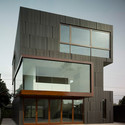
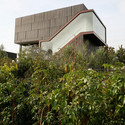
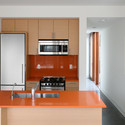
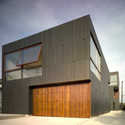
The resultant project consists of two independent structures sandwiching a courtyard space. The street front garage/studio unit is two stories with a 4-car garage (doubling as an art production space), an integrated apartment on the ground floor with an art studio on the 2nd floor. The R2 zoning designation was beneficial in allowing the apartment to operate autonomously from the rest of the programs on the property and as such it has its own kitchen, bedroom and bathroom. The main house, situated in the back of the property, is a three-story structure containing the living, dining and kitchen programs on the ground floor, home office and a guest room on the second and the master suite on the third floor.

Once the site planning and massing agenda were established, consideration was given to mapping current and potential future contextual impacts onto the project as cues for formal manipulations and articulations. As such, the key strategy was to manipulate the circulation / exhibition ribbon element and use it strategically to articulate the massing of the project. The result is the wrapping of the circulation / exhibition ribbon on the periphery of the main house volume and using it as a privacy buffering “armature.” The final design accentuates the movement of the users transitioning between programs while also projecting the exhibition activities and artwork onto the exterior.

The two structures are clothed in a custom-patterned zinc rain screen to personify the monolithic quality of the volumes while the imprints of the circulation/exhibition ribbon are identified through the use of structural glazing framed with Ipe wood. The Zinc cladding is conceptualized and detailed as a skin – a simple wrapper. Its combination of differing size panels and a special depressed unit interacts delicately with the sunlight – offering smooth and pattern shadowed variations of the skin as the day passes. To protect the artwork, high performance glass was used to virtually eliminate the penetration of harmful UV light.


Thumb up Thumb down 0
marcus says:

that stairwell is going to be a sauna.

 
# March 22, 2009 at 14:07
Thumb up Thumb down 0
hj says:

It’s a miniature of the Dutch embassy in Berlin by OMA, but a nice version nonetheless.

 
# March 22, 2009 at 15:05
Thumb up Thumb down 0
odris says:

great lines

 
# March 22, 2009 at 15:16
Thumb up Thumb down 0
aikon says:

wow. just wow. amazing building. wish theres a more detailed version of the floor plan. can’t really see it in such a small size.

 
# March 22, 2009 at 19:14
Thumb up Thumb down 0

marcus,

the stairwell is located to the north, so it doesn´t get direct sunlight….

 
# March 22, 2009 at 19:19
Thumb up Thumb down 0
CY says:

Beautiful exterior, hideous plumbing fixtures in the shower…. So clunky looking, they are not consistent with the clean, modern style of the house. So is the kitchen faucet…

 
# March 23, 2009 at 19:14
Thumb up Thumb down 0
Nando says:

increible… un gran proyecto

 
# March 30, 2009 at 12:38
Thumb up Thumb down 0
hx says:

the color seems a little too dark to be a family house…but anyway, the stair is great

 
# April 25, 2009 at 16:33
Thumb up Thumb down 0
Strasbourg says:

Yep, wonderful architecture!

 
# May 12, 2009 at 12:48
Thumb up Thumb down 0
Abdullah says:

wow!! beautiful! maybe not in California though…

 
# May 28, 2009 at 03:18
Thumb up Thumb down 0

5:20 PM Sep 3rd

I could do without the countertops, but I'll take this one, please: http://bit.ly/WUBYM

Thumb up Thumb down 0

5:23 PM Jan 6th

Mush / Studio 0.10 Architects | ArchDaily http://t.co/naHiYPD via @archdaily

Thumb up Thumb down 0

2:34 PM Nov 12th

Mush / Studio 0.10 Architects Modern Homes Modern Doors http://t.co/veb7cz6y via @archdaily

Leave a Reply »


Latest Comments »

In gally office[+]
...[+]
They must call that the “Towering Inferno law”, their code is a...[+]
You are wrong completly. This is brillant. It have harmony, scale and...[+]
Howdy very cool web site!! Guy .....[+]

Upcoming Architecture Events »

got events? invite us! click here

Architecture Books & Magazines »

Bing Thom Works / Bing Thom Architects

Bing Thom Works / Bing Thom Architects

We recently received a book by Bing Thom Architects, a firm we have previously featured. Beyond the traditional display of selected projects this book provides a range of essays by Bing Thom that deal with the questions he…


eVolo Skyscrapers

eVolo Skyscrapers

We recently received one of the limited editions (n=500) of eVolo Skycrapers. At 1224 pages (9″ x 11.5″ x 2.5″), it is less of a coffee table book than it is an actual table.  The book grew out of…


After Crisis

After Crisis

“‘After Crisis’ concentrates around the new conditions for architectural practice and around the new epistemologies that may inform it in the next future. That is, in the period after the financial bubble has collapsed and living and working conditions


Our partners »

AD on iPad via Pulse

Browse by date »

Browse by category »

Friends »