Esker house / PLASMA Studio

Uploaded by — Filed under: Houses ,Selected , , , ,
 

Architects: Plasma Studio
Location: Innichen, San Candido,
Project Year: 2006
Principals: Arch. Eva Castro, Arch. Holger Kehne, Arch Ulla Hell
Collaborators: Arch. Peter Pichler, Arch. Angelika Mair, Libny Pacheco
Contractor: Tschurtschenthaler Werner GmbH
Interior Area: 115 sqm
Terraces Area: 55 sqm
Photographs: Cristobal Palma


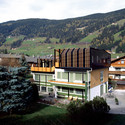
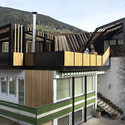
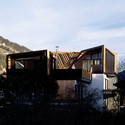
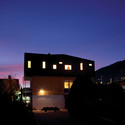
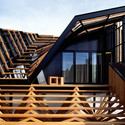
Esker Haus (esker=stratified geological formation) is a self-contained residential unit placed on top of an existing house from the 1960s.

The project has been developed as a parasite which started from adopting the structure of the host and gradually differentiated into its own unique organization and morphology.

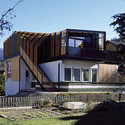
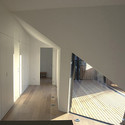
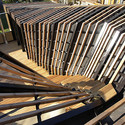
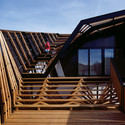
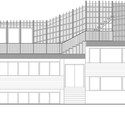
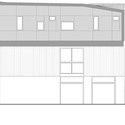
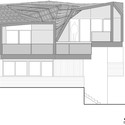
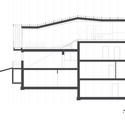
The project is formed by a series of steel and timber frames that deform to recreate the smooth hillsides of the surrounding dolomites. This partly accessible roofscape also determines the spatial character inside- the spaces are enfolded by an angular and dynamic series of planes creating new and ever-changing perspectives and spatial constellations.

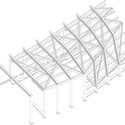
steel structure axo

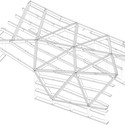
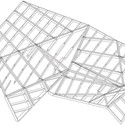
roof structure axo

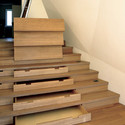
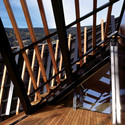
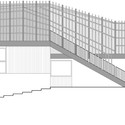
The unique stratified morphology and construction system started off from projecting each step of the external staircase as a modulor that then was proliferated as frames. These frames enable the subsequent deformation and softening of the overall geometry.

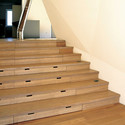
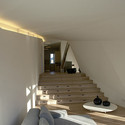
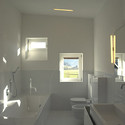
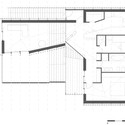
The split level organization leads to the lengthening of parts of the stairs to form a topography for informal occupation. The overall spatial character is that of an echelon with a diffusion of functions and conditions where inside and outside, above and below become gradient zones of varying intensity. These interleave as a loop that transgresses from the most private zone of bedroom and bathroom via kitchen, dining and living rooms towards the more public and exposed territory of the various terraces.

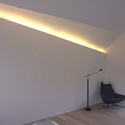
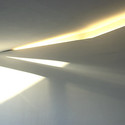
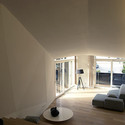
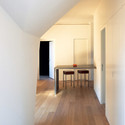
The interior spaces are the reflection of the exterior geometry with folded planes accentuating the flow through the open split-level plan.Their character is determined by the transgressions from the Cartesian orthogonal layout (determined in part by the structure below and functional requirements) towards the soft and fluid morphology of the roofscape.

Site, program and organization

To consider building a new dwelling on top of an existing house is a relevant and valuable approach, leaving ground undeveloped elsewhere and creating higher density. Plasma’s process of charging each project from its ground and context becomes here even more specific. The existing house is composed of two parts with different levels. Structural walls, chimneys, drainage and other infrastructural lines organized the site into a mesh of constraints.

We challenged the standard pitched and overhanging roof and instead developed a rich texture of different occupiable spaces.

On the outside these are a podium that leads to the top of the roof within a dip, a semi-covered pergola beneath it, a long terrace as extension to the south of the living room.

Design process

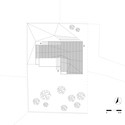
Given that the existing house has two ‘wings’ with different roof levels, we started from a simple diagram of two boxes forming a ‘T’, allowing plenty of external space for terraces to the South.

The lower Western box became the living zone with the upper Eastern box to contain the master bedroom, bathroom, 2nd bedroom and kitchen.

Bringing the access as external staircase along the North side enabled the definition of the entrance along the seam between the two zones creating a hinge area for distribution.

From this external staircase the rhythm of each step was then proliferated as frames that became deformed to produce a soft intertwining of roof and walls as continuous artificial topography.

This produces a variety of outdoor environments for sitting on the roof and enjoying great views all around or beneath sheltered from wind and sun.

Tectonics and construction

The conceptual and geometric striation was translated into a series of outside steel belts from which prefabricated composite wall/ceiling panels are suspended. Small T-sections span in perpendicular direction to the major steelwork to support the additional timber sections that complete the outer layer.

All the different systems are interdependent and it was vital to work with a specialist contractor that was able to produce all fabrication information directly from our 3D computer model.


Thumb up Thumb down 0
spoiler says:

fantastic how plasma plays with wood and the angles

 
# February 12, 2009 at 04:17
Thumb up Thumb down 0
Erling says:

Like it to, but maybe they should try to keep it more simple. It’s af bit messy with all those different types af facades. The top floor does’nt really interact with the rest of the house. Looks like the perfect playground though.

 
# February 12, 2009 at 08:47
Thumb up Thumb down 0
cado says:

beutiful!

 
# February 12, 2009 at 12:33
Thumb up Thumb down 0
Mike Mecanics says:

to complicated…

 
# February 14, 2009 at 16:07
Thumb up Thumb down 0
recorteman says:

Very modern and cool indeed, much did it cost to build?

 
# February 27, 2009 at 01:15
Thumb up Thumb down 0

1:14 AM Dec 15th

Sign in to Twitter – http://t.co/XFGI0wZf

Leave a Reply »


Latest Comments »

The best chance of making the UK a...[+]
Architects have no use for cutesy, valueless generalizations about their...[+]
He said it himself…”Architect s are not funny.”[+]
is this an attempt at humor? i must be missing something.[+]
I like it as it challenges our western view of what a school should be. Even...[+]

Upcoming Architecture Events »

got events? invite us! click here

Architecture Books & Magazines »

MARK Magazine #35

MARK Magazine #35

As you well know already we love MARK Magazine, and this issue fails to disappoint. It has projects from many of the architects we have featured here on ArchDaily such as, StudioGreenBlue, Heri&Salli, Clavel Arquitectos, Kengo Kuma, Colboc Franzen, Studio Velocity, Takeshi Hosaka, Fuhrimann Hachler, Toyo Ito, Nieto Sobejano, L3P…


Volume 27: Aging

Volume 27: Aging

I never can get enough of Volume. This issue is loaded with provocative articles that stimulate discussion about a pressing reality, the dramatic demographic shift in the age of human populations. Throughout this issue there are articles like Martti…


Mark Magazine #33

Mark Magazine #33

We recently received the newest edition of Mark Magazine. Number 33 offers in depth looks of several  projects ArchDaily has previously featured such as: Sunset Chapel by BNKR Arquitectura, iGuzzini Illuminazione Spain Headquarters by MiAS Arquitectes, Villa Geldrop by Hofman Dujardin…


Our partners »

AD on iPad via Pulse

Browse by date »

Browse by category »

Friends »