
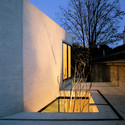
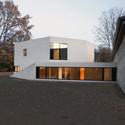

House in Frontenex / Charles Pictet Architecte
21
Dec 2008

Architects: Charles Pictet Architecte FAS SIA
Location: Frontenex, France
Collaborator: Philippe Le Roy, Architecte EPFZ
Engineering: Jean Regad, Genève
Project Year: 2004-2006
Photographs: Francesca Giovanelli
The construction is located on an old property that comprises several high-quality buildings, among which an orangery dating from the early 19th century.
The project includes the building into the living space. In the orthogonal structure adjustments of the property, the only exception will be the orangery, skewed by its location.
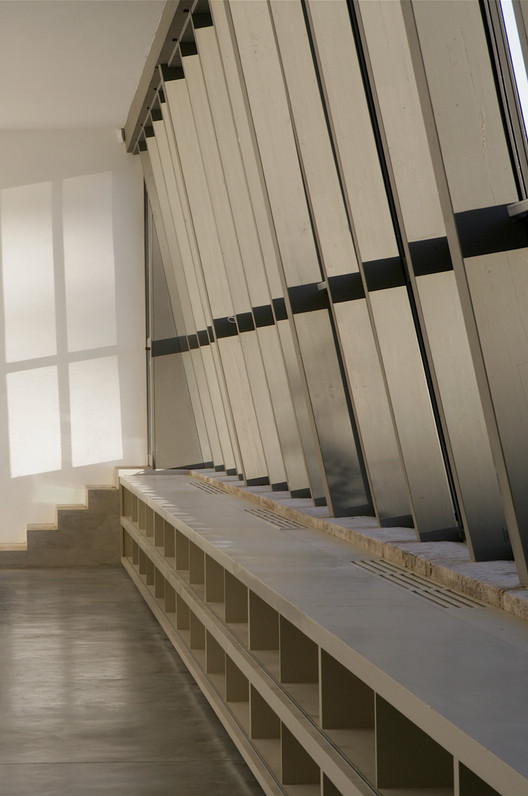
The volume of the new building articulates these two geometries and addresses the link between the two parties, the old and new.
- situation plan
- basement plan
- ground floor plan
- first floor plan
- section 01
- section 02
- section 03
on the
-- 


10 comments »
I’m really interested in this sort of project. Usually, a contemporary house built on its own seems to be offering a particular vision of the world and of its owner’s domestic life. Endorsing a modern home often means endorsing a modern sensibility. Cases like this are compelling to me because its owners are endorsing the reality of competing visions in the world. This house acknowledges complication in a way that I really like. It’s as if all houses are specific, rather than representatives of their respective schools; that’s an idea I really respond to.
–
http://www.contemporaryartdaily.com
Is the location really in France? The architect’s website lists it as Frontenex-GE where GE is Geneva, in Switzerland.
Really interesting and inspiring! Beautiful work with concrete!
tset,
Frontenex is in France:
http://en.wikipedia.org/wiki/Frontenex
Constructed Area?
Esthetiquement tres joli!
As an American, even a Californian, living in Europe and France it is interesting for me to understand the terrain between new architecture and the built environment. This is especially true in France where the restrictions on building are so severe.
In comparing this, for example, to projects of Alvaro Siza in Belgium, I see two fundamentally different approaches. The Siza approach is to encompass the terrain and wrap it around a poetic heart. This approach uses the built environment as a pedestal upon which to display a sculptural evolution.
It is extremely difficult to decipher which approach makes more sense. However, I do find a discreet legibility in enhancing the built environment from, for example, the Renaissance to the Baroque, to the Neoclassical, and on to modernism.
This kind of work does emphasize the legible lines of differentiation between past, present, and future in a way that I find really satisfying.
Very gray but beuatyful!
It is indeed Frontenex in Switzerland, I’ve check on google earth where you can see the House.
Links to this article »