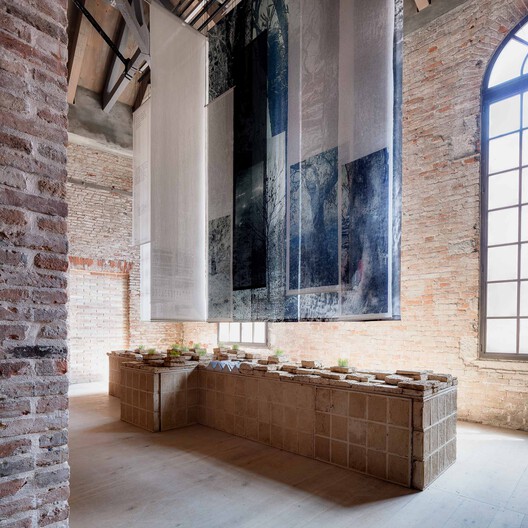
Gaggiandre. Image © Andrea Avezzù-Courtesy of La Biennale di Venezia

Venice Architecture Biennale 2025

presented by

The full ArchDaily coverage, featuring news, interviews, and pavilions of the Venice Architecture Biennale 2025, proudly presented by Constructing a Sustainable Future, the sustainable construction media.

U.S. Pavilion at 2025 Venice Architecture Biennale Showcases ‘PORCH: An Architecture of Generosity'

U.S. Pavilion at 2025 Venice Architecture Biennale Showcases ‘PORCH: An Architecture of Generosity'

The Fay Jones School of Architecture and Design at the University of Arkansas, in collaboration with DesignConnects and the Crystal Bridges Museum of American Art, has been chosen by the U.S. Department of State's Bureau of Educational and Cultural Affairs to represent the United States at the 2025 Venice Architecture Biennale. The selected theme, "PORCH: An Architecture of Generosity," explores the timeless architectural and cultural significance of the American porch, showcasing its continued relevance as a space for connection, inclusivity, and civic engagement.

Read more »

Nothing Is Lost, Everything Transforms: The Reusable Future of the Biennial’s Structures

Nothing Is Lost, Everything Transforms: The Reusable Future of the Biennial’s Structures

At the end of each edition of the Architecture Biennale, far from the public eye, tons of exhibition materials are transported across Venice in handcarts and boats. Only a small portion of these materials is reused. The main obstacles are the limited storage space in Venice and the high logistical costs—recurring challenges for circular architecture. As a result, most of the waste ends up in landfills or nearby recycling centers. But this scenario is beginning to change. In response to growing environmental concerns, architects are developing strategies to make reuse more viable. These efforts go beyond architectural and construction decisions—they also involve logistics and international trade.

Read more »

“Before Architecture, There Is Land”: In Conversation With Lynn Chamoun, Elias Tamer, Shereen Doummar, and Edouard Souhaid, Curators of the Lebanese Pavilion

“Before Architecture, There Is Land”: In Conversation With Lynn Chamoun, Elias Tamer, Shereen Doummar, and Edouard Souhaid, Curators of the Lebanese Pavilion

The Lebanese Pavilion at the Venice Architecture Biennale 2025 explores the land as a site of memory, intelligence, and resistance. Titled The Land Remembers, the exhibition is presented by the Collective for Architecture Lebanon, composed of Lynn Chamoun, Elias Tamer, Shereen Doummar, and Edouard Souhaid, and takes the form of a fictional public institution: the Ministry of Land Intelligens. The pavilion addresses the ongoing ecological crisis in Lebanon through an architectural lens, framing ecocide as both an environmental and social injustice. Positioned within this year's curatorial framework Intelligens: Natural. Artificial. Collective. the project calls for a reevaluation of how architecture engages with damaged landscapes. In this interview with ArchDaily editors during the Biennale, the curators explain how the project impels a rethinking of architecture's foundational commitment to the land.

Read more »

Croatian Pavilion at the 2025 Venice Architecture Biennale Explores the "Intelligence of Errors"

Croatian Pavilion at the 2025 Venice Architecture Biennale Explores the "Intelligence of Errors"

The Croatian Pavilion presents "Intelligence of Errors" at the 19th International Architecture Exhibition – La Biennale di Venezia, an artistic and research-driven project that repositions spatial and policy-related errors as generative tools for design. Commissioned by the Ministry of Culture and Media of the Republic of Croatia, the exhibition is curated by Ida Križaj Leko, a practicing architect and head of the interdisciplinary university specialist program Urban Studies at the University of Rijeka. In dialogue with the central Biennale theme, Intelligens. Natural. Artificial. Collective., the pavilion investigates how recognizing and analyzing errors can contribute to the development of collective intelligence under non-ideal conditions.

Read more »

The Estonian Pavilion at the 2025 Venice Biennale Questions Massive Insulation Projects Through a Façade Installation

The Estonian Pavilion at the 2025 Venice Biennale Questions Massive Insulation Projects Through a Façade Installation

The installation and exhibition representing Estonia at the 19th International Architecture Exhibition of La Biennale di Venezia is curated by architects Keiti Lige, Elina Liiva, and Helena Männa. Titled Let Me Warm You, the national exhibition explores different dimensions of sustainability by questioning whether insulation-driven renovations in Estonia are simply compliance measures to meet European energy targets or whether they can also serve as opportunities to enhance the spatial and social quality of mass housing districts. To make this point, the Estonian installation covers the façade of a Venetian building with insulation panels, replicating how they are commonly installed in Estonia for mass housing renovations.

Read more »

Do We Still Need Architecture Awards? Highlights from the "Beyond the Prize" Discussion Forum in Venice, Italy

Do We Still Need Architecture Awards? Highlights from the "Beyond the Prize" Discussion Forum in Venice, Italy

During the opening week of the 19th Venice Architecture Biennale, a consortium of six major architecture awards, including the Aga Khan Award for Architecture, the Holcim Foundation Awards, the EUmies Awards, the Mies Crown Hall Americas Prize, the OBEL Award, and the Ammodo Architecture Award, convened at TBA21–Academy's Ocean Space for a critical discussion titled "Beyond the Prize." This forum aimed to reflect on the role, relevance, and future potential of architecture awards amidst pressing social and environmental challenges. ArchDaily attended the public event and took the opportunity to ask the participants: What would the field of architecture look like if we stopped organizing architecture awards?

Read more »

The Land Remembers: Lebanon’s Pavilion at the 2025 Venice Biennale Confronts Ecocide Through Architecture

The Land Remembers: Lebanon’s Pavilion at the 2025 Venice Biennale Confronts Ecocide Through Architecture

At the 19th International Architecture Exhibition of La Biennale di Venezia in 2025, the Lebanese Pavilion, curated by the Collective for Architecture Lebanon (CAL), presents "The Land Remembers," an exploration of ecocide and environmental healing. Selected by Lebanon's Ministry of Culture and the Lebanese Federation of Engineers, CAL is a non-profit organization co-founded in 2019 by Shereen Doummar, Edouard Souhaid, Elias Tamer, and Lynn Chamoun. Their curatorial vision aims to transform the pavilion into a fictional institution, the Ministry of Land Intelligens, dedicated to confronting environmental devastation and proposing strategies for ecological restoration.

Read more »

Designing a Living and Dying Structure: Picoplanktonics and the Canadian Pavilion in Venice

Designing a Living and Dying Structure: Picoplanktonics and the Canadian Pavilion in Venice

The Canada Pavilion at the 19th International Architecture Exhibition – La Biennale di Venezia, hosted Picoplanktonics. A research that emerged as a radical rethinking of how architecture can become a platform that blends biology, computation, and fabrication to propose an alternative future, one where buildings don't just minimize harm, but actively participate in planetary repair. At its core lies a humble organism: marine cyanobacteria, capable of both capturing carbon and contributing to the material growth of the structure it inhabits. The project has been developed over 5 years by a group of researchers at ETH Zurich, led by Andrea Shin Ling and a group of interdisciplinary contributors and collaborators. Together, they formed the Living Room Collective, founded a year ago to build upon this work and showcase it at the Venice Biennale. The Core team members include Nicholas Hoban, Vincent Hui, and Clayton Lee. This conversation with the team behind the project shares the philosophy, technical challenges, and speculative horizons that animated their work from printing living sand lattices to maintaining microbial life in a public exhibition. Their aim is to inspire people to reconsider architecture not as a static object, but as a living, evolving process. One that requires care, patience, and a radical shift in mindset.

Read more »

“It’s All About Human, Nature, and Emotion”: In Conversation With Ma Yansong, Curator of the Chinese Pavilion

“It’s All About Human, Nature, and Emotion”: In Conversation With Ma Yansong, Curator of the Chinese Pavilion

At the 19th Venice Architecture Biennale, the Chinese Pavilion presents Coexist, an exhibition curated by Ma Yansong, founder of MAD Architects. The pavilion assembles ten interdisciplinary teams, spanning architects, scholars, students, scientists, and even social media participants, to collectively investigate the potential of architecture to reconcile contradictions between tradition and futurity, artificial and nature, technology and emotion. Rather than presenting a singular vision, Coexist aims to open space for responses to the diverse realities shaping contemporary architecture. While on site in Venice, ArchDaily's editors had the opportunity to discuss the ideas that shaped the Chinese Pavilion with the curator.

Read more »

"Helping the Existing to Reconfigure Itself": In Conversation with Søren Pihlmann, Curator of the Danish Pavilion

"Helping the Existing to Reconfigure Itself":  In Conversation with Søren Pihlmann, Curator of the Danish Pavilion

Søren Pihlmann is the curator of the Danish Pavilion at the 2025 Venice Architecture Biennale. The exhibition, commissioned by the Danish Architecture Center, is titled Build of Site, and focuses on exploring sustainable architectural practices through the lens of reuse and resourcefulness. Pihlmann's proposal transforms the existing Danish Pavilion, located within a historic building complex in the Biennale's Giardini, into an active exhibition space for material experimentation. The installation highlights techniques that incorporate recycled and bio-based elements. The Pavilion offers visitors the opportunity to observe ongoing experimental processes, witnessing how building resources are creatively reimagined for new uses. In this on-site interview, ArchDaily editors spoke with the curator about the ideas behind the project and the challenges its execution represents.

Read more »

Serbia’s Wool Installation Explores Circular Design at Venice Architecture Biennale 2025

Serbia’s Wool Installation Explores Circular Design at Venice Architecture Biennale 2025

The Serbian Pavilion at the 19th Venice Architecture Biennale consists of an immersive installation made of wool. The exhibition, titled Unraveling: New Spaces, was curated by architect Slobodan Jović and designed by an interdisciplinary team composed of Davor Ereš, Jelena Mitrović, Igor Pantić, Sonja Krstić, Ivana Najdanović, and Petar Laušević. The interior space of the Pavilion, located in the Biennale's Giardini, is occupied by an ephemeral installation that follows the principles of circular design, effectively producing no waste. The installation consists of a broad woven wool fabric that gradually unknits according to a guided choreography of algorithmic precision, completely disassembling by the end of the Biennale's exhibition.

Read more »

Ma Yansong Curates China’s Pavilion at the Venice Architecture Biennale 2025, Exploring Coexistence Through Nature and Technology

Ma Yansong Curates China’s Pavilion at the Venice Architecture Biennale 2025, Exploring Coexistence Through Nature and Technology

The Pavilion of China at the 19th International Architecture Exhibition - La Biennale di Venezia presents the exhibition CO-EXIST, curated by Ma Yansong, founder of MAD Architects, and organized by the Ministry of Culture and Tourism of the People's Republic of China at the Arsenale. Through ten works by twelve interdisciplinary groups, the pavilion examines how traditional Chinese philosophical thought can inform architectural responses in the age of advanced technology and artificial intelligence. 

Read more »

AD Classics: Finnish Pavilion at the Venice Biennale / Alvar Aalto + Elissa Aalto

AD Classics: Finnish Pavilion at the Venice Biennale / Alvar Aalto + Elissa Aalto

Tucked within the leafy confines of the Giardini della Biennale in Venice stands a structure modest in scale yet immense in quiet conviction: the Finland Pavilion, designed by Alvar and Elissa Aalto for the 1956 Venice Biennale. Unlike the monumental pavilions that surround it, Aalto's structure was conceived not as a permanent structure, but as a temporary exhibition space for a single exhibition season. And yet, nearly seventy years on, it remains—weathered, resilient, and quietly luminous.

Read more »

Latin America at the 2025 Venice Biennale: Exploring Territory, Memory, and Ancestral Knowledge to Build the Present

Latin America at the 2025 Venice Biennale: Exploring Territory, Memory, and Ancestral Knowledge to Build the Present

The 19th edition of the Venice Architecture Biennale officially opened to the public on May 10, becoming a significant international platform for exploring the current state of global architecture and sparking conversations about the challenges the discipline faces today—both shared and specific to each territory. This year’s theme, "Intelligens. Natural. Artificial. Collective," proposed by general curator and Italian architect Carlo Ratti, invites reflection on architecture’s interconnection with other fields—such as art, artificial intelligence, and technology—while also emphasizing the importance of territories, landscapes, and, above all, the people who collectively shape our built environment.

Read more »

The Holy See Pavilion Presents a Living Practice of Restoration at the Venice Architecture Biennale 2025

The Holy See Pavilion Presents a Living Practice of Restoration at the Venice Architecture Biennale 2025

At the 19th International Architecture Exhibition, La Biennale di Venezia, the Dicastery for Culture and Education presents "Opera Aperta", a project that positions architecture as a practice of collective care and responsibility. Curated by Marina Otero Verzier and Giovanna Zabotti, Opera Aperta is set within the Santa Maria Ausiliatrice Complex in Venice's Castello district. Designed by Tatiana Bilbao ESTUDIO and MAIO Architects, the project transforms the 500-square-meter site into a space for collaborative restoration and public engagement. Conceived as a work in progress rather than a finished installation, Opera Aperta functions as a platform for ongoing exchange, participation, and engagement rooted in the local context. This open and process-oriented approach was recognized during the opening events, where the Holy See Pavilion received the Golden Lion's Special Mention for National Participation.

Read more »

From Root to Roof: In Venice, ArchDaily Highlights Restorative Emerging Practices

From Root to Roof: In Venice, ArchDaily Highlights Restorative Emerging Practices

In partnership with the European Cultural Center (ECC), ArchDaily has launched its inaugural exhibition as part of the seventh iteration of Time Space Existence, an architectural showcase occurring concurrently with the 19th Venice Architecture Biennale. Open from May 10 to November 23, 2025, in various locations throughout Venice, this edition centers on the theme of "Repair, Regenerate, and Reuse," promoting innovative and sustainable approaches in architecture. ArchDaily's contribution is located at Palazzo Mora, complementing other venues like Palazzo Bembo, Marinaressa Gardens, and Palazzo Michiel.

Read more »

When a Pavilion Becomes a Living Laboratory

When a Pavilion Becomes a Living Laboratory

A pavilion in a Biennale serves as a platform for cultural expression, allowing a nation to articulate its architectural identity while responding to global challenges. These national exhibitions reflect how each country interprets the event's central theme through the lens of its own landscapes, histories, and future aspirations, reinforcing architecture's ability to act not only as a built discipline, but also as a catalyst for reflection, transformation, and dialogue. In this context, Montenegro's contribution resonates with particular force. Titled Terram Intelligere: INTERSTITIUM, the pavilion draws on the concept of a newly understood anatomical system of fluid-filled spaces running throughout the human body, facilitating connection and exchange. Once considered dense and inert, the interstitium is now revealed to be a network of dynamic interrelation — a metaphor that the curators use to reframe architecture as an active, living inquiry into natural, artificial, and collective intelligence, in tune with this edition's theme: Natural. Artificial. Collective.

Read more »

“A Site of Destruction, a Site of Opportunity”: In Conversation With Kabage Karanja and Kathryn Yusoff, Curators of the British Pavilion

“A Site of Destruction, a Site of Opportunity”: In Conversation With Kabage Karanja and Kathryn Yusoff, Curators of the British Pavilion

Kabage Karanja, co-founder and director of Cave_bureau based in Nairobi, Kenya, and Kathyrn Yusoff, professor of Inhuman Geography at the University of London, are the curators of the British Pavilion at the 19th Venice Architecture Biennale. Together, they form the UK-Kenya curatorial team behind GBR – Geology of Britannic Repair, an exhibition that rethinks the Pavilion as both a symbolic and material site. Their approach reflects on Britain's architectural legacy and its entanglement with histories of colonialism, geological extraction, and the urgency of the climate crisis. In recognition of their exploration of the relationship between Great Britain and Kenya, focusing on themes of reparation and renewal, the Pavilion curators and commissioner were awarded a Special Mention for National Participation by the Biennale jury. While on site in Venice, ArchDaily's editors had a chance to discuss with the curators about the ideas that shaped the British Pavilion.

Read more »