Do you know a great example of high density living environments built within the last 30 years? Share your knowledge and contribute to the creation of an open repository via Crowd Creation. To be truly exemplary, the area should include a mixture of functions (at least some of them high-rise) where the physical fabric retains a human scale at street level despite the high density.
In January 2021, Phaidon published Radical Architecture of the Future, which presents the world's most inspiring, innovative, and advanced architecture, offering new ways to view, understand, and build our environment and the spaces that surround us.
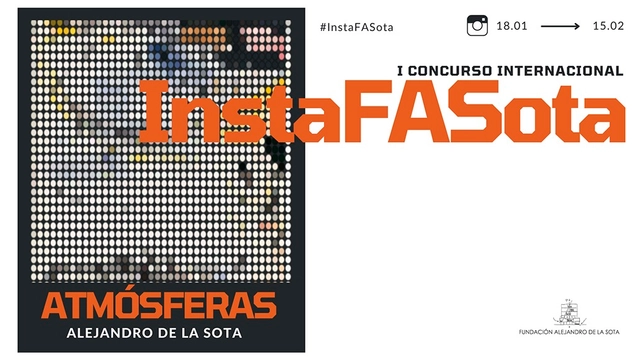
”Music is the air that sounds; architecture is the air we breathe, but an air charged with scents, with wisdom, an air transformed by that very thing: Architecture” - Alejandro de la Sota.
With the emergence of COVID-19, we have had to adapt to living differently than we were used to, which has been directly reflected in our working style. Where and how do we work today? A large portion of the workforce has transitioned to working from home, where feasible. While comfortable for many, for others it has meant a radical shift, bringing new spatial and resource requirements. For architects, engineers, builders, and contractors, this challenge has been particularly complex, as much of their work involves handling large, high-cost devices.
In this article, we present 3 innovative solutions that replace the traditional, bulky plotter, allowing us to print in large formats from our own homes.
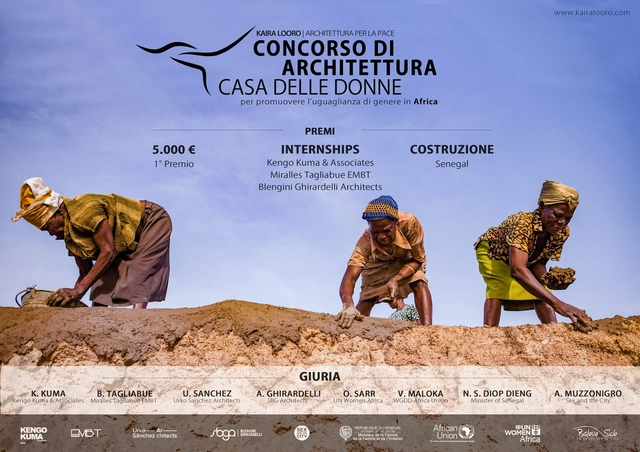
The competition aims to design a "Women's House" through symbolic, ecological architecture inspired by local traditions. It is envisioned as a space where associations and various elements of society can meet and discuss issues on equal terms and human rights, thereby fostering the involvement and emancipation of the women's community in support of the territory's social, economic, and political development. Gender equality is not merely a fundamental human right; it is a necessary condition for a prosperous world.
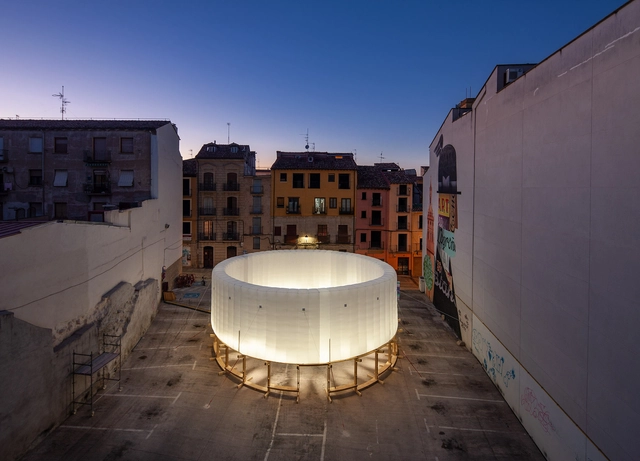
Concéntrico 07, the International Festival of Architecture and Design in Logroño, invites reflection on the urban environment and the city through architecture and design proposals in various formats. The new edition will take place from September 2 to 5, 2021.
‘Fronteiras_Japão: Society and its spaces - ‘間 ma, art and Japanese spaces’ / Author's collection.
'Fronteiras_Japão: Sociedade e seus espaços' aims to provide an introductory exploration of Japanese space, charting new perspectives and horizons while discussing society, culture, architecture, the city, and the unique worldview of the nation.
Through a collection of 13 chapters, Peggy Deamer examines the profession of architecture not as an abstraction, but as an assemblage of architectural workers.
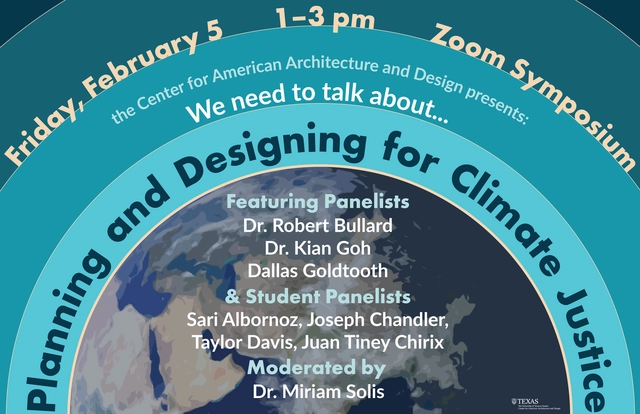
The cumulative effects of agriculture, industrialization, and urbanization are unequivocally changing our climate and producing globally unprecedented challenges related to food production, building materials, and human and ecosystem health, and exacerbating conditions that promote the spread of pandemic diseases, and these challenges are disproportionately affecting low-income communities and communities of color. This is not new. Our built environments create impacts on all of the above forces, and play a critical role in the creation of, and potential dismantling of, inequitable conditions of living and human and ecosystem health. How do we as designers of buildings and cities contribute to climate change and its deeply-rooted, systemic impacts, and what can we do now to turn our impact positive? How do we recognize, through our planning and building processes, the links between human health in our communities, particularly in communities of color, and the health of the planet and its ecosystems? How do we designing for climate justice, carbon neutrality, and equitable impact of positive change? And how do we reform our pedagogical approaches in our academies to ensure equitable climate considerations “go without saying”?
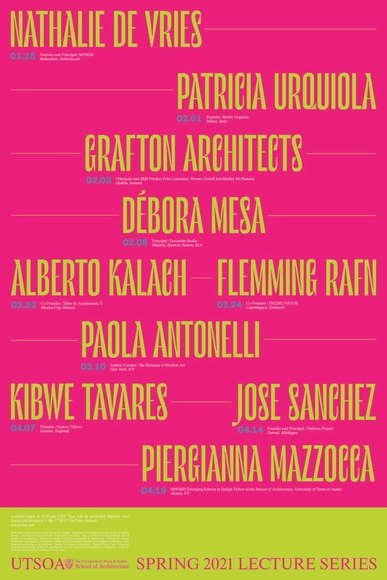
The University of Texas at Austin School of Architecture is pleased to announce its Spring 2021 Lecture Series. With speakers hailing from across the globe, this semester’s lineup represents an exciting range of contemporary voices and international perspectives. Featuring a new, dynamic slate of speakers each semester, the School of Architecture’s lecture series plays an integral role in fulfilling the school’s commitment to fostering lively intellectual curiosity and the open exchange of ideas.
Starting Monday, January 25 and continuing throughout the semester, lecturers representing a broad cross-section of cultural practices—including Pritzker Prize Laureates, video game designers, filmmakers, and beyond—will present talks that push the traditional boundaries of the design disciplines, address some of society’s most pressing challenges, and help us reimagine the relationship between ourselves design and the world around us.
INTRODUCTION History of Architecture is a 2021 Presentation and Writing Competition, organized by Archiol. Architecture evolved over the centuries, with the rise and fall of civilizations. Architecture is the essence of the history of Human Civilization. The competition, History of Architecture is looking for a presentation board and essay submissions on any of the periods from the history of architecture.
We want students to explore what architecture truly means and what it can achieve without any constraints. This competition encourages students to create unconventional and exceptional designs. The aim is to let your imagination run wild and design a breathtaking Visitors Center.
100-hour individual design contest • Issue #01 Jan 2021
We are excited to announce our first-ever 100-hour individual architecture drawing contest! In this architecture competition, individual contestants will be given the detailed brief 100 hours prior to the submission deadline. We are challenging you as an individual to come up with a design concept and pitch it to us within 100 hours! All you have to submit at the end is one JPG panel & 150 words of the design description.