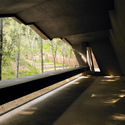
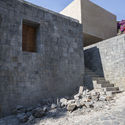
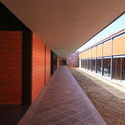
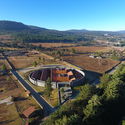
Seoul-based architect Moon Hoon describes his style and attitude towards design as “putting architecture to the edge of art” and having as much fun as possible in the process.
Hoon’s drawing history began 40 years ago, and is a habit he still maintains in the form of diaries or, as he likes to call them, "magic books." All of his interests come together in these books from which ideas emerge and transform into architecture—futuristic fantasies in diary format, with drawings which eventually get constructed in real life.
Keep reading to see some of these drawings and their real-life, built counterparts!
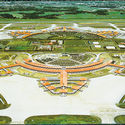
For 40 years, Paul Andreu was among the world's foremost airport design experts. Reflecting on this before the turn of the millennium, he stated that architectural historians of the future might consider the 1990s as “the age of the air terminal.” But shortly after this, he left the arena of airport design to focus on other large projects, many of them in China. In this interview, the latest of Vladimir Belogolovsky's “City of Ideas” series, Andreu explains why he made the switch and shares his thoughts on how good architecture is made—saying it often depends more on what you don't tell your client than what you do.
Paul Andreu: Before we start, I must explain something. I am an architect and engineer. For a long time I was not an independent architect but worked at and then was the head of airport works at Aéroports de Paris Ingénierie or ADPi, a subsidiary of Aéroports de Paris (ADP). This public establishment is not only in charge of the planning, design, and operation of three Paris-region airports, but is also involved in airport works all around the world, as well as other large-scale architectural projects. First, we did airports in France, then in the Middle East and Africa, then in China and all over Asia, and then we developed projects in other parts of the world. Most of the time we developed our projects from concept all the way through construction; although once we did just the concept for Kansai airport on a specially built island in the Bay of Osaka. As you know, it was designed by Renzo Piano and I consulted for him on function and circulation aspects.
Photographer Laurian Ghinitoiuhas visited Herzog & de Meuron's Elbphilharmonie Hamburg, Germany – a 2017 winner of the ArchDaily Building of the Year award. The striking silhouette of this cultural centre and concert hall, which is identical in ground plan to the brick block of the older building upon which it sits, is often photographed as an isolated object. In this photo-essay, the context of the port around the project is often foregrounded – and unusual views offer new perspectives onto its iconic design.
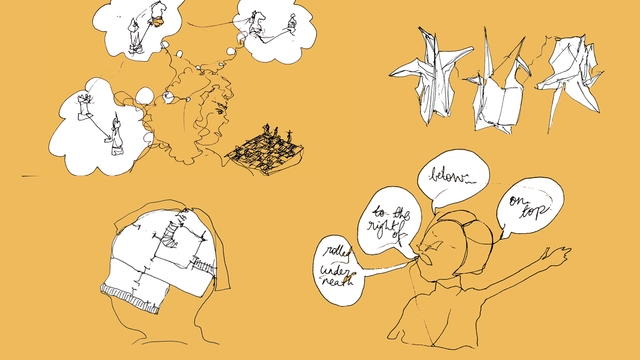
Architects design and organize spaces; without space, there is no architecture. So it goes without saying, therefore, that spatial intelligence is of high importance to architects. Luckily for us, spatial intelligence is not something you’re inherently gifted at or just “born with,” it’s something that can be trained and improved through practice. More practice means more advancement, so why not make it enjoyable and easy—easy enough even to do in your everyday life? From drawing to speaking to engaging in play, here are 9 everyday activities to improve your spatial intelligence.
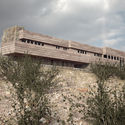
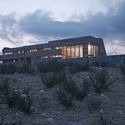
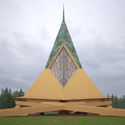
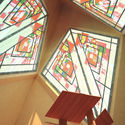
With the help of a vast array of software, Spanish architect David Romero has digitally recreated a series of iconic works by Frank Lloyd Wright, two of which have been demolished and a third that was never built. The three projects were based in the United States: the Larkin Administration Building (1903-1950), the Rose Pauson House (1939-1943) and the Trinity Chapel (1958).
"The 3D visualization tools that we have are rarely used to investigate the past architecture and the truth is that there is a huge field to explore,” said Romero in an interview with ArchDaily about his project Hooked on the Past. Romero worked with AutoCAD, 3ds Max, Vray, and Photoshop while restoring black and white photographs, sketches and drawings of these works.
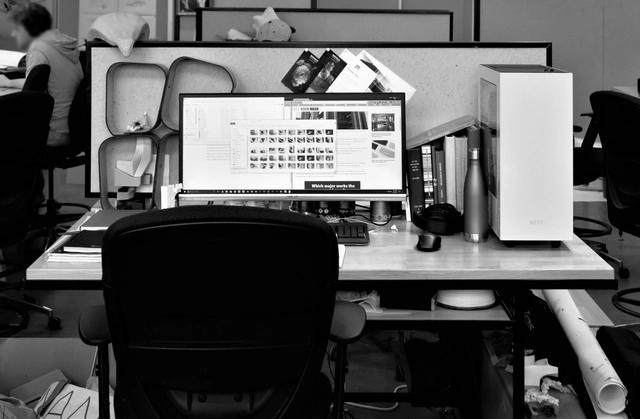
After reading through ArchDaily’s article on the hours architecture students work outside of class, I was curious. I made it through a Bachelor of Science in Architecture degree and I’m currently enrolled in the Master of Architecture program at the University of Pennsylvania, so how does the time I spend on coursework stack up to the average of 22.2 hours per week? Granted, the data they presented only represented first-year students, but it could still be an interesting comparison. With that in mind I set out to log one week of my time, just like you would at a job. Here’s what I found.
https://www.archdaily.com/806550/85-studio-hours-a-week-in-the-life-of-a-master-of-architecture-studentKurt Nelson
The 2017 Pritzker Prize was a surprise to many, awarded to the three founders of RCR Arquitectes, a modest Spanish firm located in the small town of Olot in Catalonia. Many people and critics shared their astonishment at the prize being awarded to three individuals for the first time since the Pritzker Prize began in 1979, including the third female winner, and at the relatively low profile of RCR Arquitectes before March 1st.
Whether this surprise was pleasant or shocking differs from critic to critic, but there nevertheless seems to be a consensus on the jury’s decision to venture further into politics and away from their traditional interest in celebrity architects. As clearly stated in the jury’s citation: “In this day and age, there is an important question that people all over the world are asking, and it is not just about architecture; it is about law, politics, and government as well.” Are they steering the prize in the right, or wrong, direction?
Works by Gabriela Carrillo (left) and Rozana Montiel (right)
The Architectural Review and The Architects’ Journal have announced two Mexican architects as winners of their 2017 “Women in Architecture” Awards. This year’s Architect of the Year is awarded to Gabriela Carrillo of Taller Mauricio Rocha + Gabriela Carrillo, while Rozana Montiel Estudio de Arquitectura’s Rozana Montiel was named the winner of the Moira Gemmill Prize for Emerging Architecture. Both women were selecting for demonstrating “excellence in design and a commitment to working both sustainably and democratically with local communities.”
In designing his (unbuilt) house for the Arts & ArchitectureCase Study program, Whitney Smith, like Richard Neutra, prioritized the connection to outdoor space. His motivation, however, was more specific than a desire to extend the living area of a small house. Rather, he wanted to create a highly personal space, geared to the passion of his hypothetical client. Seeing conventional plans as a straitjacket for residents who craved appropriate working space within their home (be it a sewing studio or a photography darkroom), he aspired to fit this house to the needs of a keen horticulturist.
The 2015 Milan Expo required the input of more than 145 countries and 50 international organizations resulting in over 70 temporary pavilions; a combined effort totaling more than €13 billion. Norman Foster’s rippling pavilion for the United Arab Emirates ended up at €60 million. The massive slab of concrete, laid out over the previously green agricultural land to act as the Expo’s foundation cost a whopping €224 million. Even Vietnam’s “low cost” pavilion came in at $2.09 million.
Compare that with, for example, IKEA’s proposal for a temporary refugee shelter that can house 5, costing just $1000, and one can see the absurdity of spending gargantuan sums on buildings that will perhaps be sold to be used later as a clubhouse, or to a museum as another temporary cultural center. Where is the architectural action behind an architectural event that boasts “Energy for Life” or “Better City, Better Life” - the slogan of the Shanghai 2010 Expo - yet spends extraordinary amounts of resources on structures that provide little sustainable development to parts of the world that are actually in dire need of it?
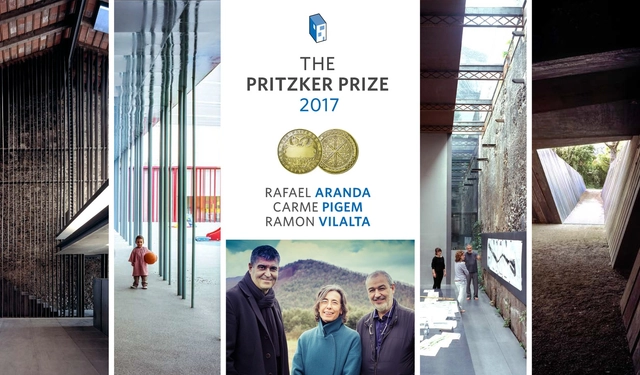
Rafael Aranda, Carme Pigem and Ramon Vilalta have been named as the laureates of the 2017 Pritzker Prize. Their projects emphasize materiality and craft – considered use of color, transparency (and thereby light) define an oeuvre which ranges from public buildings to houses, a kindergarten and a winery.
The three architects—all of whom are Spanish Catalan and originate from Olot, Girona (where they are all presently based)—have worked collaboratively together as RCR Arquitectes since 1988; they simultaneously graduated in Architecture from ETSAV, the School of Architecture in Valles (Escola Tècnica Superior d’Arquitectura del Vallès) a year prior. This 39th incarnation of the Prize represents the first instance in which three architects have been recognized at once, and only the second time—following Rafael Moneo in 1996—that Spanish practitioners have been honored.
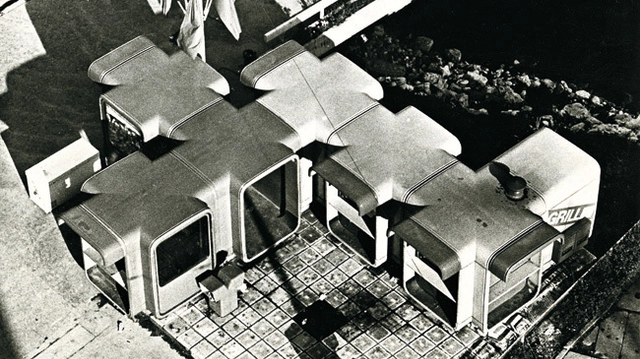
Slovenian designer Saša J. Mächtig conceived the concept for the Kiosk K67 project half a century ago, but its ideas of indeterminacy and open-endedness remain relevant. Image Courtesy of Museum of Architecture & Design, Ljubljana
Even in relative old age, the Kiosk K67—a shape-shifting system of modular fiberglass structures—keeps active. A kiosk in Kromberk, Slovenia, in the former Yugoslavia has become a beehive. Another, used by a Bosnia and Herzegovina food vendor, has received a masonry addition. In Ljubljana, a kiosk that formerly sheltered parking lot attendants now supports an automated ticket machine.
These may not have been adaptations the Slovenian designer Saša J. Mächtig had in mind when he first conceived the K67 50 years ago. But accounting for all of them would have been impossible. In theory, the system permitted unlimited configurations and variations. By the time production stopped in 1999, around 7,500 units of the K67 had been manufactured. While most remained in Yugoslavia, some were exported abroad—among other places, to Poland, Japan, New Zealand, Kenya, Iraq, the former Soviet Union, and the United States. Around the world, they were adapted to uses ranging from border patrol stations and ski lift ticket booths to retail and fast-food stands. No one is really sure how many are still in use today, or what other kinds of folksy, improvised alterations have been made to them, but among the greatest pleasures of the kiosks is their endless capacity to surprise. The K67, a recent retrospective of Mächtig’s work at the Museum of Architecture and Design in Ljubljana managed to restore its original brilliance. And it did so without suppressing the deviations. As the show’s curator Maja Vardjan writes in her catalogue essay, what distinguishes the K67 is “its position between architecture and industrial design, embeddedness in the framework of a modern city and society, the rituals of daily life, and, last but not least, its persistent capacity to reinvent itself.” While the visionary architectural schemes of the 1960s and 1970s may inspire wistful longing (What could have been!), the K67 kiosks, even as they disappear from view, provoke a question: Why have they persisted for so long?
On Thursday, December 22nd, an email arrived in the inboxes of ArchDaily’s editors that made us sit up, shake off our holiday-induced lethargy, and take notice. MASS Design Group’s Year in Review email might initially have blended in with the many other holiday wishes and 2016 recaps we receive at that time of year—it recapped such highlights as Michael Murphy’s TED Talk in February or the launch of the first African Design Center—but it had one thing that we hadn’t seen from other firm’s years-in-review: detailed statistics about the firm’s achievements that year.
In recent decades, certain aspects of architecture have become increasingly open to scientific analysis, most notably when it comes to a building’s environmental impact. It’s no surprise, therefore, to see MASS Design Group’s claims that their work uses 74% less embodied carbon than typical building projects, or that 78% of their materials are sourced within 100 kilometers, but alongside these were some more unusual metrics: since it was founded, the firm has invested 88% of construction costs regionally, created 15,765 jobs, and in 2016 alone, their work served a total of 64,580 users. These numbers suggest a way of thinking about architecture that few have attempted before—a way that, if widely adopted, could fundamentally change the way architecture is practiced and evaluated. We spoke to MASS co-founder Alan Ricks to find out how these statistics are calculated, and what purpose they serve.
The "architectural pilgrimage" is much more than just everyday tourism. Studying and admiring a building through text and images often creates a hunger in architects, thanks to the space between the limitations of 2D representation and the true experience of the building. Seeing a building in person that one has long loved from a distance can become something of a spiritual experience, and architects often plan vacations around favorite or important spaces. But too often, architects become transfixed by a need to visit the same dozen European cities that have come to make up the traveling architect's bucket list.
The list here shares some sites that may not have made your list just yet. Although somewhat less well known than the canonical cities, the architecture of these six cities is sure to hold its ground against the world's best. The locations here make ideal long weekend trips (depending of course on where you are traveling from), although it never hurts to have more than a few days to really become immersed in a city. We have selected a few must-see buildings from each location, but each has even more to offer than what you see here—so don't be afraid to explore!
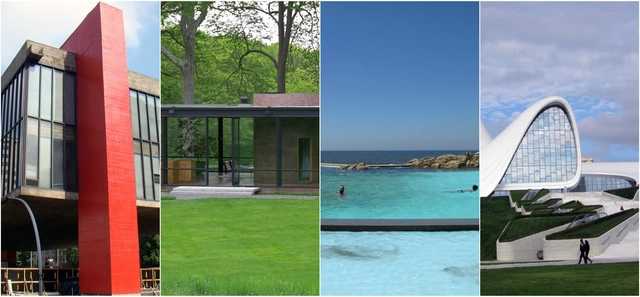
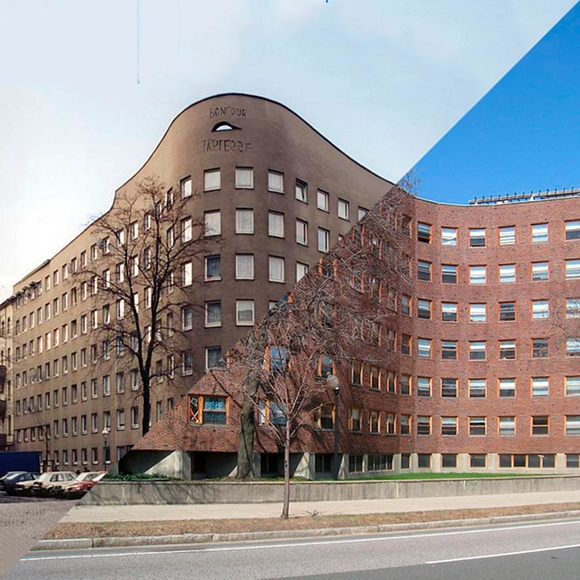
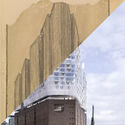
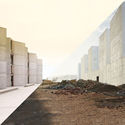
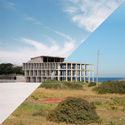
Confórmi(also on Instagram) is a project which began two years ago as a way to manage its curator's visual references. Bologna-based Davide Trabucco, the curator in question, describes the archive as "a personal work-instrument" that positions apparently dichotic elements into a visual relationship with each other. All of these images, Trabucco believes, "are already present in our collective imagery and in visual culture." Their visual impact is clear: formally and aesthetically, each visual pairing "is immediately understandable – even to the uninitiated."
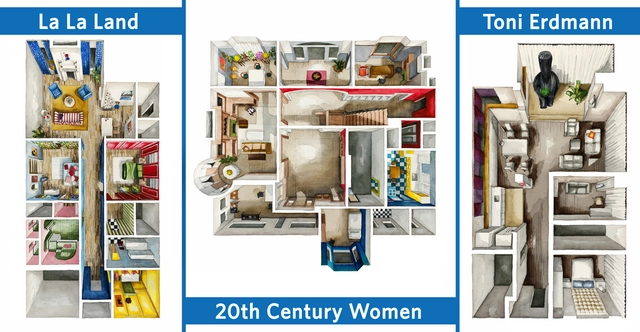
You’ve seen the floor plans from Hit TV Shows brought to you by Iñaki Aliste Lizarralde, Homes.com, and Drawbotics. Now, with the Academy Awards just around the corner, we're bringing you a series of floor plans from Oscar-nominated films, all painted in watercolor by Boryana Ilieva (who previously brought us the floor plans of Stranger Things). With movies such as La La Land, Fences, Elle, 20th Century Women and Toni Erdmann depicted in meticulous details, Ilieva’s watercolors not only provide us with a new perspective of the familiar spaces, but also highlight the important architectural features that help construct these captivating storylines.
The best thing about Revit templates is how much time they can save you. The worst thing about Revit templates is how much time they take to create.
It’s a bit of a catch-22. In order to save time, you need to spend time. It’s not easy to find that time when you have billable projects to work on and deadlines to meet. Believe me, I know.
And once you do finish the template, how often do you review it and keep it updated? What if you have a project that’s a new building-type? Does your template still work for that kind of building? What if you need to follow an owner’s BIM standard? Can you modify your template to fit their requirements?
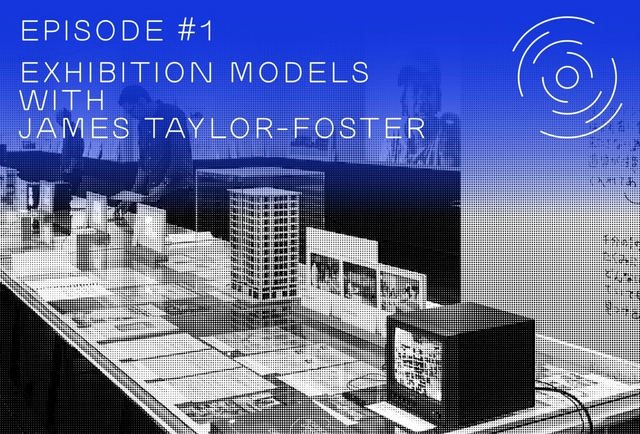
GSAPP Conversationsis a podcast series designed to offer a window onto the expanding field of contemporary architectural practice. Each episode pivots around discussions on current projects, research, and obsessions of a diverse group of invited guests at Columbia, from both emerging and well-established practices. Usually hosted by the Dean of the GSAPP, Amale Andraos, the conversations also feature the school's influential faculty and alumni and give students the opportunity to engage architects on issues of concern to the next generation.





.jpg?1488828506 "Charles-de-Gaulle airport, Terminal II, modules A & B, Paris, 1972-1982. Image © Labo ADP")

.jpg?1488821716&format=webp&width=640&height=580)
.jpg?1488821999 "© Laurian Ghinitoiu")
.jpg?1488822128 "© Laurian Ghinitoiu")
.jpg?1488821802 "© Laurian Ghinitoiu")
.jpg?1488821732 "© Laurian Ghinitoiu")
.jpg?1488821716)




.jpg?1488583403 "Courtesy of Pritzker Prize. Image © Hisao Suzuki")