Videos
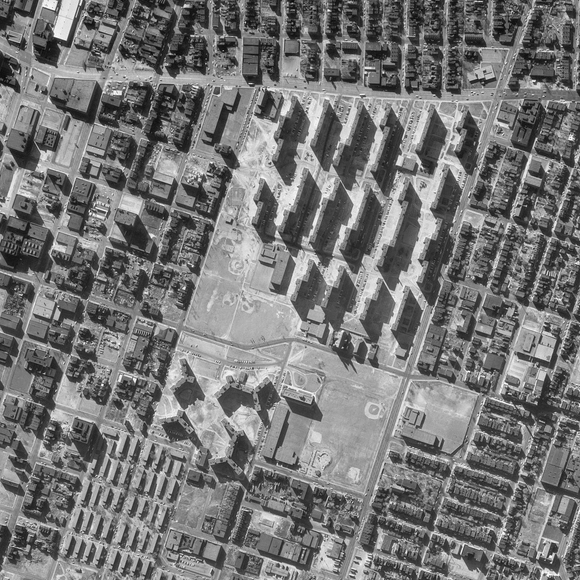
An aerial photo by the US Geological Survey compares the narrow, monolithic blocks of Pruitt-Igoe with the neighboring pre-Modernist buildings of St. Louis. ImageCourtesy of Wikimedia user Junkyardsparkle (Public Domain)
Few buildings in history can claim as infamous a legacy as that of the Pruitt-Igoe Housing Project of St. Louis, Missouri. Built during the height of Modernism this nominally innovative collection of residential towers was meant to stand as a triumph of rational architectural design over the ills of poverty and urban blight; instead, two decades of turmoil preceded the final, unceremonious destruction of the entire complex in 1973. The fall of Pruitt-Igoe ultimately came to signify not only the failure of one public housing project, but arguably the death knell of the entire Modernist era of design.
A post shared by Office Of Adrian Phiffer (@officeofadrianphiffer) on
Instagram is an app. Instagram shows images. Instagram is a verb. Instagram it! Instagram has 600 million users. Numbers are very important. These days, they are an exact expression of what one is, or isn’t; by the way, how many followers do you have? Instagram is the great equalizer.
I don’t think Instagram is about news. Instagram is about influence. It is that very moment when the old order is changed; the moment when the recent graduate changes the established practice. Instagram is space. Have you seen @archiveofaffinities? It is better than any school library. It is the space to spend your most important time. It is a spa.
Love architectural video games like Minecraft or SimCity? Then it's worth checking out this ecological city simulator, Block'hood, which allows players to build their own arcology-style structures for humans and other species to coexist, all while managing a range of environmental and engineering conditions.
Following our review of the beta version of the game last March, the final edition has now launched on gaming platform Steam. New features include a 5-episode guided story mode, an increased maximum building size, an unlockable "unconstrained" mode, and compatibility in 8 different languages: English, Spanish, French, German, Japanese, Chinese, Portuguese and Russian.
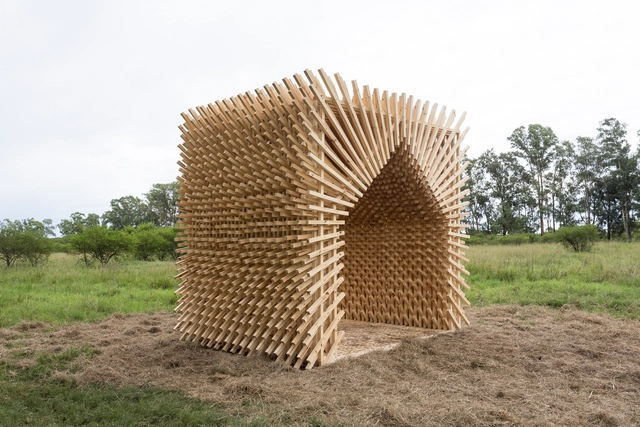
For the past seven years, Hungary-based Hello Wood has been gathering participants from across the globe for its summer camps to engage in a week-long curriculum about creating spaces, networks, and knowledge. However, this year the event has expanded its borders even further; organized with partners MANDARINA and TACADI, Hello Wood Argentina was the first local Hello Wood summer camp, drawing a group of 150 students, architects, and designers. Hello Wood focuses on socially-engaged concepts and turning architectural theory into practice with collaborative week-long design-build projects. As a complement to traditional university education, students get the chance to work and learn alongside famous international architects to bring their concepts to life.
The theme of Hello WoodArgentina’s first summer camp was "Con-Tacto" (Contact), located in Ceibas, Entre Ríos. Curator Jaime Grinberg selected applicants with strong concepts to generate spaces that encouraged connection, whether traditional, functional, utopian, or idealized. Concepts also needed to be simple, natural, and feasible for a team of students to produce in a week. Hello Wood’s educational platform focuses on achieving social benefits and improving the quality of life through architecture and design. See below for photos of the projects built at Hello Wood Argentina.
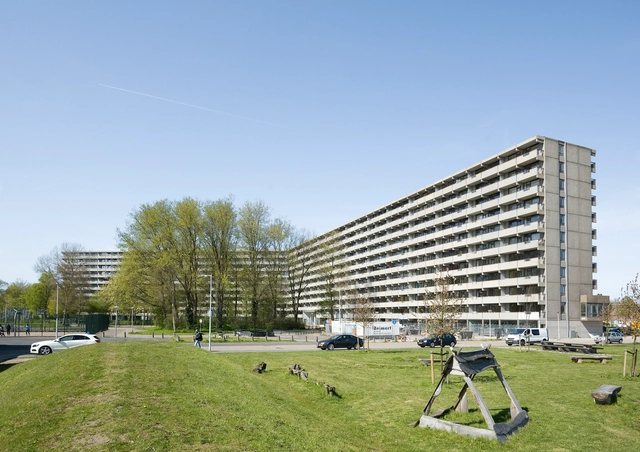
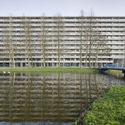
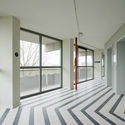
One of the largest residential buildings in the Netherlands, the complex was saved from the wrecking ball through its transformation into a rejuvenated framework called a “Klusflat," within which inhabitants could renovate their apartments by themselves. This is the first time the award has been given to a renovation of an existing building.
More than likely you've heard the term SEO, but, for the uninitiated, SEO literally means Search Engine Optimization— technical jargon for a set of methods used to boost your website's rank in Google's search results.
Now, why should you care? Well, according to this article put out by the SEO gurus at MOZ, the top 3 positions in Google's search results account for a whopping 55% of organic clicks, with the number one spot alone netting over 30%.
Think about that, over one third of visitors click on the first result they see. Naturally, everyone wants to be number one, so we've outlined below 5 steps you can take to help boost your website's ranking.
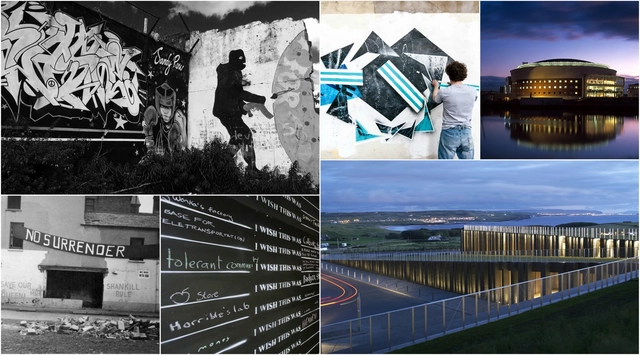
Architecture is often intertwined with political context. This deep connection is especially evident in Northern Ireland, a place of infamously complex politics. The state came into existence as a consequence of war in 1921, when Ireland was partitioned into an independent Irish Free State (now the Republic of Ireland) and Northern Ireland, an industrious region still controlled by Britain. Conflict has since ensued in Northern Ireland between a majority pro-British Unionist population, and a minority, though significant, Irish Nationalist community. The latter half of the twentieth century witnessed a brutal struggle, with over three thousand people killed, thousands more injured, and harrowing images spread across the world.
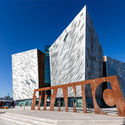
The turbulence of Northern Ireland’s conflict is played out in the architectural development of Belfast, its capital city. With thirty years of war from the 1960s to 1990s, the architecture of Belfast embodied a city under siege. When the prospect of peace dawned in the 1990s, an architecture of hope, confidence, and defiance emerged. In the present day, with Northern Ireland firmly on a peaceful path, Belfast has played host to a series of bold architectural ideas and landmark public buildings by award-winning architects. With the rich, bitter, emotive history of Northern Ireland viewed through multiple, often conflicting prisms, the architectural development of Belfast offers a tangible narrative of a city which burned, smoldered, and rose from the ashes.
The Bailey house—one of Richard Neutra’s four Case Study designs for Arts & Architecture—forms one of five Bluff houses, standing high above the ocean. The brief was to create a low-budget home for a young family, with just two bedrooms, but offering the possibility of expansion as time went by (which did in fact transpire; additional Neutra-designed wings were later built).
Neutra employed the same indoor-outdoor philosophy that can be seen at work in his unbuilt Alpha and Omega houses, using large sliding glass doors to create light and a visual sense of space, as well as ensuring that the house physically opened up to, as he put it, “borrow space from the outdoors.” With this sunny Californian ocean-view setting, it made perfect sense to use the back garden and terrace as living and dining room.
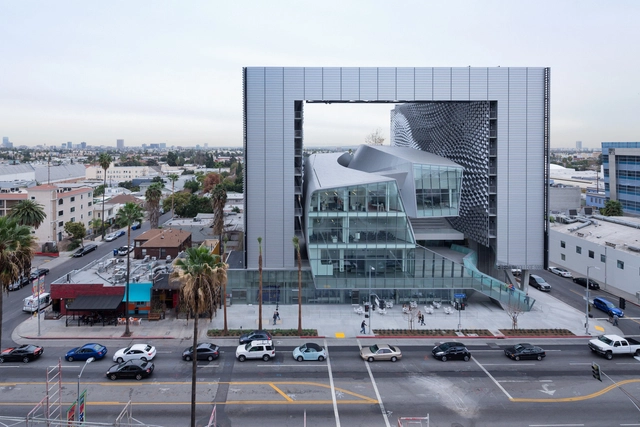
For many observers, Thom Mayne might easily be considered the most unpredictable personality in architecture. Once labeled the “bad boy of architecture” by critics—a moniker which he has, at times, enthusiastically adopted and even encouraged—Mayne's actions in the architecture world can range from something as responsible as designing one of the United States' most sustainable university campuses to something as outrageous as proposing one of the world's tallest towers in a revered Austrian mountain town. In this interview, the latest from Vladimir Belogolovsky's “City of Ideas” series, Mayne discusses his ideas, his past statements on architecture, and where he thinks the profession will go next. The interview was originally published by the Berlin-based SPEECH Magazine.
What did Pritzker Prize winner Frank Gehry get when he designed the Stata Center, an exuberantly whimsical academic complex for MIT? A very large check, plus a major lawsuit, alleging negligence and breach of contract due to rampant leaks, mold, cracks, drainage problems and sliding ice. Sometimes the most inspired designs can go awry. And when they do, some clients lawyer up. Here are 9 fascinating examples.
In #donotsettle’s latest escapade, architect Kris Provoost scrutinizes Perkins+Will’s Shanghai Natural History Museum. The boyishly charming and ever-inquisitive vlogger presents a unique POV tour of the unusual building situated in the middle of the Jing'an Sculpture Park.
Over a soundtrack of slick house music, Provoost offers up tidbits that cannot be gleaned from a photo. As he approaches the structure, he points out topographical aspects, the relationship of the structure to its context, and various construction details. The rapid-fire architectural observations are often punctuated by brief cross-sectional sketches that augment the experiential commentary.
Louis Kahn’s Kimbell Art Museum is a masterclass in natural lighting, with thin-shelled concrete vaults that feature subtle openings to reflect light into the galleries below. While Kahn’s wing of the Fort Worth Museum opened in 1972, in 2013 a second Renzo Piano-designed pavilion was added to the complex. Piano was selected to design the addition because he had worked for Kahn as a budding architect, and the homage to his former mentor is evident in the building’s similar layout and use of translucent glass panels. In this video, architect-photographer Songkai Liu takes viewers on a serene stroll through the museum’s campus. Time-lapses and pans of Kahn’s concrete are juxtaposed with the clean details of Piano’s glass in a soothing exploration of the two complementary projects.
In most architecture projects, the input of the end user of the space is an important consideration; but what if those users are no longer living? Memorial architecture for the dead is a uniquely emotional type of design and often reveals much about a certain culture or group of people. Especially in the case of ancient tombs, archaeologists can learn about past societies’ customs and beliefs by examining their burial spaces. The personal nature of funerary spaces and monuments conveys a sense of importance and gravity to viewers and visitors, even centuries after the memorials were created.
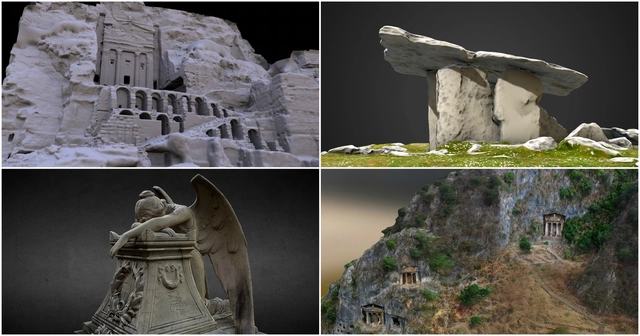
The list of 3D models that follow, supplied by our friends at Sketchfab, explores memorial spaces and artifacts that span both space and time, representing a variety of cultures and civilizations.
The interplay of tantalizing eroticism continues within Christian Grey’s luxury tower in the recently-released film sequel, Fifty Shades Darker. In the first film, Grey’s plush apartment played an integral role in undressing the personas of Anastasia Steele, who liberates herself from her chaste existence, and Christian, who exposes the seething and fiery carnal desires and fetishism behind his glorified masculine beauty, charm, and appearance.
Grey's penthouse, which resonates with his unyielding and intimidating Heathcliff undertones in the first part of the trilogy, turns over a new leaf in the sequel. There is ambient warmth in the penthouse; nevertheless, the high level of sophistication prevails in his penchant for singular tastes and fastidiously-selected objects and it remains unapologetically lush.
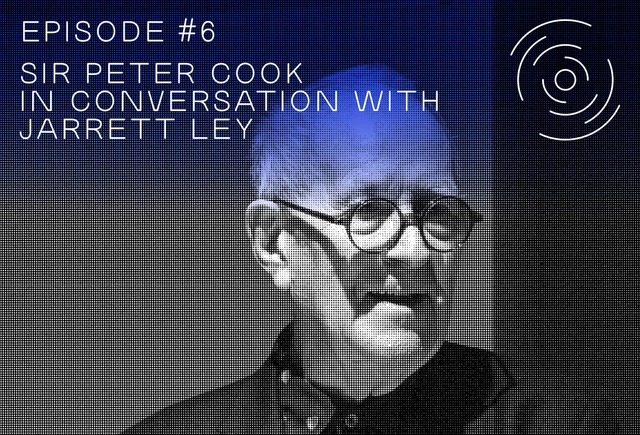
In the sixth episode of GSAPP Conversations, Jarrett Ley (a current GSAPP student) speaks with Sir Peter Cook. They discuss architecture as a tool for shaping radical thought, the relationship of the current political climate in Britain, Europe, and the United States on architectural education and practice, and how the most interesting contemporary architectural projects appear to stem from "unknown architects in smaller countries."
https://www.archdaily.com/870552/peter-cook-concerned-by-contemporary-drawing-culture-gsapp-conversationsAD Editorial Team
As the American Dream dies, we must rethink our suburbs, homes, and communities. Seen here: ,L’Abri de la Bourgeoisie, after L’Abri du Pauvre, Claude-Nicolas Ledoux, 1804, from Atlas of Another America, Park Books, 2016. Image Courtesy of Keith Krumwiede
Americans define themselves through work; it builds character, or so we believe. The American Dream is premised on individual achievement, with the promise that our labor will be rewarded and measured by the things we collect and consume. For many, the sine qua non of the dream, our greatest collectible, is the single-family house. Of all our products, it is the one we most rely upon to represent our aspirations and achievements.






.jpg?1494620356 "Courtesy of Block'hood")
.jpg?1494620342 "Courtesy of Block'hood")
.jpg?1494620366 "Courtesy of Block'hood")








.jpg?1494330446 "The Cooper Union for the Advancement of Science and Art, 2006. Image © Iwan Baan")





.jpg?1494051634)