
Poland-based Jednacz Architekci shared with us their proposal for the Museum of Polish History competition, for which they received 2nd Prize.
More images and architect’s description after the break.


Poland-based Jednacz Architekci shared with us their proposal for the Museum of Polish History competition, for which they received 2nd Prize.
More images and architect’s description after the break.

2G is a bilingual (english/spanish) magazine published by Spanish editorial Gustavo Gili, a series of monographs that has featured architects such as Sou Fujimoto, Williams Tsien, Lacaton & Vassal, OFIS, Tony Fretton, and classics such as Mies van der Rohe (Issue 48/49
Issue 51 features the spanish practice Morales Giles Mariscal, which I already knew about because of 2 housing projects in Ceuta, Spain, with an interesting mix of unit configurations.
On this monograph you can see several completed and ongoing projects by the firm, for different uses: housing, educational, civic, cultural, etc. The different approaches used for each project are a reflect of a constant exploration by the firm, being “clean lines” the only common feature across them.

We start this week’s Round Up with Part III of Health Architecture. Check the first part and second part in case you missed them. The other four, after the break!
T-Clinic / Suppose Design Office With this project we wanted to see what we could do amidst the functional constraints of a clinic. Instead of keeping places normally used for movement such as an elevator shaft or stair wells closed, we wanted to open them up to collect light, using them as lightwells to maintain the lighting coming- in from above (read more…)

ACADIA 2010 will focus on the changing nature of information and its impact on architectural education, research, and practice. The conference will gather leading practitioners, theorists, and researchers who will examine the relation that architecture has with technology and information, and how the latter propels today’s most innovative design experimentation and research. ACADIA 2010 will be centered on a series of peer-reviewed paper sessions and a groundbreaking exhibition including peer-reviewed projects.

As the key words “Sustainability, Innovation and Communication” cornerstones, the Swedish Pavilion, designed by SWECO, showcases how the nation’s spirit of innovation solves problems, improves the urban environment and living standards, and demonstrates the importance of communication under the new technology situation.
The pavilion comprises four cube-like structures that are arranged to form a cross-like space between them — a shape much like Sweden’s flag when seen from above.The outside walls show a city-like grid; the inside walls are covered with images of nature. These cubes are connected by elevated walkways, and house the exhibition,VIP areas, a shop, a café, and a large covered courtyard — room enough for everyone.
More images and description after the break.

Designed by Aedas Sport, the innovative 75,000-seat stadium will be the first LEED-certified building in the NFL and will capture the luxury and drama of the world’s entertainment capital. The project anticipates completion for the 2013 season. Both the NFL and the client, Majestic Realty, are committed to making a progressive statement with this building and are exploring a number of initiatives that will make this the most environmentally progressive stadium in the U.S. Aedas Sport has employed the unique topography of the site to build the stadium into a hillside, reducing the steel structure by 40% and allowing at least two-thirds of the seating bowl to be built on grade.
More images and full architect’s description after the break.

The ‘Concrete Geometries’ Research Cluster at the Architectural Association School of Architecture in London is seeking submissions of work from the fields of art, architecture, sciences and humanities that explore the relationship between spatial form and social or aesthetic processes.

We continue with more proposals for the Museum of Polish History Competition, this time with the proposal by kOnyk architecture (more projects by the firm previously featured at AD). One of the key feature’s of their proposal is to construct a parking structure over the Trasa Lazienkowska Highway that will serve as a “land bridge” that will unify the park as well as be a platform for observation of the Wilsa River below.
More images and architect’s description after the break.
At ArchDaily we also have place for those projects or ideas that doesn’t seem to fit anywhere else. Ideas, toys or rankings, these are the posts we enjoy for their creativity and of course, sense of humour. Enjoy!

A reader sent us this quite unusual project. We don’t know where it is or who designed it, so if you know please do tell us. What do you think it is? My guess, something related with music…

When we received the book Interactive Architecture by Michael Fox and Miles Kemp (published by PA Press), I thought it would be just another compilation of interactive installations and responsive façades… but this book is goes beyond that. A wide selection of projects, ranging from small installations, to programable houses, to large scale intelligent buildings, goes in parallel with a series of writings from different fields (architecture, industrial design, computer programming, engineering, physical computing) which not only covers building or technical aspects of interactive, kinetic and dynamic spaces, but also its sociological, psychological and environmental implications.
Under this approach, the book is a good learning tool to those who are starting to learn and experiment with interactive systems, contextualized and understanding current trends and the integration of new technologies. Even if the actual projects or trends shown on the book render obsolete, the concepts, processes and workflows described here will not.
More after the break.
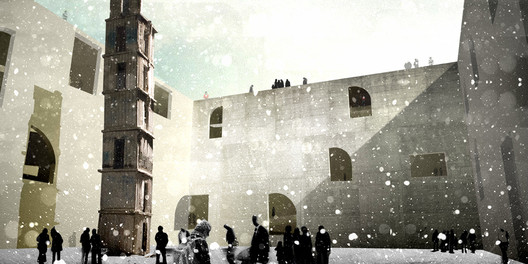
Colombian architects Paisajes Emergentes (one of our AD Futures) shared with us their proposal for the Museum of Polish History competition. The project consists in five historical galleries articulated by an open air courtyard.
More images and architect’s description after the break.
We all remember how spectacular was Alex Roman’s CG Shortfilm about Louis Kahn’s Phillips Exteter Academy Library. Now, you can see Roman’s latest animated video called “The Third & The Seventh”. The video was created with 3dsmax, Vray, After Effects, and Premiere. You can also enjoy the making of after the break.

Langdon Reis Architects with Kelly Doran and Louis Hall have won EUROPAN 10 with a scheme for Vardø, Norway. “Repositioning the Remote” by LRA offers to rethink Vardø’s harbour in order to inform the future of the Barents Sea. In the short term, a set of cultural buildings and spaces inserted into the harbour front serve to regenerate the civic life of the area and attract new users to the community.
With the next phase of Norwegian energy production set to exploit reserves proximate to Vardø, the harbour will act to service the industry while protecting the fragile ecology of the region.
Europan is a biennial competition for young architects that looks for innovative housing solutions in sites across Europe, incorporating social and economic variables specific to each territory. This year, there were 56 winners, so if your project was one of them and you wish to be featured in ArchDaily, please contact us through our contact form.
More images and architect’s description after the break.

ULHT (Universidade Lusófona de Humanidades e Tecnologias) organized an international workshop on the theme of waterfront design (European Workshop Waterfront Urban Design) EWWUD. The workshop is coordinated by Pedro Ressano Garcia. This event will take place between 14 and 28 March 2010 and has several international specialists in nine foreign universities.
Solutions for the relocation of port facilities and the consequent waterfront regeneration of old ports are dependet upon the capacity of both port and city to sucessfully develop the necessary means of negotiation, to work towards mutual improvements. while Port Representatives privilege the efficiency of maritime activity, City leaders pursue improvements to their citizens quality of life.
Exchange of good pratices between port cities is required with two goals: to support the port’s needed to expand and relocate, and to produce urban waterfront REGENERATION that integrates rather than segregates neighborhoods and their citizens. The Workshop’s objectives and list of universities involved, after the break.

Schmidt hammer lassen architects have won a competition for a Congress and Hotel Centre on the central harbour front of Helsingborg in Sweden, which is a 15-minute ferry trip from Elsinore in Denmark. The property development competition was won in conjunction with Swedish developer Midroc and engineering/architect consultants Sweco.
Architect’s description and more images after the break.
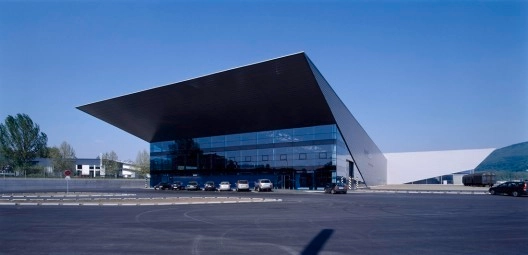
From Italy, Chile, Austria, Taiwan and Argentina. Here’s our second Round Up from our previously featured industrial architecture. Check our first part here!

Stockholm Bypass (Förbifart Stockholm) is the new highway linking the southern and the northern parts of Stockholm, planned to be open in 2020. The major part of the project – 17 of the 21 kilometres – consists of tunnels. The length of the tunnels requires extra care in designing a safe and attractive environment.
Early conceptual sketches are now interpreted by researchers in behavioural science and traffic safety in cooperation with Rotstein Arkitekter, the architects in charge of the tunnel design. Daylight illumination in the tunnels, optical guidance based on curvature and designed underground domes (working as lungs with fresh air and natural light) are creating continuous flows and unique landmarks.
An early stage of the design concept is now featured in this autumn’s main exhibition at the Swedish Museum of Architecture, spotlighting infrastructure – road and rail traffic – and its connection with urban planning.
More images after the break.