
The International Urban Project Award (IUPA) is presented by Bauwelt (Berlin, Germany) and World Architecture Magazine (WA, Tsinghua University, Beijing, China), with the support of BAU China and Messe München.
The International Urban Project Award (IUPA) is presented by Bauwelt (Berlin, Germany) and World Architecture Magazine (WA, Tsinghua University, Beijing, China), with the support of BAU China and Messe München.

Architects, designers, and multidisciplinary teams across Europe: this is your opportunity to help shape the future of sustainable construction.
At revalu, we are launching an open call for innovative projects that prioritize lower-carbon architecture through the use of local, bio-based, and environmentally responsible materials.

The Romanian Order of Architects (OAR) and the Contracting Authority – the University of Bucharest, are glad to announce the official launch of "The Garden of University House, Bucharest" International Design Competition.

Living With : Dialogues Across Time

Join Scandinavia's leading event on digitalization of the building industry!

Experience the installation This is Not a Forest – a venue-specific installation created by the design practice Archival in collaboration with DAC and Dinesen Lab. Through an architectural installation featuring sound, light and scent, the exhibition follows the journey of wood from raw resource to architecture, and questions how we value natural resources today.

It concerns the construction of a permanent pavilion intended above all to foster a new form of cooperation between different disciplines (art & science), and to offer radically new, method-driven approaches to such collaboration. Conceived as a kind of laboratory and prototyping space, it is meant to be a place for new forms of experimentation.

Buildner has announced the results of its competition, the Concrete Pavilion. Part of Buildner's Material Studies series, the competition invited architects and designers to explore the architectural potential of concrete through the design of an experimental pavilion. Participants were challenged to reconsider the material beyond its conventional use, investigating its spatial, structural, and sensory possibilities.

The third GADU International Congress on Gender, Architecture, Design, and Urbanism will take place from November 4 to 6, in both virtual and in-person formats at the Faculty of Architecture, Design, and Urbanism of the University of Buenos Aires, Argentina.
The event is organized as part of the activities of the GADU program, based at the Institute of Human Spatiality at FADU UBA.

This talk explores how earth-based materials and participatory design practices can help create spaces that foster memory, connection and belonging.

La Pyramide: The Futuristic soul of Abidjan, Côte d'Ivoire.

The exhibition Wellbeing in the City, at the Casa de la Arquitectura and curated by Izaskun Chinchilla, is conceived as a critical device that reconsiders the foundations upon which urban wellbeing has historically been constructed. Rather than defining wellbeing as a set of indicators (life expectancy, obesity or diabetes rates) or the provision of services, the exhibition approaches it as a relational condition, dependent on the quality of interactions between bodies, communities, and environments. At the core of its conceptual framework lies the Quechua term Sumak Kawsay — Buen Vivir or Good Living — which integrates material, biological, social, and ecological dimensions within a single plane.

CAMPOSAZ 54:54 | Progetto Manifattura

In the face of an urgent and ongoing climate crisis, the future of the built environment increasingly depends on adaptive reuse. For today's emerging architects and designers, the work of continuously transforming existing buildings—a process known globally as umbau—may indeed become the crux of professional practice for many. So what will it take to produce the next generation of umbau innovators?
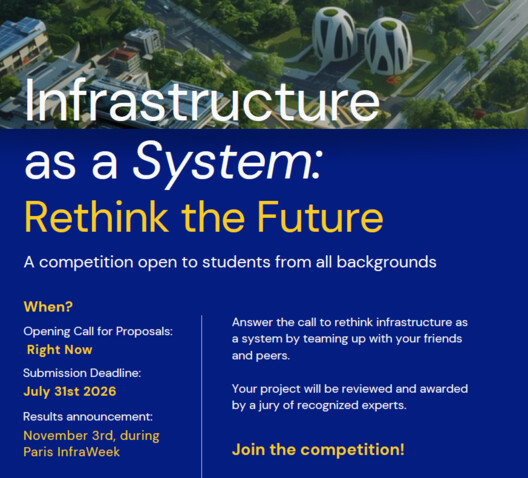
Following the success of last year's edition, InfraVision, the Think Tank founded by Vauban and Altermind, is pleased to announce the 2nd edition of its international student competition in 2026.

Qbiss Notch, a new design edition developed by Pininfarina for Trimo's Qbiss façade system, has received the Red Dot Design Award. Based on Trimo's Qbiss façade technology, the project introduces vertically installed modular Qbiss panels, an alphabet of engraved Glyphs, and Notches with integrated lighting. Together, these elements allow designers to create distinctive façade compositions. Despite its visual flexibility, the system is designed around the efficiency and precision of prefabricated construction.

Are you an interior furnishings professional? You are invited to the latest edition of The Design Room Madrid 2026. Register here!

CHURU is a collection of mobile architectural experiences, where each edition consists of an expedition, workshops, and a final publication that compiles the artistic works of the travelers who document the journey.