
This talk explores how earth-based materials and participatory design practices can help create spaces that foster memory, connection and belonging.
This talk explores how earth-based materials and participatory design practices can help create spaces that foster memory, connection and belonging.

La Pyramide: The Futuristic soul of Abidjan, Côte d'Ivoire.

The exhibition Wellbeing in the City, at the Casa de la Arquitectura and curated by Izaskun Chinchilla, is conceived as a critical device that reconsiders the foundations upon which urban wellbeing has historically been constructed. Rather than defining wellbeing as a set of indicators (life expectancy, obesity or diabetes rates) or the provision of services, the exhibition approaches it as a relational condition, dependent on the quality of interactions between bodies, communities, and environments. At the core of its conceptual framework lies the Quechua term Sumak Kawsay — Buen Vivir or Good Living — which integrates material, biological, social, and ecological dimensions within a single plane.

CAMPOSAZ 54:54 | Progetto Manifattura

In the face of an urgent and ongoing climate crisis, the future of the built environment increasingly depends on adaptive reuse. For today's emerging architects and designers, the work of continuously transforming existing buildings—a process known globally as umbau—may indeed become the crux of professional practice for many. So what will it take to produce the next generation of umbau innovators?
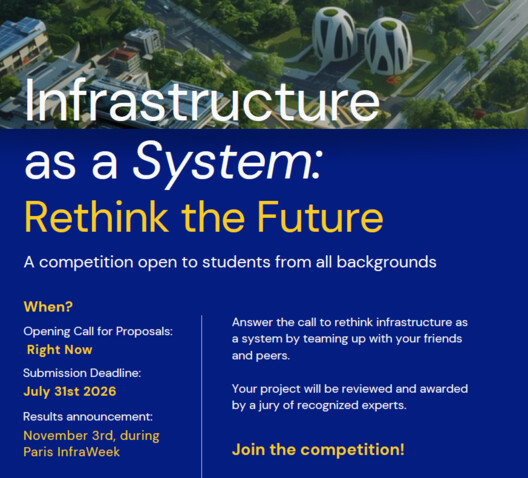
Following the success of last year's edition, InfraVision, the Think Tank founded by Vauban and Altermind, is pleased to announce the 2nd edition of its international student competition in 2026.

Qbiss Notch, a new design edition developed by Pininfarina for Trimo's Qbiss façade system, has received the Red Dot Design Award. Based on Trimo's Qbiss façade technology, the project introduces vertically installed modular Qbiss panels, an alphabet of engraved Glyphs, and Notches with integrated lighting. Together, these elements allow designers to create distinctive façade compositions. Despite its visual flexibility, the system is designed around the efficiency and precision of prefabricated construction.

Are you an interior furnishings professional? You are invited to the latest edition of The Design Room Madrid 2026. Register here!

CHURU is a collection of mobile architectural experiences, where each edition consists of an expedition, workshops, and a final publication that compiles the artistic works of the travelers who document the journey.

COSENTINO CITY CDMX CELEBRATES ITS SECOND ANNIVERSARY
We invite you to join us in commemorating two years of collaboration, inspiration, and memorable experiences in this space that has brought together the design and architecture community.
It would be an honor to have you with us for a special evening to toast to everything we have built together.
Please RSVP and join us in celebrating this significant milestone.

Karl van Es spent twenty years as a practicing architect before walking away to solve a problem every architect faces: the resources to travel like a professional simply do not exist. Mainstream guidebooks and travel apps rarely highlight the buildings that truly matter to the architectural community. Åvontuura was born from that frustration — an independent publisher of illustrated architecture guides created by an architect, for architects. Its latest release, Madrid, maps 70 of the city's most significant buildings, representing a mission to bridge the gap between architectural interest and travel logistics.

On May 30, Jean-Michel Othoniel will inaugurate his first institutional exhibition at the Instituto Bardi – Casa de Vidro. Titled "Poetic Living," the exhibition presents new works by the French artist, created specifically to occupy the house in dialogue with the architecture and body of work of Lina Bo Bardi.

Beyond AI_ded Design:
Looking Forward, Looking Backward
Thirty years after its founding, SIGraDi and the University of Chile invite the academic, professional, and creative community to participate in the 30th international congress of the Ibero-American Society of Digital Graphics, to be held in Santiago at the University of Chile from November 18 to 20, 2026.
This gathering marks a symbolic return to the University of Chile, which hosted SIGraDi 2006 two decades ago under the theme "The Human Factor." At that time, we invited participants to reflect critically on the role humans played in the emerging world of digital design. That critical look at the past—and the future—is more relevant than ever in the face of even more disruptive technologies.
In this spirit, we are proposing the concept of "AI_ded Design," a notion that updates the legacy of CAD (Computer-Aided Design) and projects it toward a new horizon where design, architecture, and urbanism are redefined by algorithmic structures, intelligent environments, and autonomous systems mediated by Artificial Intelligence.
We invite you to think beyond computer-aided design. We aim to open a space for discussion on a form of design where computation—increasingly transparent, ubiquitous, and autonomous—gives way to new forms of cognition, agency, emergence, distributed processes, and a necessary technological ethics that reconfigures design practices.
To stimulate this collective conversation, we propose four open questions:
What have we learned in these 30 years?
What have we improved in these 30 years?
What have we achieved in these 30 years?
What challenges are emerging in the relationship between humans, machines, and environments?

The exhibition "Charles & Ray Eames: The Unusual Beauty of Common Things" proposes an expanded reading of one of the 20th century's most influential practices, shifting the focus from the object to the system of relationships that produces it. More than just furniture designers, the Eameses emerge as builders of a visual culture that articulates materials, images, games, and knowledge within a single field of experimentation.

Peris + Toral

Though fleeting, Christo and Jeanne-Claude's projects left iconic afterimages in dozens of natural and urban landscapes, creating, as they themselves put it, "gentle disturbances."

Register today for the AIA Conference on Architecture & Design® 2026—the architecture and design event of the year! AIA26 is more than a conference—it’s where the people behind the $700 billion AEC industry come to understand what’s happening now and shape what’s next.

Heritage is often discussed in terms of preservation, yet its deeper value lies in how it shapes identity, belonging and meaning in the built environment.
Rooted and Relevant will explore the role of heritage in contemporary placemaking, asking how historic context can ground development while remaining resonant for modern audiences.
Is heritage too often absent from placemaking conversations? What is lost when identity is treated as a marketing exercise rather than something embedded in the cultural and physical fabric of a place?