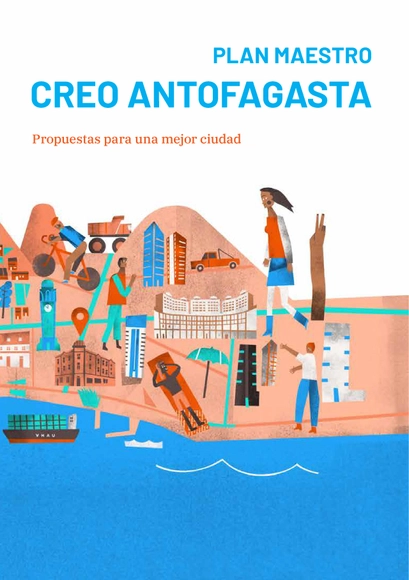
Over the past few years, through a process of citizen participation and dialogue between various public and private stakeholders, CREO Antofagasta has developed a Master Plan aimed at guiding the city's growth in alignment with the vision its residents hold for 2035.
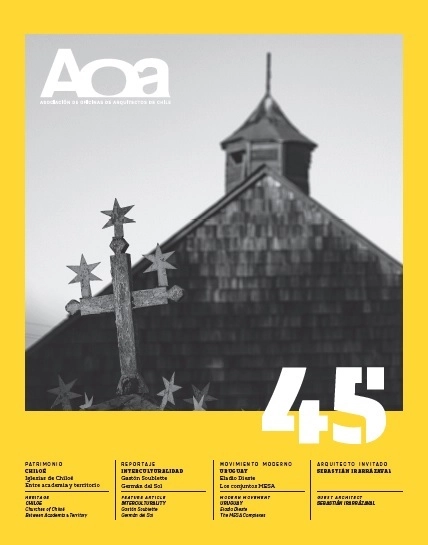
Rescuing the architectural and cultural value of the Churches of Chiloé, concluding the series on Modern Architecture in Uruguay, and addressing interculturality within the territory, geography, and heritage are all part of the contents of the 45th edition of the Association of Architecture Offices (AOA) magazine, which was recently presented.
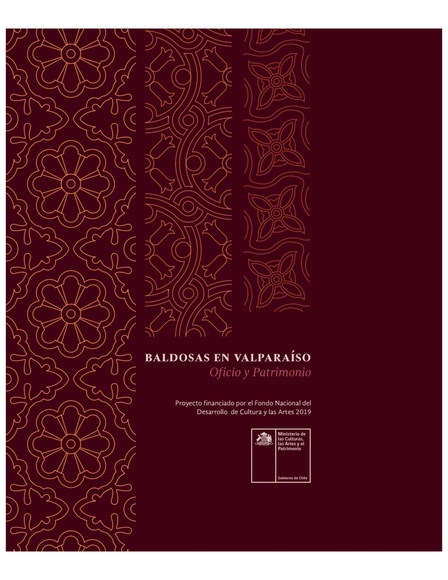
"Baldosas en Valparaíso, oficio y patrimonio" [Tiles in Valparaíso: Craft and Heritage] is a research project aimed at safeguarding the craft of hydraulic tiles—a trade with over a century of tradition in the Valparaíso Region, utilizing an artisanal technique that has remained unchanged for over 150 years of global production.
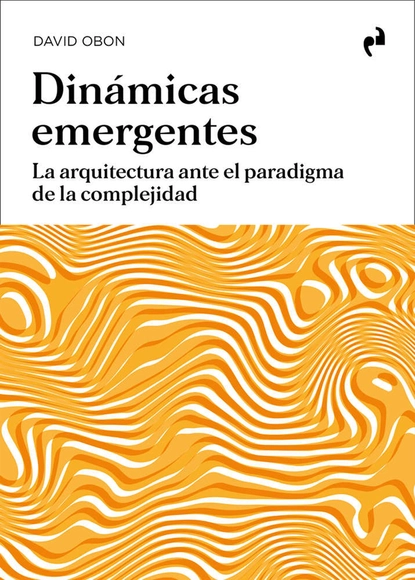
Above all, this book is an invitation. An invitation to discover a new way of seeing and thinking about the world, which in turn entails a new way of seeing and thinking about architecture. Drawing on complexity science and Edgar Morin’s complex thought, David Obon opens the door to knowledge that transcends disciplinary boundaries. It is a form of knowledge capable of recognizing the multidimensionality of our discipline—a knowledge that does not simplify, but rather reconnects, articulates, and clarifies. It is a knowledge that speaks to us of order and disorder, but above all, of creation. These insights have germinated across multiple disciplines to construct a new emerging paradigm: the paradigm of complexity.
Interior architecture today operates at the intersection of physical and mediated spaces, such as those of mass communication, digital platforms, or the visual arts. If we consider any form of representation as potential architecture—from writing to photography, from drawing to film—this essay addresses contemporary interiors as "expanded media" platforms that belong to different places and temporalities, reaffirming the role of interior architecture in the construction of contemporaneity.
"Everyone knows that myths never really happened, yet they are always happening. Now, they continue not only through the adventures of ancient heroes but also by making their way into the ubiquitous and most popular stories of contemporary film, games, and literature." - Olga Tokarczuk.
In this collection of essays, architect Josep Llinàs experiments with new formats, such as Instagram stories, answering to no one but the heroes featured in his narrative. Ever-present is the work of Josep Maria Jujol—who dents, twists, and blurs everything he touches—a body of work far removed from any Calvinist work ethic, which Llinàs links to folk wisdom and, ultimately, to the behavior of a child. Beyond Jujol, other figures emerge: from Alejandro de la Sota to José Antonio Coderch, from David Lynch to Peter Handke, from his grandson to his parents, and from there to his great-grandparents... Meanwhile, never losing his smile, he draws, cuts paper, builds models and collages, and writes stories for the sheer joy of it—his status as a septuagenarian having liberated him from work as a form of punishment—only to channel them back into his architectural practice.
Straddling theory-fiction, speculative fabulation, audiovisual research, and dramaturgy, Teatro Della Terra Alienata imagines a fictional scenario of territorial secession. It addresses the urgency raised in the 2018 UN IPCC report, which identified the decline of the Great Barrier Reef as part of a "wicked problem" that demands radical political action, as well as new imaginaries and aesthetic paradigms.
URBANBATfest is a festival that acts as a laboratory—or a laboratory that evolves into a festival. It is a research process focused on urban transformations and an environment for learning, experimentation, and collective creation designed to drive urban innovation.
In this new edition of URBANBATfest, under the theme "No future," we are opening a space for reflection on the future of cities. We are examining the responsibility of architecture and urban planning within this context of multidimensional crisis, their complicity and forms of resistance, their possibilities and limitations, their tools and working methodologies, their relationship with other disciplines, their areas of intervention, their capacity to create new imaginaries, and how to cohabit the present and the future.
Harquitectes is one of the most compelling architecture firms on the current international scene. While their work has been extensively published—in various monographic magazine issues, among other publications—less attention has been paid to the thinking that underlies the nearly twenty years of work by these Catalan architects. This book compiles a series of texts and interviews that offer moments of reflection and unprecedented, long-awaited theoretical construction regarding Harquitectes' architectural production and their professional attitude. It provides broad context regarding the firm as a project in itself, as well as insights into the specific character of their work.
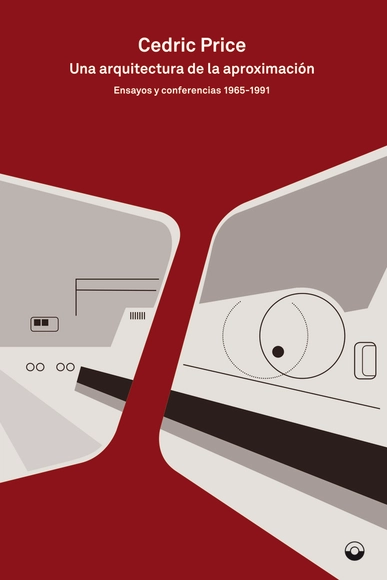
This book brings together, for the first time in Spanish, more than twenty writings and lectures by British architect Cedric Price. Drawn from diverse sources, Price’s texts reveal an exceptional understanding of architecture, filtered through a critical and complex—yet honest and ironic—personality.
Educational institutions, community leaders, and professional organizations mobilize around the debate on social housing and public policy in the city center.
Educational institutions, community leaders, and professional organizations are mobilizing around a debate on social housing and public policy in city centers. Featuring over 60 speakers, the event will take place in May in a remote format; registration is free and open to the public.
The designers of the 2020 edition: Karol Suguikawa (MT), Pietro Oliveira (MG), Rodrigo Ambrosio (AL), Luly Vianna (SP), and Gustavo Bittencourt (RJ)
The 2022 edition of the Semana Criativa de Tiradentes has been scheduled: it will take place from October 20 to 23 in the historic city of Tiradentes, Minas Gerais. The event will be held in person, featuring four days packed with lectures, panel discussions, exhibitions, workshops, and experiences centered on the Brazilian artisanal universe. Daily lectures will be available on the Semana Criativa YouTube channel throughout the festival.
Diagrams, transpositions, and space: alternatives for contemporary urban complexity. Credits: Paco Editorial
Immaterial flows characterize the urban condition in the era of globalized information, intensifying its existing complexity. Temptations to return to the past, or a penchant for the radical or purely virtual, accompany the uncertainty of a landscape undergoing profound social transformations. To intervene in a perceptible way, a new cohesion is required, provided by a diagrammatic unfolding of the urban condition and a move beyond form-based urban readings. This new arrangement aims to reveal more than the simple sum of its parts.
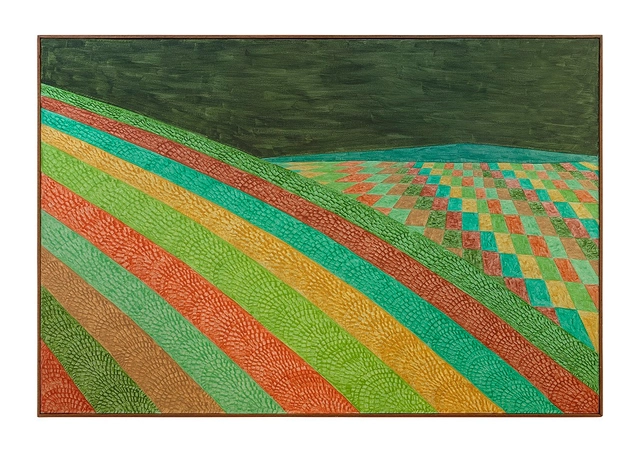
Painting by Almir Mendes de Souza, part of the exhibition. Photo: Courtesy of the organization
Curated by art historian and critic Enock Sacramento, one of the leading experts on these modernist currents in Brazilian art, the exhibition marks the opening of the Sala Guido Arturo Palomba. This space pays tribute to the forensic psychiatrist, a renowned expert in legal medicine and the cultural director of the Pinacoteca of the Associação Paulista de Medicina (APM).
Videos
Invitation to the book launch of Emil Bered Architect. 70 years of the UFRGS Faculty of Architecture. Image: Monica L. Bohre
Edited by Sérgio M. Marques, César Vieira, and Eneida R. Ströher, with the collaboration of the Bered family, the book will be launched during the 70th-anniversary celebrations of the UFRGS Faculty of Architecture.
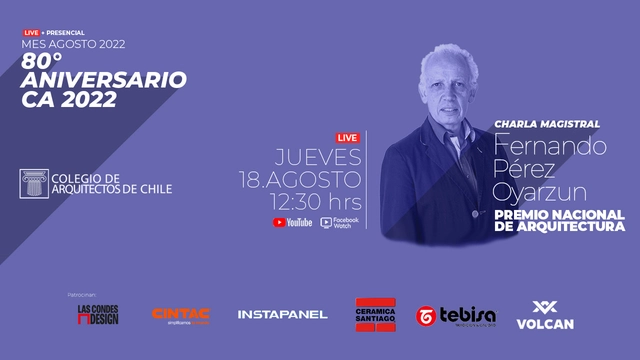
On Thursday, August 18, at 12:30 p.m., a keynote lecture and discussion will be held featuring the recently elected 2022 National Architecture Prize winner, Fernando Pérez Oyarzún.
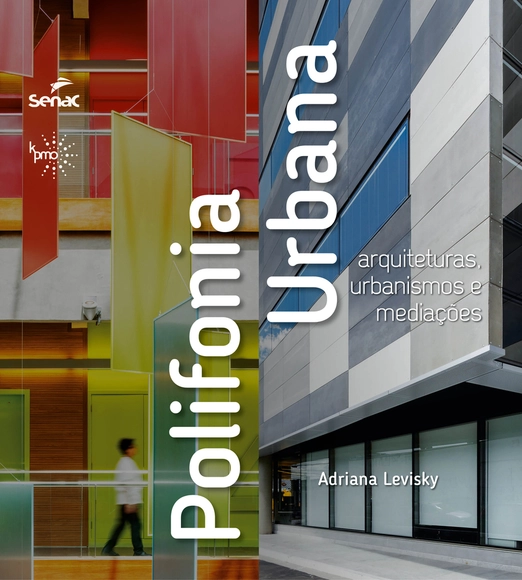
Cover of Adriana Levisky's book published by Editora Senac / KPMO Cultura e Arte
On November 25th, architect and urban planner Adriana Levisky, partner at Levisky Arquitetos | Estratégia Urbana, will give a talk at the 20th edition of FLIP, an important Brazilian cultural event where literature encompasses various urban themes brought into focus during the literary festival.



.jpg?1654779211&format=webp&width=640&height=580)