□³LE Competition is looking for individual shelter solutions for evacuation centers in Japan proposals. Record-breaking rainfall and subsequent flooding, hurricanes, earthquakes, volcano eruptions, heatwaves, and forest fires, humanity is experiencing devastating natural disasters with no signs of easing.
Volume Zero Competitions invites you to design The community pavilion would serve as a medium to raise awareness surrounding the issues faced by women in today’s society.
The worth of a civilization can be gauged from the place that it gives to women. Women today have distinguished themselves in various spheres of life as orators, doctors, diplomats and so on. There is no denying the fact that women all across the globe have made tremendous progress in this constantly developing economy.
The Terraforming is a three-year (2020–2022) design-research initiative of the Strelka Institute, directed by Benjamin H. Bratton and Nicolay Boyadjiev. The program runs as an interdisciplinary design think-tank and will host contributions from multiple faculty and experts including Lydia Kallipoliti, Clapperton Chakanetsa Mavhunga, Tobias Rees, Valerie Olson, Christina Agapakis, Ken Goldberg, Venkatesh Rao, Fred Scharmen, David Delgado and many others. The third and final cycle of The Terraforming program invites a group of 30 interdisciplinary researchers to join the initiative for 5 months from February - June 2022.* The premise of the design research program is that a viable future depends on comprehensive terraforming, not of Mars to make it suitable for Earth-like life, but of Earth itself — ecologically, geopolitically, geotechnologically. The research of the first two years has reoriented foundational debates on how to conceive and model that viability, based on speculative analyses of synthetic intelligence, automation and ecology, food systems, space law, new modes of governance, the evolution of cities and much more. The final year returns to the question of the built environment at multiple scales, from the epidermal to the continental. Artificial environments are designed spaces for diverse functions and ways of being and knowing: the city, the laboratory, the factory, the home, the space station, virtual and mixed reality, the body itself, etc. All speak to the planetary as both the condition that makes specific enclosed worlds possible and also as a collective compositional project. In 2022 The Terraforming is adding a new chapter of motivating research themes - Artificial Environments, Astropolitics, Synthetic/Spatial Materialism, Planetary Sapience. The program is tuition-free (researchers receive a monthly stipend) and invites architects, urbanists, filmmakers, media theorists, historians, philosophers, science-fiction writers, artists, engineers, economists, political scientists, ecologists, anthropologists and graphic designers to apply and work collaboratively on interdisciplinary projects at the intersection of cinema, text and speculative design-research. Applications will be accepted till November 7, 2021. For more information visit theterraforming.strelka.com or contact us at apply@strelka.com
mOOO calls on architects live in every continent to submit successful and unsuccessful stories of their ventures in a video format, to fire up young architects to create their unique careers and realise the full potential of an architect’s skill set.
Transformation of the space, once intended for military infrastructure, into a public multifunctional city park has multiple significance for the future development of Banja Luka.
SUMMARY Our world is changing fast, while ambitions and challenges match in importance. In this context, design can play a huge role. How do we imagine the world to be? What range of possibilities we haven’t discovered yet? What’s a Non Architecture for a World in crisis? In 2020 we started the second phase of competitions to address the issues of tomorrow.
IMPORTANT DATES Submission Deadline: December 31, 2021 Voting Opens: January 5, 2022 Voting Closes: January 31, 2022 Event Participants Announced: February 3, 2022
Impact Design Competitions invite you to envision and create an innovative sustainable solution that maximizes usable space in a minimum footprint.
A “home” is a space that is intimate to all. Apart from being our safe haven, a home goes beyond its everyday function of being a shelter for its users and their activities; it connects with each of us on an emotional and personal level. As time evolves, the definition of “home” also keeps changing. The 21st century witnessed concepts like Airbnb, Co-Living, Smart Homes, Tiny Homes, etc. gaining popularity with both young and older generations alike sparking movements across the globe.
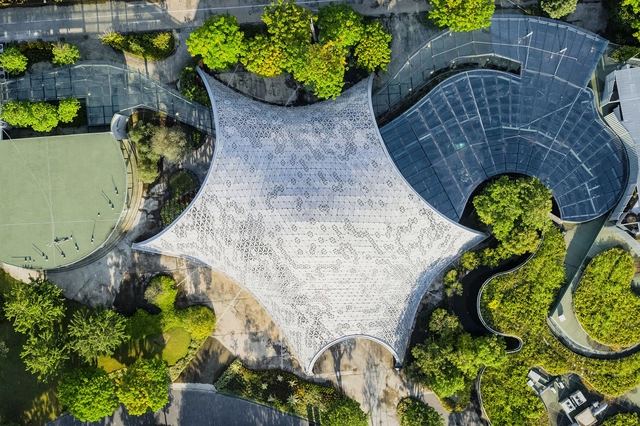
The Future of Us Pavilion. Image Courtesy of iF DESIGN AWARD
We may live in big cities with tall buildings and wide roads, yet we still feel the need for a connection with nature. Architects and interior designers have responded to this desire for a more natural living space with creative concepts and a number of outstanding ideas have won an iF DESIGN AWARD 2021.
With Agrob Buchtal's striking new Canyon facade tile, facades can be structured either vertically or horizontally. Through light and shadow, its parallel lines are emphasised in ever new ways. Image Courtesy of Agrob Buchtal
The new Kaijo and Canyon surfaces by designer Markus Bischof for Agrob Buchtal may differ significantly in form, but both create striking, geometric facades.