Oscar Aceves

BROWSE ALL FROM THIS AUTHOR HERE
↓
Subscriber Access

What is the architectural discourse for the middle class in Chile?

Mark Wigley asserts that architects, rather than builders, are talkers. "Architects do not make solid objects. They make discourses about objects," Wigley argues in “Typographic Intelligence” (2002). This becomes particularly relevant when linked to philosopher Michel Foucault's concept of discourse. In *The Order of Discourse*, Foucault argues that discourses consist of a series of statements or propositions that communicate a certain idea, defining everything that can be said about a topic by shaping a specific way of understanding reality.

Discourses, then, are not merely a specific glossary of words; rather, they encompass the meanings or ideologies conveyed through them. With this in mind, I want to suggest that architecture can be understood as a discipline in which a set of discourses operates, managed by a regulatory body that constantly validates which of them generate architecture and which do not. When examining the discourses that operate within architecture, we find that several can coexist and justify one another, while others ignore and exclude each other—shaping different statements of truth. There may even be discursive strategies that appear extinct due to disuse or deliberate concealment.

Subscriber Access

A blue elephant in the room: the Chilean pavilion at the Venice Biennale

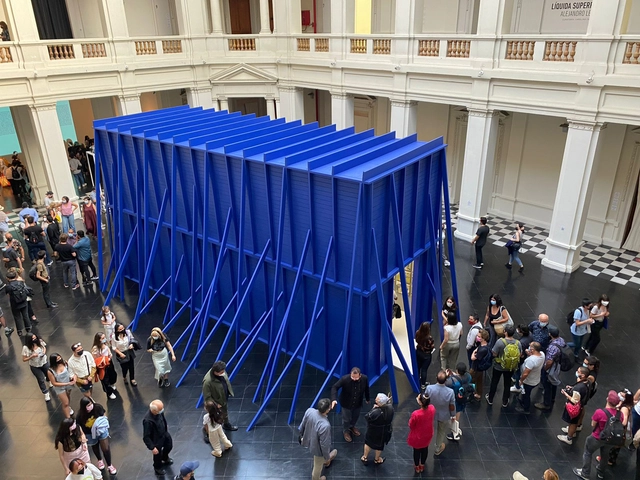
As in previous years, Chile's Ministry of Cultures, Arts, and Heritage has organized the exhibition of Testimonial Spaces, the country's most recent national pavilion presented at the 2021 Venice Biennale, in the lobby of the Museum of Contemporary Art in Parque Forestal (Santiago), making it accessible to the local public.

Although the ministry's open call for each biennale typically focuses on the design of a pavilion, the brief specifies that the selected curator will be responsible for developing both a curatorial concept and an architectural proposal. Certainly, in a contemporary context, the notion of a pavilion is a highly malleable category, making the distinction established in the guidelines particularly intriguing: while a curatorial concept should clearly be associated with some relevant architectural framework, it is not necessarily an architectural proposal in and of itself.

A blue elephant in the room: the Chilean pavilion at the Venice Biennale - Imagen 1 de 4A blue elephant in the room: the Chilean pavilion at the Venice Biennale - Imagen 2 de 4A blue elephant in the room: the Chilean pavilion at the Venice Biennale - Imagen 3 de 4A blue elephant in the room: the Chilean pavilion at the Venice Biennale - Imagen 4 de 4A blue elephant in the room: the Chilean pavilion at the Venice Biennale - More Images+ 7