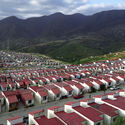
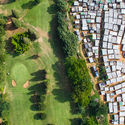
The philosopher and sociologist Henri Lefebvre coined the notion of "production of space" in 1974, breaking with the vision of space as a container or scenario of objects and social relations, to move towards space understood as a process. From this vision based on the Marxist tradition, space is a product and a producer of social relations and processes.
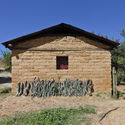
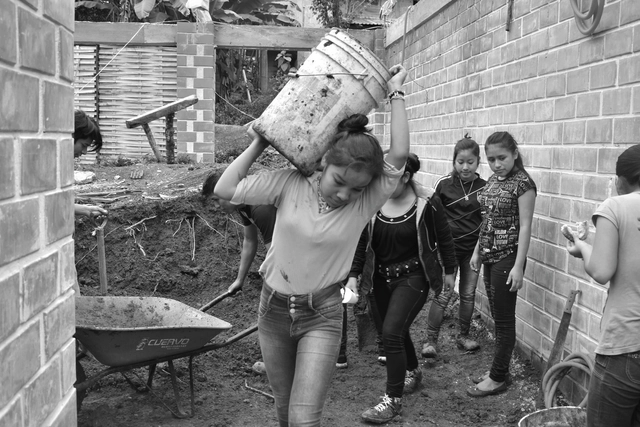
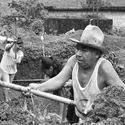
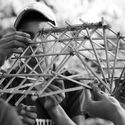
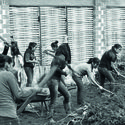
Traditional architecture is based on a complex understanding of dwelling, the collective production and transmission of knowledge, and construction through mutual-aid community processes that strengthen the social fabric, cultural identity, and territorial bond. In other words, it is a practice of community self-production where the inhabitants themselves, without intermediaries, manage the multiple processes involved in materializing their habitat, always relying on collective intelligence. Today, architecture has shifted from being a communal asset to an exclusive language of a few where, despite still requiring the organized participation of various actors, its production is credited to a single author: an individual entity who, without possessing the diverse knowledge required to complete a work from start to finish, is recognized as the mastermind behind all processes. The professionalization of architecture has not only individualized its discourse and complicated the transmission of knowledge; it has also discriminated against and rejected the knowledge produced outside of academic, professional, and governmental institutions, labeling it as precarious—thereby opening the door to racism.
https://www.archdaily.com/1124047/architecture-and-racism-when-design-is-used-as-a-colonial-toolMariana Ordoñez y Jesica Amescua
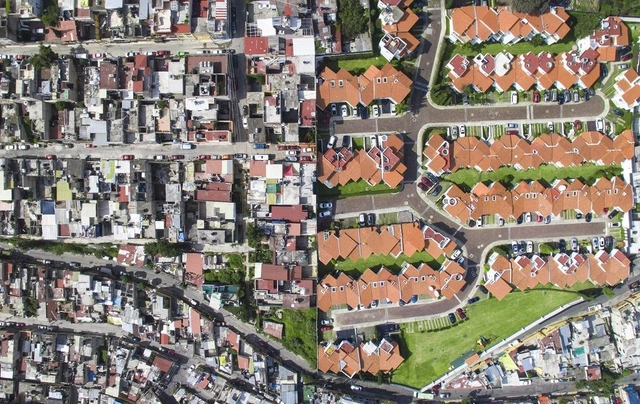
In light of recent statements by the Federal Government and the new programs announced by institutions involved in housing production in Mexico, we believe it is essential to open a dialogue and exchange ideas to better understand the concepts of self-construction, self-production, and the “Social Production and Management of Habitat” [SPMH], as well as the role of architecture in these social processes.
https://www.archdaily.com/1123823/the-role-of-architecture-in-self-construction-self-production-and-assisted-social-housing-productionMariana Ordoñez y Jesica Amescua
The word and the ear, along with the heart, have many paths, many ways, many calendars, and many geographies to find each other. And this struggle for life can be one of them. - Communiqué from the Zapatista Army of National Liberation regarding COVID-19
While governments around the world call for “social distancing” and some of them militarize public space through violence and the shattering of collectivity, the Zapatista Army of National Liberation calls to “raise high the banner of the struggle for humanity,” to not lose human contact, and to keep social struggles alive.
https://www.archdaily.com/1124192/the-pandemic-makes-visible-what-has-always-been-there-inequality-and-individualismMariana Ordoñez y Jesica Amescua