João Santos

BROWSE ALL FROM THIS AUTHOR HERE

Alienation and Narrative Space in the Apple TV+ Series "Severance"

Subscriber Access | 

One of the most highly acclaimed television productions of recent years, “Severance” (released as “Ruptura” in Brazil), the Apple TV+ sci-fi series released in 2022, establishes an intriguing premise: employees of the mysterious Lumon Industries volunteer to undergo a procedure that surgically separates their personal and professional memories, ensuring that their work and private lives never overlap. The procedure thus creates an intermittent alter ego, mutually unaware of the other self and hyper-focused on its respective domain. The deft direction of Ben Stiller and Aoife McArdle, coupled with stellar performances from the cast, does justice to Dan Erickson's brilliant plot. Here, however, we focus on how the show's primary setting—the corporate headquarters in the fictional town of Kier—heightens the distress of the small team of employees through the architecture that houses and alienates them during the workday.

Public fountains as zones of relief from urban heat

Subscriber Access | 

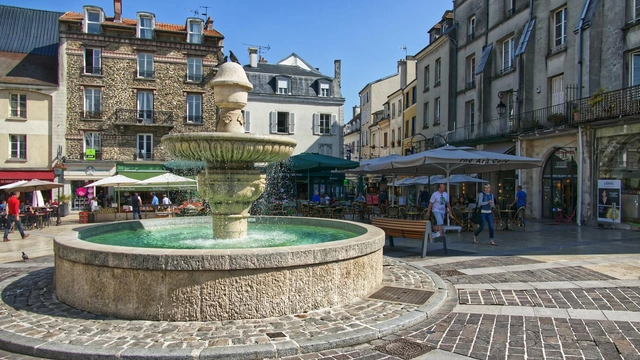
A direct consequence of global warming, heatwaves have become increasingly devastating and frequent with each passing summer. The most recent of these has been sweeping across Europe for days, worsening in western nations, such as Belgium and the United Kingdom. The melting runway surface at Luton Airport and the fires in the village of Wennington, London, and in Calatayud, southwestern Spain, are just some of the incidents that underscore the critical scale of this crisis.

Public fountains as zones of relief from urban heat - Imagen 1 de 4Public fountains as zones of relief from urban heat - Imagen 2 de 4Public fountains as zones of relief from urban heat - Imagen 3 de 4Public fountains as zones of relief from urban heat - Imagen 4 de 4Public fountains as zones of relief from urban heat - More Images+ 1

Where does a city begin and where does it end?

Subscriber Access | 

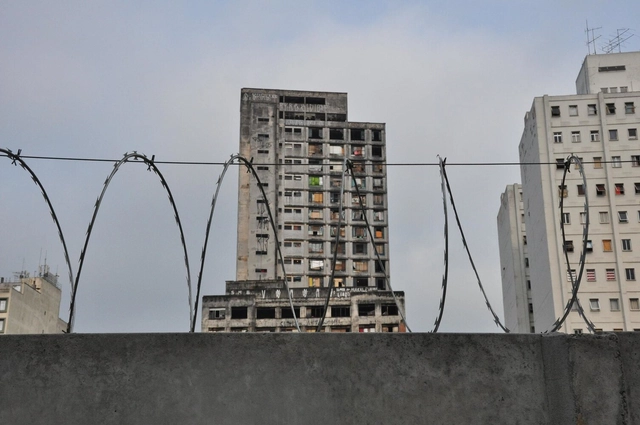
The question in the title of this article stems from the premise that if cities—in modern terms—are spatial entities possessing an originating and demarcating point of development, then they must also possess an equivalent point (or line) of finitude. One could easily resolve this question by turning to cartography. From an administrative and organizational perspective, maps allow us, to some extent, to define the boundaries of any urban agglomeration. However, the boundaries set by scalar representation fail to dismiss this reflection, as our perception of the city is far more complex. As Ferrão (2003) suggests, in a formulation that encompasses the socio-political dimension of the issue alongside geography and architecture: the city is an “object of increasingly invisible contours.”

Suppression of rights on the construction site: parallels between Brasília and Qatar

Subscriber Access | 

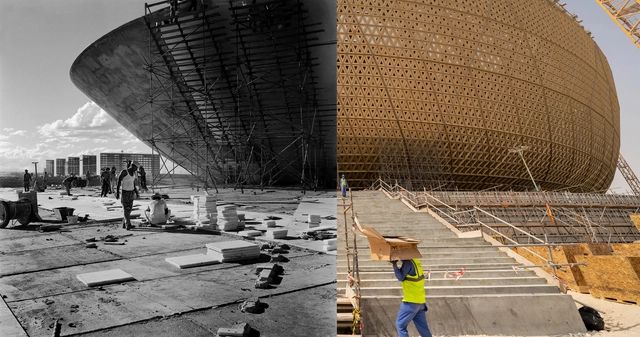
Sixty-two years separate the inauguration of Brasília and the opening of the 22nd edition of the FIFA Men's World Cup, hosted in 2022 in Qatar. Of course, it is not only their placement in time and space that differentiates these two historical occasions; we must also add the geopolitical context, the character, the actors, and the interests surrounding each. What, then, remains as a link between them? Beyond the fact that the emirate now has its own model city (Lusail)—built in the wilderness of the peninsula under the playbook of the latest urban and technological trends, echoing to some extent the avant-garde spirit of Brazil's Federal District at the time of its construction—the inextricable link between the two events lies in the construction sites that materialized the architecture hosting them.