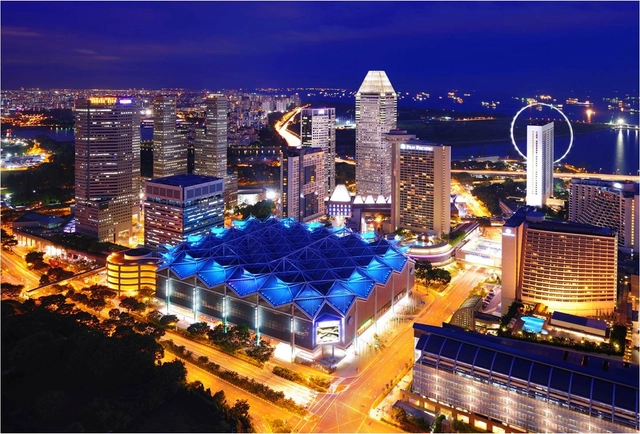
WAF 2015: Suntec Singapore Convention Centre, Singapore
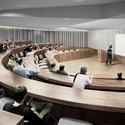
Now in its eighth year, the forthcoming 2015 World Architecture FestivalAwards (WAF) will take place in Suntec in central Singapore following three days of intensive live presentations and judging. Following a $180 million modernisation programme, the redesigned space will host WAF’s soundproofed crit rooms, auditorium and Festival Hall Stage. Entries are now invited from architects and designers for the 2015 edition of what is described as "the biggest architectural awards programme in the world." The awards are expected to attract more than 750 entries, around half of which will be shortlisted into thirty categories. The closing date for entries is the end of May, and shortlisting will take place in early June.
Adam Nathaniel Furman's tenure as the recipient of the 2014/15 Rome Prize for Architecture at the British School at Rome has come to an end. The project that he has investigated over the past months, entitled The Roman Singularity, sought to explore and celebrate Rome as “the contemporary city par-excellence” – “an urban version of the internet, a place where the analogical-whole history of society, architecture, politics, literature and art coalesce into a space so intense and delimited that they collapse under the enormity of their own mass into a singularity of human endeavour.”
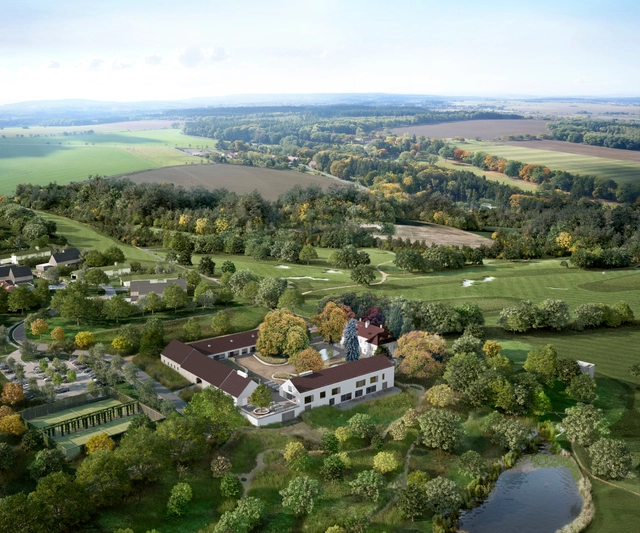
Proposal: John Pawson (Chateau Aerial View). Image Courtesy of Oaks Prague
Three practices have been appointed to the design team for Oaks Prague, a new rural residential development located in the commune of Popivičky, close to the city of Prague. John Pawson, Richard Meier + Partners and Eva Jiřičná with AI-Design have drawn up design proposals for key buildings for the scheme, which is managed by the Czech development company Arendon. In November last year, ten practices were shortlisted in a competition to design housing schemes for the €400 million, 220-home "residential and lifestyle development" in Popivičky.
The entire development, which has previously been master-planned by EDSA assisted by Chapman Taylor and John Thompson & Partners, "responds to the form, layout and vernacular of the surrounding Czech villages."
The Royal Institute of British Architects (RIBA) has launched a call for applications for the 2015 RIBA Boyd Auger Scholarship. The generous scholarship, which has been awarded since 2008, supports the personal, professional and academic development of its student recipients by contributing towards their "imaginative and original research and travel."
Following our top 40 Architecture Docs to Watch in 2014and our favourite 30 Architecture Docs to Watch in 2013, 2015 is no exception! Our latest round up continues to feature a fantastic range of films and documentaries telling the tales of unsung architectural heroes and unheard urban narratives from around the world. This entirely fresh selection looks past the panoply of stars to bring you more of the best architectural documentaries which will provoke, intrigue and beguile.
From a film which explores one man's dream to build a cathedral (#4) and a simultaneous history of and vision of Rotterdam's future (#7), to a tour of the world's last surviving squatter town in Copenhagen (#14) and A Short History of Abandoned Sets in Morocco (#16), we present - in no particular order - thirty freshly picked documentaries for you to watch in 2015.
The Royal Institute of British Architects (RIBA)’s Future Trends Survey for January 2015 has revealed strong levels of optimism as workload forecasts remain strongly positive across all regions of the UK. Following little change in indexes between November and December 2014, the workload index has once again remained consistent at +29. Workload forecast balance figures have remained high, the highest numbers being reported from practices in Northern Ireland at +67 (from +50) and Scotland at +57 (from +75). Furthermore, practices of all sizes have been responding with positive workload prospects heading into the next quarter.
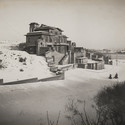
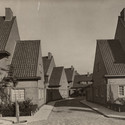
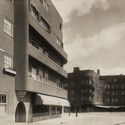
The Netherlands Builds in Brick is one of the latest exhibitions at Het Nieuwe Instituut (formerly the NAi) in Rotterdam. It seeks to modify the "assumed triumph of Modernism" in the interwar period, drawing upon two photographic collections from the Institute's extensive archives. The exhibition has been curated to highlight that brick remained the favoured construction material throughout the advocacy of the Modernist movement, even for experimental construction.
Videos
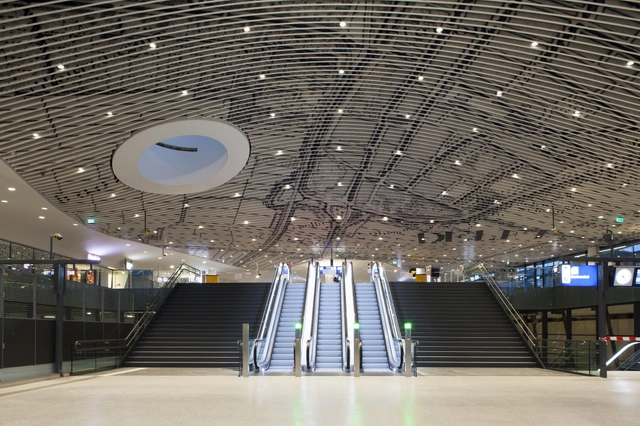
Arrival into the 'vaulted' station hall. Image Courtesy of Mecanoo
Six years after the original announcement of the project, the first phase of Mecanoo's new Train Station and City Hall complex in Delft, The Netherlands, has been opened to the public. Within the new station hall an undulating 'vault', which has been designed to evoke an "unforgettable arrival experience", features a scaled 1877 map of the Dutch city rendered in blue and white. Columns wrapped in a mosaic of Delft-blue titles, also reminiscent of the colours of Delftware, one of the city's most famous global exports. The station platforms below ground have been designed by Benthem Crouwel, the Dutch practice behind Rotterdam Centraal Station.
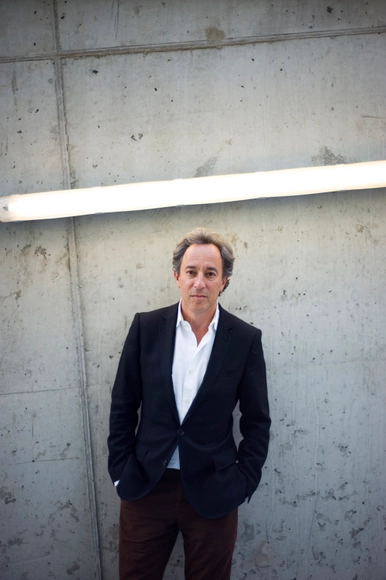
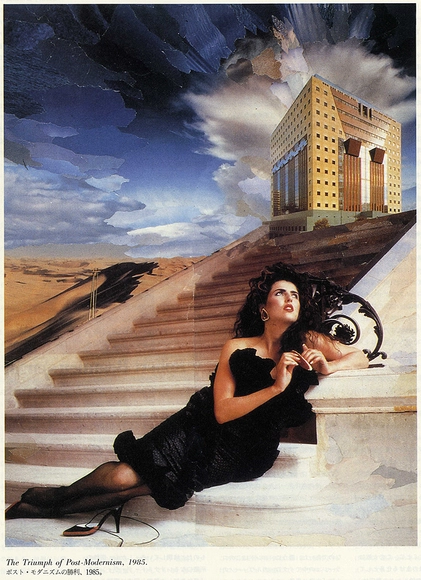
Being such a recent movement in the international architectural discourse, the reach and significance of post-modernism can sometimes go unnoticed. In this selection, chosen by Adam Nathaniel Furman, the "incredibly rich, extensive and complex ecosystem of projects that have grown out of the initial explosion of postmodernism from the 1960s to the early 1990s" are placed side by side for our delight.
From mosques that imagine an idyllic past, via Walt Disney’s Aladdin from the 1990s, to a theatre in Moscow that turns its façade into a constructivist collage of classical scenes, "there are categories in post-modernism to be discovered, and tactics to be learned." These projects trace forms of complex stylistic figuration, from the high years of academic postmodernism, to the more popular of its forms that spread like wildfire in the latter part of the 20th century.
Astropad: use your iPad as a drawing tablet for your Mac. Image Courtesy of Astropad
Astropad, an app for iOS and Mac, transforms your existing iPad into a professional graphics tablet without the need for additional hardware. Having been developed by Matt Ronge and Giovanni Donelli - both former Apple engineers - the app allows for the iPad to act as a extended trackpad as well as work with most third-party styluses.
Videos
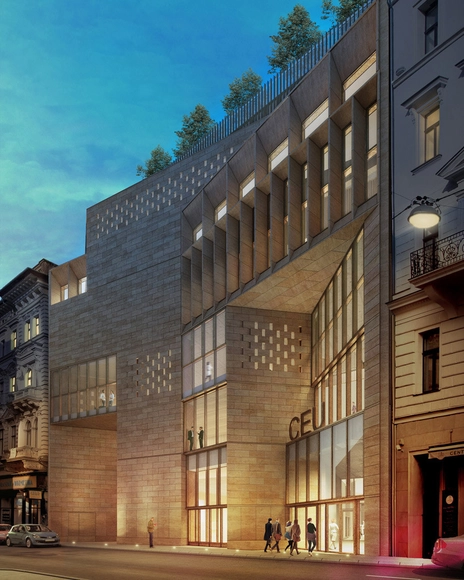
View from street. Image Courtesy of O'Donnell + Tuomey / Central European University
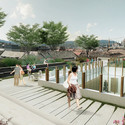
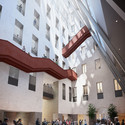
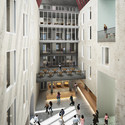
Work has begun on O'Donnell + Tuomey's first project in Hungary. The new collection of buildings and restoration projects for the Central European University in Budapest sits within existing courtyards in a dense area of the city. Bringing a total of 35,000m² of new space to the inner-city campus, the project consists of a new library spread across five floors, an auditorium, multiple public spaces, teaching and learning facilities, study rooms, and a café.
Lateral Office'sArctic Adaptations exhibition, which was recognised with a Special Mention at the 2014 Venice Biennale, will travel make its debut in Canada at the Winnipeg Art Gallery this week before heading to Whitehouse, Vancouver, and Calgary. The exhibition "surveys a century of Arctic architecture, an urbanising present, and a projective near future of adaptive architecture in Nunavut" though interactive models, photography, and topographical maps of the twenty five communities of the area, as well as Inuit carvers’ scale models of some of the most recognised buildings in the territory. In addition, it proposes a future of adaptive and responsive architecture for Canada's northern territories.
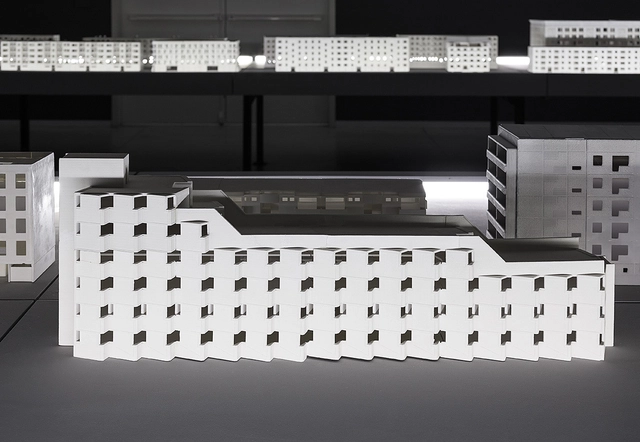
Between 1945 and 1981 around 170 million prefabricated (prefab) residential units were constructed worldwide. Now, as part of a study undertaken by Pedro Alonso and Hugo Palmarola of the Pontificia Universidad Católica de Chile between 2012 and 2014, an exhibition at the Tel Aviv Museum of Art features 28 large concrete panel systems from between 1931 and 1981.In so doing, it explores a transnational circulation of these objects of construction, "weaving them into a historical collage of ambitions and short-lived enthusiasm for utopian dreams."
This show, curated by Meira Yagid-Haimovici, is an attempt to reveal "how architecture and urbanism was charged with historical, social, and political narratives, and how the modernist vision promoted the fusion of aesthetics and politics." The models, which are being exhibited as part of the Production Routes exhibition, seek to highlight the richness embodied in 'generic' architecture through the lens of prefab construction methods.
Videos
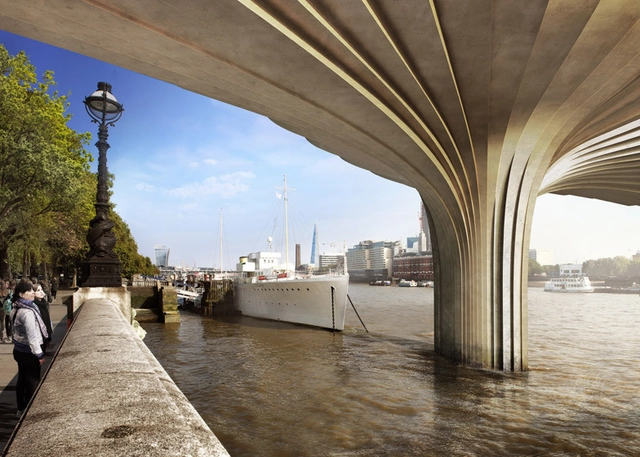
New image showing the copper-nickel (cupronickel) cladding. Image Courtesy of Arup
Arup have released a new image of the proposed copper-nickel alloy cladding that will adorn Heatherwick Studio's Garden Bridge in London. According to a report by the Architects' Journal, the "concrete structure will be coated in 'cupro-nickel', from its feet on the riverbed up to the base of the balustrades on the bridge deck." The copper will be donated from Glencore, a multi-national mining company, forming "a protective skin to the carbon steel structure giving it a maintenance free 120-year life, protecting the bridge from river and environmental corrosion." More than 240 tonnes of the metal alloy, which often finds use in medical equipment and ship propellers, will be used.
Videos
Winning Entry: Exhibition Space. Image Courtesy of UNESCO
UNESCO, in collaboration with the Afghan Ministry of Information and Culture, have announced the winning proposal for the Bamiyan Cultural Centre. An Argentina-based team, lead by Carlos Nahuel Recabarren alongside Manuel Alberto Martínez Catalán and Franco Morero, were selected from 1,070 design entries from 117 countries. Prepatory work on implementing their scheme, entitled Descriptive Memory: The Eternal Presence of Absence, "will start immediately" close to the boundaries of the Bamiyan World Heritage site.
See the winning entry and the four runners-up after the break.