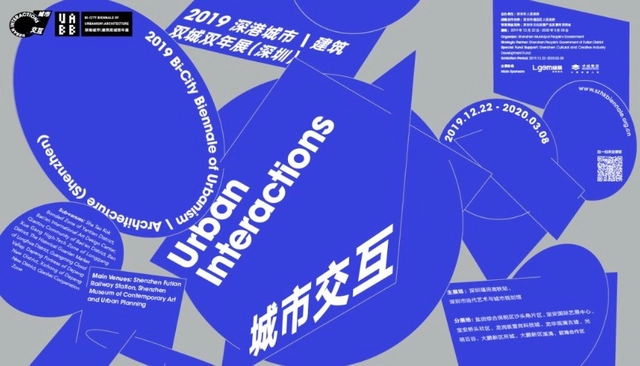
On December 20, 2019, the opening press conference for the eighth **Bi-City Biennale of Urbanism\Architecture (Shenzhen)** (hereinafter "UABB") was held at the **Shenzhen Museum of Contemporary Art and Urban Planning (MOCAPE)**, marking the official launch of this year's biennale.
Under the theme of "**Urban Interactions**," this year's UABB is chief-curated by architect and director of the MIT Senseable City Lab **Carlo Ratti**, academician of the Chinese Academy of Engineering **Meng Jianmin**, and renowned curator and art critic **Fabio Cavallucci**. The South China-Turin Joint Lab (Politecnico di Torino and South China University of Technology) serves as the academic curator. The exhibition **opens on December 21, 2019, at the main venues—the Shenzhen Futian High-Speed Railway Station and the Shenzhen Museum of Contemporary Art and Urban Planning—and will officially open to the public on December 22**. In addition, **nine sub-venues** across various districts of Shenzhen will interface with the main venues, establishing an organic network of interaction throughout the city.
The exhibition comprises two main sections, "**Eyes of the City**" and "**Ascending City**," each exploring the evolving relationship between urban space and technological innovation from distinct perspectives. **The main venues showcase over 140 works, bringing together more than 280 exhibitors from 24 countries and regions**. These include renowned international and domestic architects, artists, and institutions such as MVRDV, Liam Young, Stefano Boeri, Sou Fujimoto, Thomas Heatherwick, Ryoji Ikeda, Wang Shu, Yung Ho Chang, Dominique Perrault, Philip F. Yuan, Liu Cixin, and Academicians Cui Kai and Wang Jianguo.
