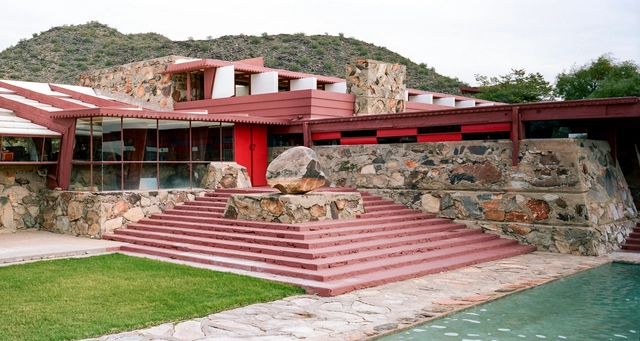
After a several year battle, the Frank Lloyd Wright School of Architecture has been approved to maintain its accreditation as an institute of higher learning. The school’s status had earlier been threatened due to new laws by the Higher Learning Commission (HLC) that require universities, colleges and other institutions to be financially and administratively independent from "larger institutions with multi-faceted missions."
With the decision, the school will be able to continue to offer its 3-year Master of Architecture program, as well as its additional education programs such as its 8-week-long non-degree Immersion Program.
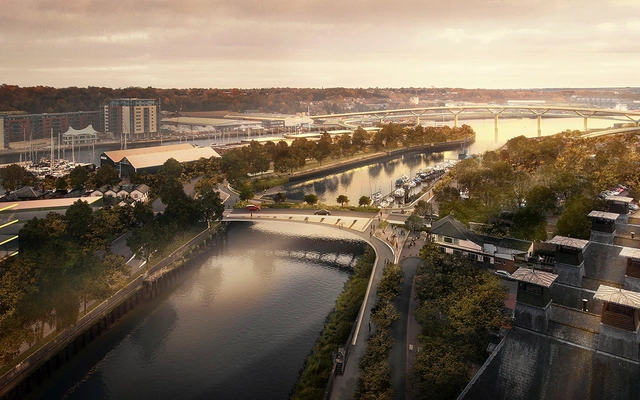
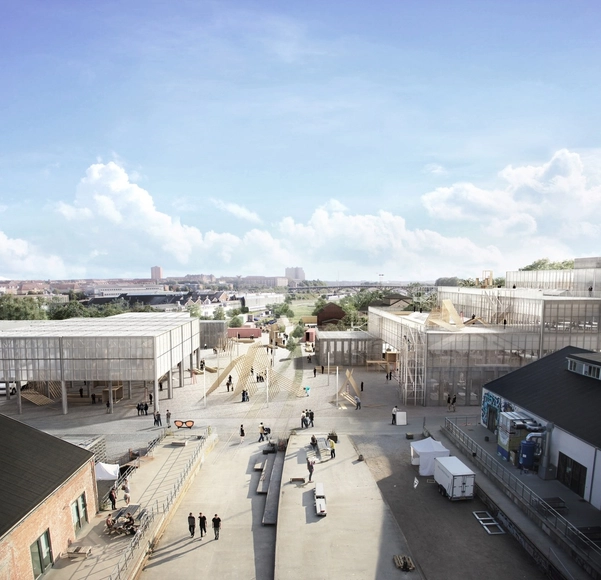
Competing against a shortlist of internationally acclaimed architects, the team led by newly established practice Vargo Nielsen Palle (in collaboration with ADEPT and Rolvung & Brøndsted Arkitekter) has been selected as the winners of the NEW AARCH competition, which sought designs for several new buildings for the Aarhus School of Architecture and the development of the surrounding area in Aarhus known as Godsbanearealerne.
The restricted competition consisted of three invited practices – BIG, SANAA and Lacaton & Vassal – and the three winners of the earlier open qualifying competition, Vargo Nielsen Palle, Erik Giudice Architects, and ALL (Atelier Lorentzen Langkilde). Vargo Nielsen Palle’s proposal was chosen as the unanimous winner.
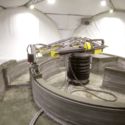
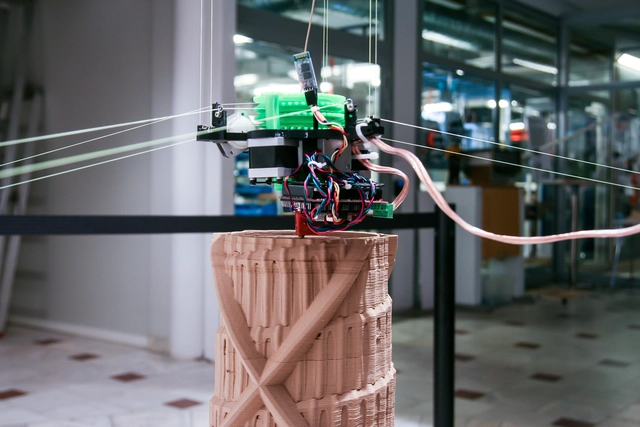
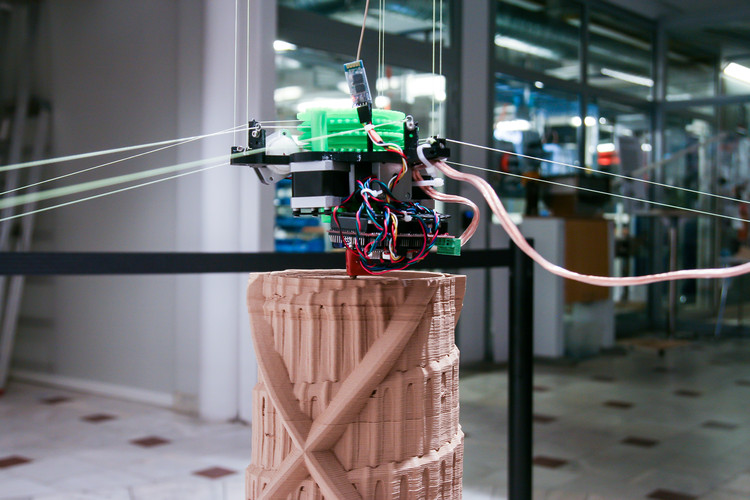
Sliperiet, Umeå Arts Campus has developed a new type of 3D printer that features increased printing flexibility at a lower cost. Called Hangprinter. The system is suspended by a series of thin fishing lines, it does not require a frame or rails, but rather, it can be attached to any stable surface, for instance, a ceiling.
As a part of the +Project innovation initiative, the Hangprinter is in the process of making a “Tower of Babel,” a project that currently measures almost three-and-a-half meters tall, making it the tallest object the system has made, as well as “much taller than the scope of any commercially available large format printer.”
Invented by Torbjørn Ludvigsen, who began the project while a student at Umeå University, the Hangprinter’s design was originally formulated to reduce costs. “The frame or box was almost half the cost of the final 3D printer, and I thought I could do without it,” said Ludvigsen. Hangprinter can be put together for about 200 Euros.
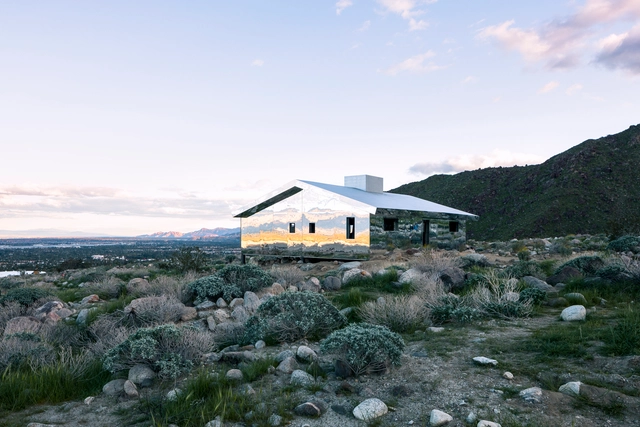
Marrying the great expanses of the American west with a series of mirrored faces, MIRAGE is an installation situated in the Southern California desert and the work of Doug Aitken, an American artist, and filmmaker. An experimental adaptation of the traditional suburban ranch-style house, the sculpture hones in on architecture’s relationship with its landscape, manifesting itself as a life-sized kaleidoscope.
The California Ranch Style house was first designed by a small collective of architects in the 1920s and 30s, inspired by the spatial fluidity of Frank Lloyd Wright’s work and melded with the local single storey homes that belonged to ranchers. Following the Second World War, the simplicity of this housing typology resulted in its quick rise in popularity, adopted by commercial builders to match the rapid urbanization of the American countryside.
Humor is a very rare quality in architecture, most architects are too serious -Andreas Ruby, director of the Swiss Architecture Museum S AM, Basel
Since its founding in 1996, Slovenia architecture firm Sadar+Vuga has grown to become one of their country’s most influential architectural forces, with a range of projects covering interior design, to stadiums, to city master plans. In a new documentary by director Damjan Kozole, the firm’s history is being archived for the first time.
Tesla has completed a massive, 55,000-panel solar farm on the Hawaiian island of Kauai that will allow them to experiment with medium-term energy storage at a utility scale. Hooked up to the farm are 272 of the company’s lithium Powerpacks, which are capable of storing of combined 52 megawatt-hours of power.
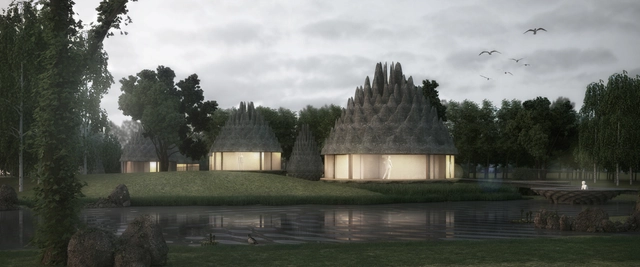
Focussing on prefabricated and sustainable means of construction, Italian practices 3GATTI Architecture Studio and OFL Architecture have envisioned an airy forest resort and spa in the historical region of Kurzeme, Latvia. The Pinecones Resort does its name justice by the spiky cone-like units that inhabit the site, made possible through the use of an inflatable roof constructed from ETFE, a lightweight polymer film.
ETFE, or Ethylene Tetra Fluoro Ethylene, is the most extensively used material for inflatable roofing. Being 100% recyclable and having a minimal carbon footprint in terms of transportation and installation, the material is highly sustainable and in the case of this particular project, offers flexible and dynamic building forms.
Professor Alan Short of the University of Cambridge has published a book advocating for the revival of 19th-century architectural ideas to address the crippling energy use of modern skyscrapers. The Recovery of Natural Environments in Architecture proposes an end to the architectural fetish for glass, steel, and air conditioning, instead drawing inspiration from forgotten techniques in naturally ventilated buildings of the 1800s. The book is a culmination of 30 years’ research and design by Prof. Short and his colleagues at the University of Cambridge.
https://www.archdaily.com/866864/new-book-calls-for-an-end-to-our-fetish-for-conditioned-skyscrapersNiall Patrick Walsh
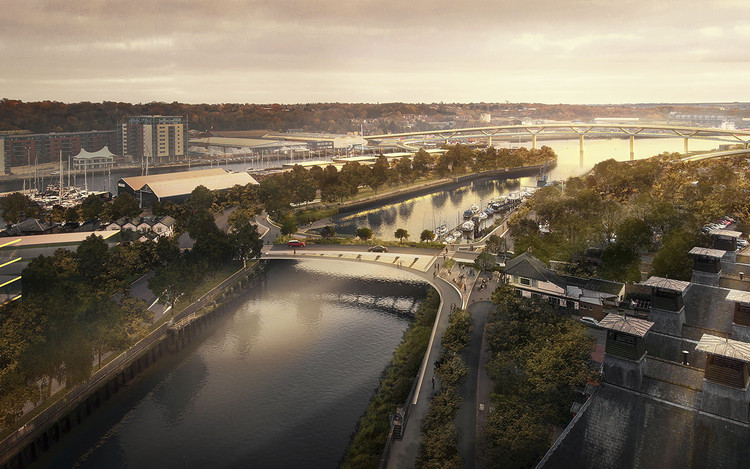
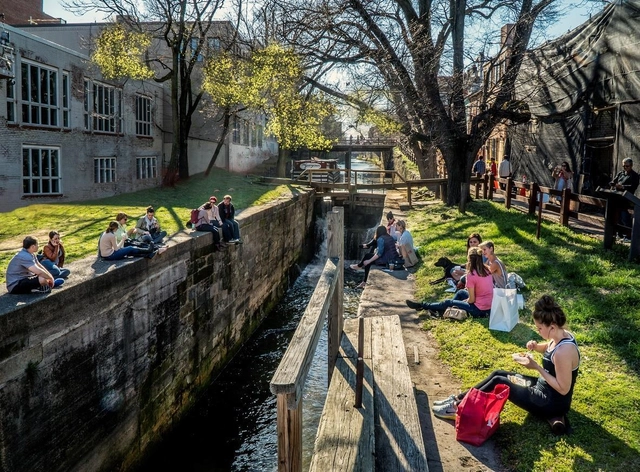
James Corner Field Operations, the urban design and landscape architecture firm behind the High Line in New York City, has been selected by Georgetown Heritage to complete a similar transformation of a historic canal in the Washington D.C. neighborhood of Georgetown. Working with the National Park Service and the D.C. Office of Planning, the team will design a comprehensive master plan for a one-mile section of the Chesapeake and Ohio National Historical Park (C&O Canal NHP) to update the site from a historic location into a community asset.
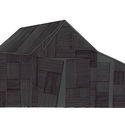
John Redington, a Texas-based illustrator, documents abandoned rural sheds and their modest architectural impact. In this visual essay he reveals this unseen, underrepresented vernacular arguing that the "shaky charm of the abandoned shed could offer a look into a more humble form of inspiration for architects."
The car rattles on a loose road as thick white dust rises from the back of its tires. On either side seas of sunburned grass just barely keep themselves from breaking onto the path. The sky sits heavily on the horizon, as the fragrance of both wild and cultivated plants fill the air.
As any architect who has played with LEGO can tell you (which, let’s face it, is nearly all of us), one of the most exciting yet struggling steps is just starting off on that tabula rasa of the standard, flat LEGO base. But for anyone looking to build something within the context of their environment, you were flat out of luck. Now, that all may be changing, thanks to a new LEGO-compatible tape, currently being funded on Indiegogo.
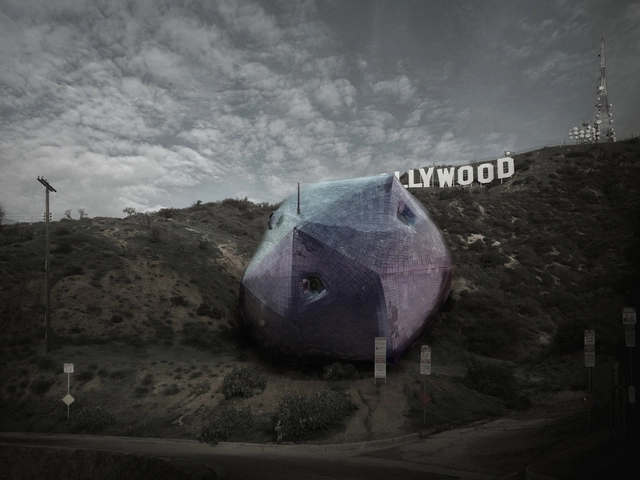
First Place: Ambivalent House / Hirsuta (Jason Payne, Michael Zimmerman, Joseph Giampietro, Ryosuke Imaeda); Los Angeles, California, USA. Image Courtesy of arch out loud
Architectural research initiative arch out loud, in partnership with Last House on Mulholland (LHOM), has released the winner of their competition to design a house of the future, to be sited directly below the Hollywood Sign.
Serving as a “design charette” to generate ideas about potential uses for the currently open site, the competition called for residential designs that demonstrate the use of innovative technology and integrative environmental strategies, while capitalizing on the prominence of the site.
The Hollywood competition received entries from 500 designers across the world, selecting three winners, with an additional owner’s choice.
The winners of the Hollywood design competition are:
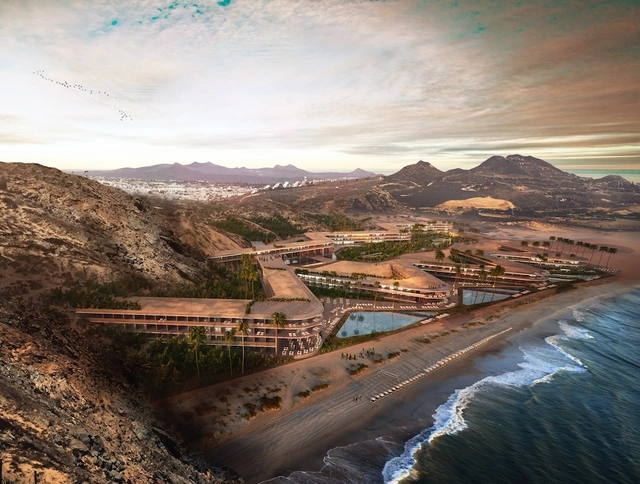
Sordo Madaleno Arquitectos (SMA) has revealed their recent competition proposal for St Regis Los Cabos, a 12.4-hectare hotel and residential project on the southern tip of the Gulf of California in Mexico, bordering the Pacific Ocean.
In response to the site’s natural conditions—vast area, views, and exposure to predominant winds—the project’s volumetric design focuses on the use of camouflaged materials, terraces, and methods to provide shelter from the wind, all of which creates two parallel undulating forms at the edge of the beach.
The hotel and its amenities will be aligned with the east side of the complex, such that they achieve a layout with as many rooms as possible with direct views of the Pacific Ocean that rotate to ensure privacy.
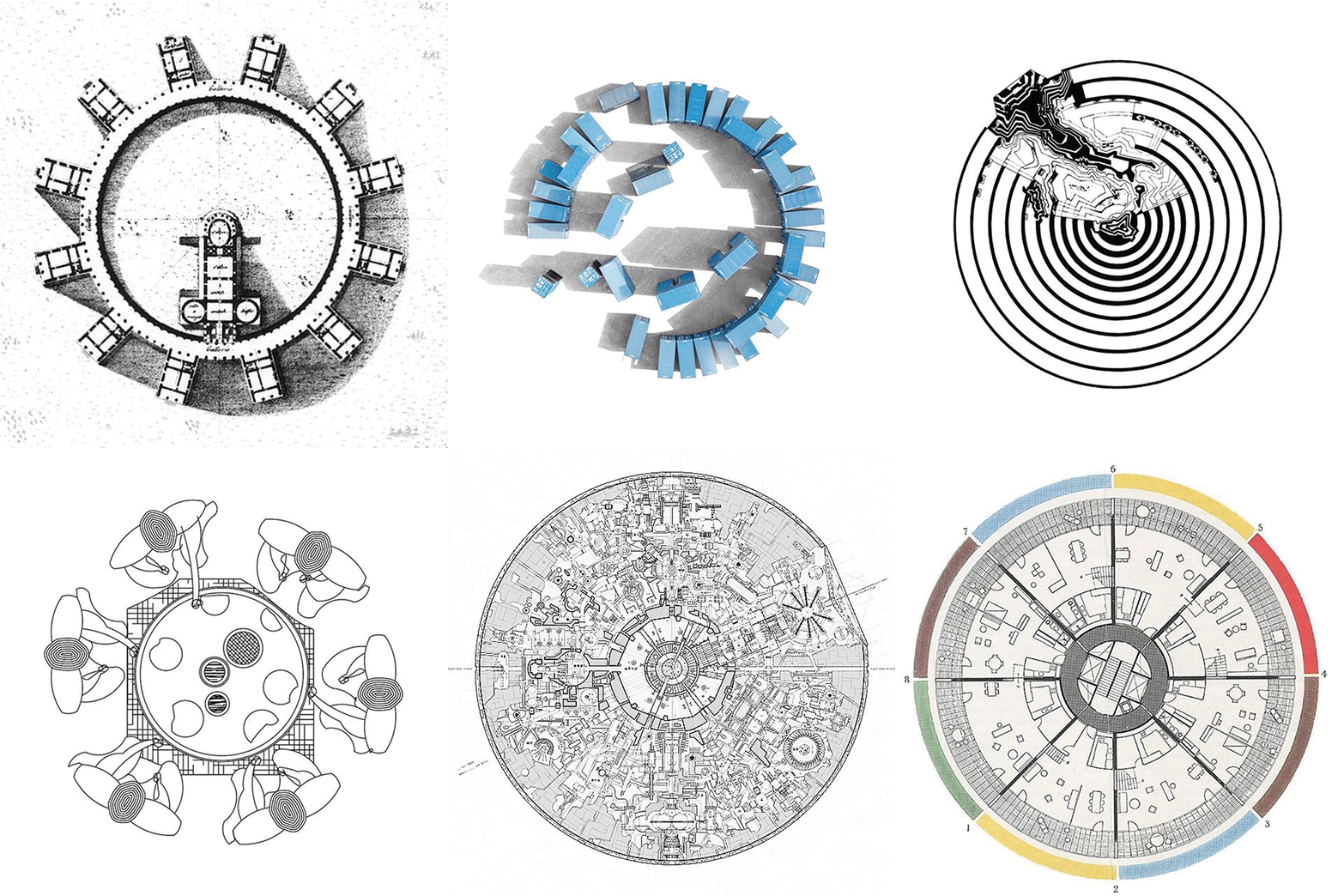
“The circle . . . is the synthesis of the greatest oppositions. [It] combines the concentric and the excentric in a single form, and in equilibrium. Of the three primary forms [triangle, square, circle], it points most clearly to the fourth dimension.”
Inspired by this obsession, one Instagram account titled “Circular Spaces” has collected many of the best examples of circles found in architecture. The account tracks the geometries at all scales, from the planet-sized plan of the Death Star to the familiar intimacy of a round dining table. Check out a selection from “Circular Spaces” below.
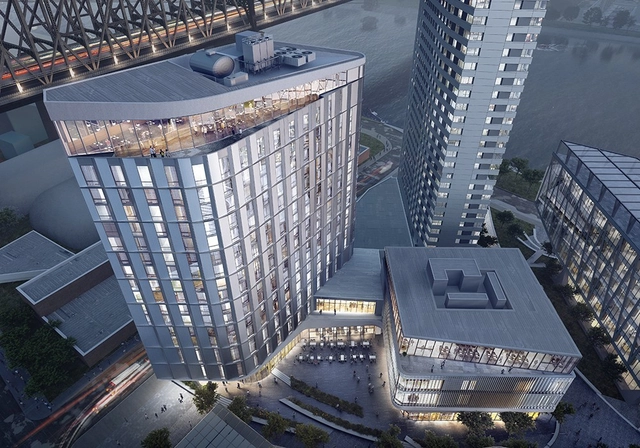
Cornell Tech has revealed that Snøhetta will be the latest firm to design buildings for its currently under-construction Roosevelt Island Campus, joining structures by top architects including Morphosis, Weiss/Manfredi, Handel Architects, and Skidmore Owings & Merrill. The two new buildings, the Verizon Executive Education Center and Graduate Hotel, will be the final part of phase one of the campus master plan, slated for completion in 2019.
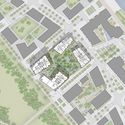
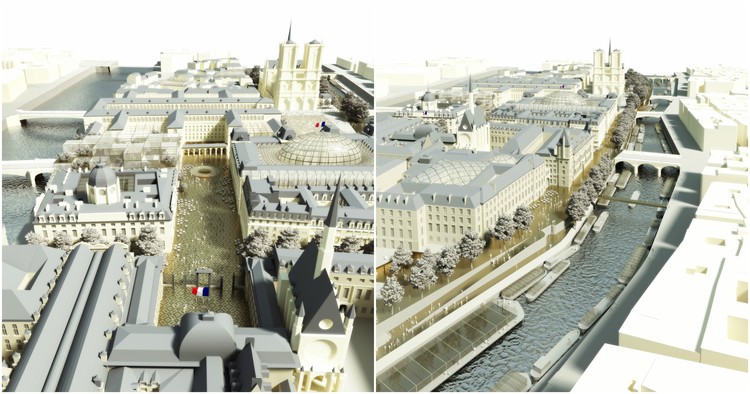
One of two islands in the Parisian Seine, the Île de la Cité is largely known to tourists as little more than the location of such popular destinations as the Notre Dame Cathedral and the Sainte Chapelle—a fate that belies the island's 2000-year history as the center of Paris. However, now there are plans underway to restore the whole island to its former importance: under Philippe Bélaval, the French Centre for National Monuments has selected Dominique Perrault Architecture to design a 25-year masterplan, titled Mission Île de la Cité, to bring back the island’s relevance as something more than a dissonant collection of tourist destinations.
A new piece of bipartisan legislation has been tabled by The United States Senate and House of Representatives named the Timber Innovation Act. The bills were put forward to further the development of tall timber buildings in the US, thereby supporting the nation’s considerable timber market and the rural manufacturing jobs it entails.
“The United States has an opportunity to bring new, sustainable mass timber technology to our construction industry, and the Timber Innovation Actdirects technical assistance and research components already in place,” said Robert Glowinski, President and CEO of the American Wood Council (AWC).
https://www.archdaily.com/866841/new-timber-innovation-act-advocates-for-nationwide-timber-construction-in-the-united-statesOsman Bari
CBack in 2006, the team of Mecanoo and Ayesa placed first in an international competition with its winning proposal for a perforated courthouse in Córdoba, combining the area’s historical character with a modern twist. Now, after almost a decade, the Palace of Justice is set for completion later this year, having broken ground in 2015.
Inspired by Córdoba’sMoorish origins, the design balances a contemporary concrete mass with traditional exterior courtyard spaces; a reflection of the plan of the old city. These are faced by colored ceramic tiles, which break the façade’s uniformity.
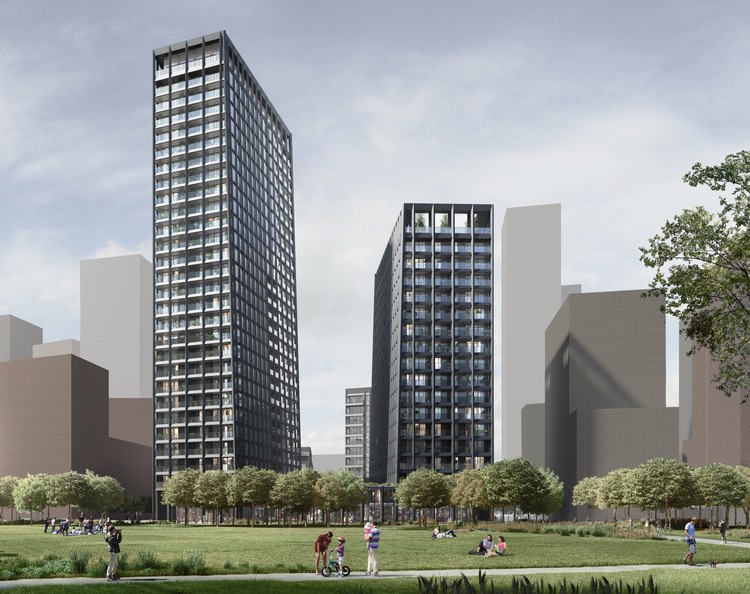
Renderings have been revealed of KPF’s One Bayfront Plaza, a 92-story mixed-use tower in downtown Miami that when completed will reach 1,049 feet tall, becoming one of 5 new buildings that will share the title of Miami's tallest tower.
The project is being developed by Florida East Coast Realty, and will bring 902 apartments, 200 hotels rooms, 532,000 square feet of office space and 104,000 square feet of retail to downtown Miami. Located at 100 South Biscayne Boulevard, the project will total 3.3 million square feet.
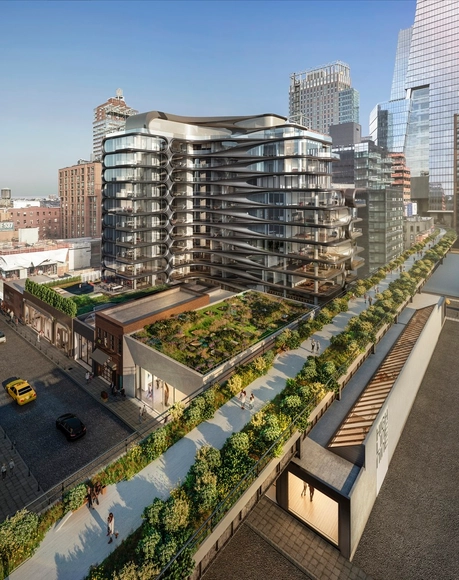
Real Estate firm Related Companies has announced the development of 15 new art gallery spaces to be located in and around the base of Zaha Hadid’s 520 West 28th Street residential building, located along the High Line in the New York neighborhood of Chelsea. The acclaimed Paul Kasmin Gallery, currently located in three West Chelsea locations, will serve as the anchor tenant with a 5,000 square-foot gallery in the base of the Hadid-designed building and additional space in the ‘High Line Nine,’ a collection of full service boutique exhibition spaces located adjacent to the building beneath the High Line.
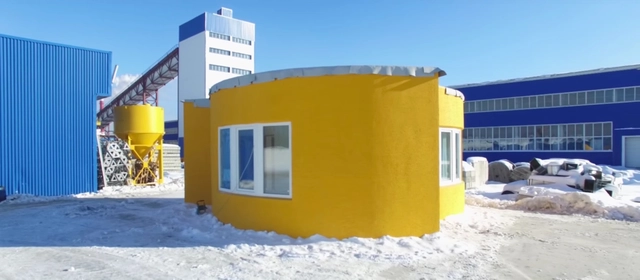
In recent times, 3D printing technology has made some great strides in its production content and quality, and now it has successfully printed the world’s first liveable house in Stupino, Russia. Responsible for this feat are San Francisco 3D printing startup Apis Cor, and Russian real estate developer PIK, who began the project in December of last year.
“Now we can say with confidence that with Apis Cor solution, the construction 3D printing has leaped to a new evolutionary stage,” said the project team. “The company and its partners are confident that the house in Stupino was the first step that can convince the world that 3D technology in the construction market is a reality.”
Courtesy of Flicker User Andreas Levers, Creative Commons
Amongst many things, Europe is known for some of the world’s most bicycle-friendly cities, offering safe and convenient travel routes for its two-wheeled commuters. Berlin, however, does not sit high on this list, but in an effort to address this, a new plan for a system of bicycle “superhighways” is undergoing implementation, incentivising cycling as an efficient means of transport.
Studies commissioned by Berlin’s Senate Department for the Environment, Transport, and Climate Protection looked into 30 possible bike paths, covering stretches of at least 5km. Of these, 12 have been selected as future superhighways, intended to be completely separated from other vehicles on the road.
https://www.archdaily.com/866846/this-system-of-superhighways-creates-a-more-bicycle-friendly-berlinOsman Bari
















_Paolo_Rosselli_DSC_8101.jpg?1489090441 "Professor Short argues that skyscraper design must depart from its current reliance on glass and steel, and begin to harness natural ventilation. Boeri Studio's Bosco Verticale. Image Courtesy of Paolo Rosselli")




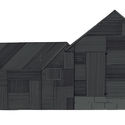
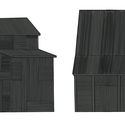
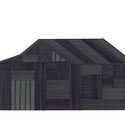

















.jpg?1488852741)
.jpg?1488852874 "© Fernando Alda")
.jpg?1488852752 "© Fernando Alda")
.jpg?1488852864 "© Fernando Alda")