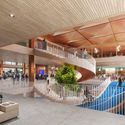
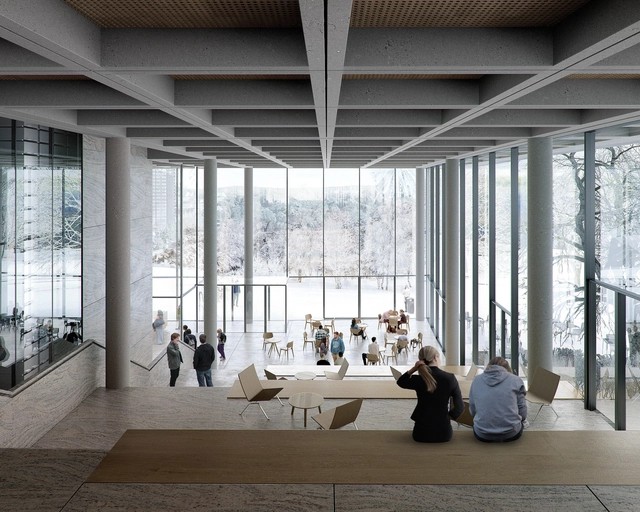
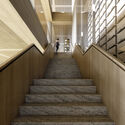
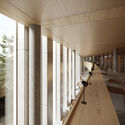
Skidmore, Owings & Merrill (SOM) and TranSystems are redesigning one of Chicago busiest and oldest elevated rail networks. The Chicago State/Lake Station's new design offers improved accessibility, safety, and comfort to all passengers, and respects the surrounding historic fabric of the downtown area. The proposed design includes wider platforms, a hovering glass canopy, a new fly-over connection bridge, elevators, and street level enhancements.
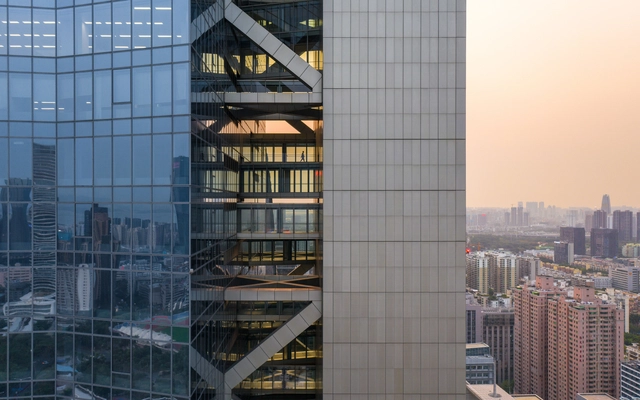
With its Shenzen project, design firm Morphosis reimagines the skyscraper typology, maximizing the flexibility of the floor plan through a detached-core scheme that shifts circulation, services and amenities to the building's exterior. Using a pioneering structural system, the project's spatial configuration diversifies the interiors' functional possibilities while reshaping the circulation routes within the building, with glass sky-bridges and large-scale steel braces knitting the core to the tower's main body. Completed in 2018 with a gradual opening that continues into 2021, the 359.8-metre tower is currently the tallest detached-core building in the world.
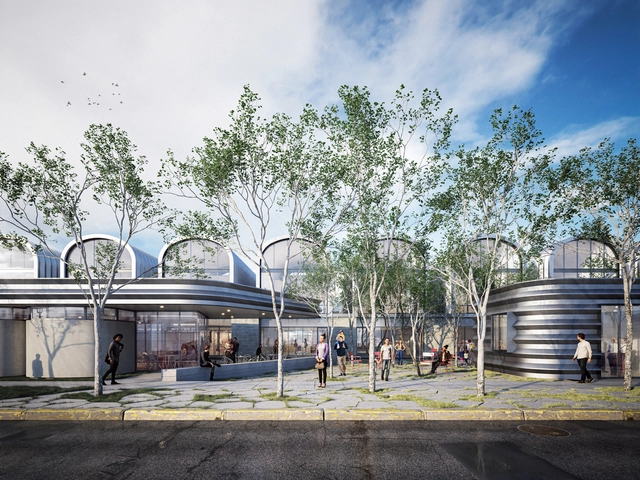
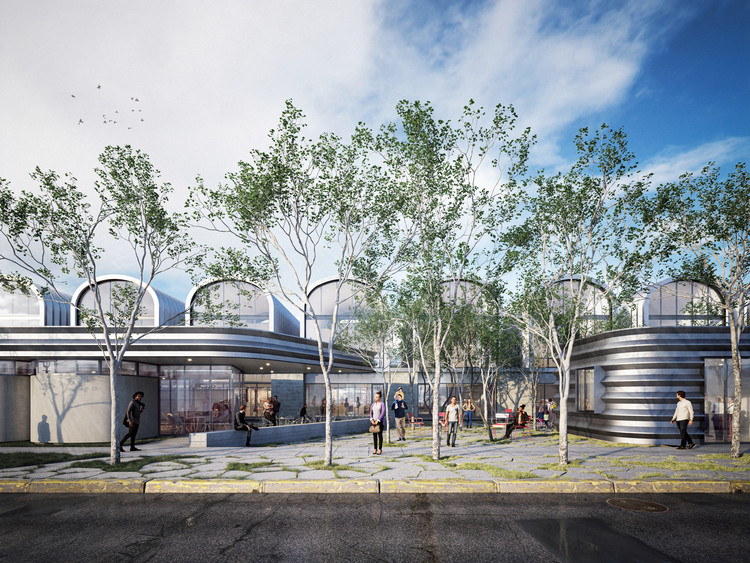
Marlon Blackwell Architects has designed a series of eight live-work Quonset huts as part of a larger development project in Fort Worth, Texas. Working with landscape architect Julie Bargmann of D.I.R.T studio and Studio Outside, the team created the proposal for Prince Concepts. The project has broken ground, and will include 5,500 square feet of office space and three retail locations, as well as a public park.
Auckland in New Zealand has topped the ranking in the 2021 EIU's annual world's most liveable city survey. Classifying 140 cities across five categories including stability, healthcare, culture and environment, education, and infrastructure, this year’s edition of the review has been highly affected by the global pandemic. Australia, Japan, and New Zealand took leading positions, while European and Canadian cities fell down the ranking.
As part of the Dogpatch mixed-use waterfront development, Foster + Partner'sPower Station extension has finally broken ground. The master plan will create multiple new residential, commercial, and recreational spaces, honoring its industrial past and reconnecting the community with the San Francisco Bay waterfront. The architecture firm's 2-building proposal provides the neighborhood with an ideal urban framework to help create a vibrant, healthy, and inclusive community.
With 38% of projects over budget and 35% behind schedule, according to the 42nd Annual Deltek Clarity Report, architecture firms are focusing on the fundamentals. This includes tracking metrics and adopting new technology to keep a closer pulse on performance and profitability. Many architecture firms have a ways to go as only 25% currently see their business as digitally mature, but 76% of firms envision firm digital sophistication in five years, according to the report.
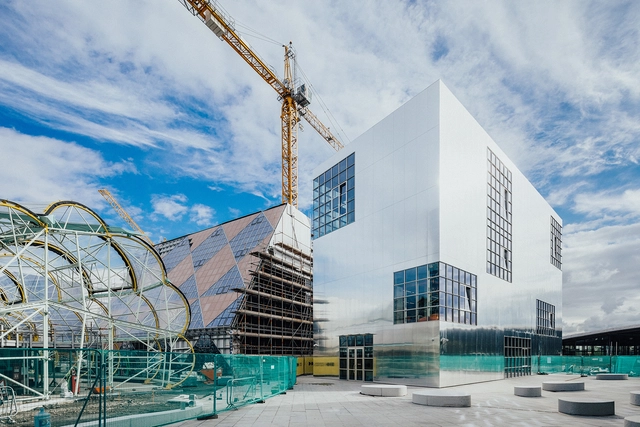
Barcelona-based studio Barozzi Veiga has completed its first UK project, which will house Ravensbourne University’s Institute for Creativity and Technology. The building, whose interiors are designed by Brinkworth, is also the first to be completed within the Design District, London’s new purpose-built creative hub at the heart of the Greenwich Peninsula. Featuring a polished aluminium-clad façade that reflects the neighbouring buildings, the design engages with the surrounding context, while also referencing the area’s industrial past.
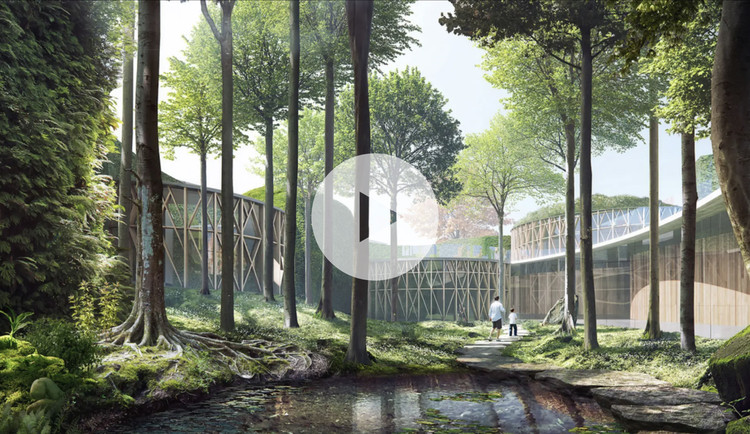
Videos
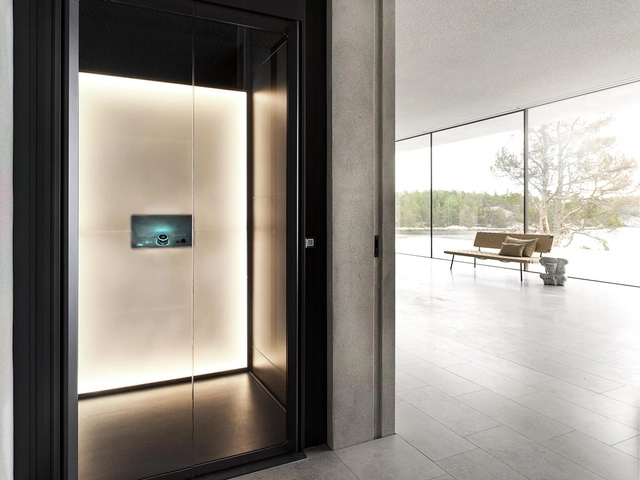
Basements and rooftops which may have previously been difficult to access can be opened up to all in multi-generational households. The only problem is getting grandma off the benchpress. Photographer: Erik Undéhn. Image Courtesy of Aritco
Platform lifts. Swedish manufacturer ARITCO shows how architects can integrate them into residential properties without them looking like an afterthought – but rather a serious design statement.
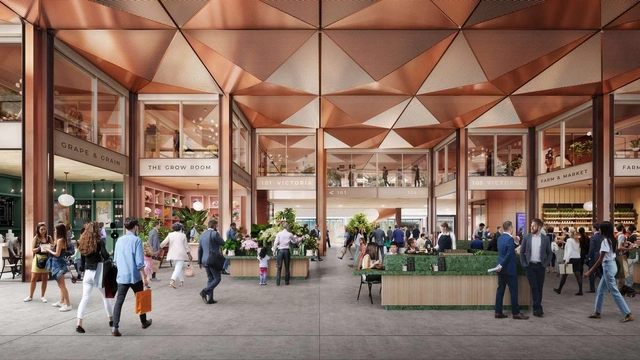
Located in the heart of Westminster, a short distance away from the Buckingham Palace, Henning Larsen are building a community hub that reimagines traditional office and commercial spaces. 105 Victoria Street will be the architecture firm's first ever project in London, providing visitors with an urban plaza that enables an active and social working environment both indoors and outdoors. The project is being developed by BentallGreenOak and is designed in collaboration with Adamson Associates Architects and KPF.
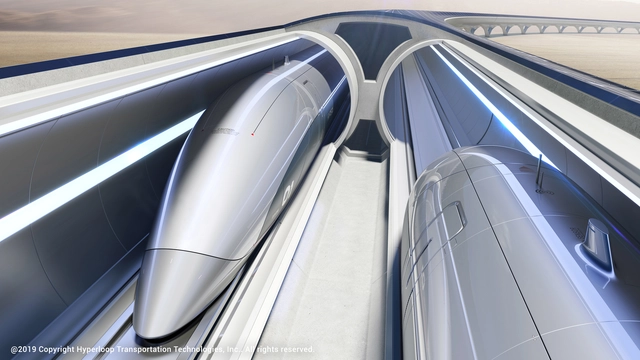
Zaha Hadid Architects is collaborating with Hyperloop Italia to co-design the next phase of works of the transport vehicles, marking a turning point for the future of transportation. The collaboration aims to merge transformative architecture, engineering, and urban planning with the most efficient and sustainable transport network to improve accessibility, connectivity, and well-being in cities.
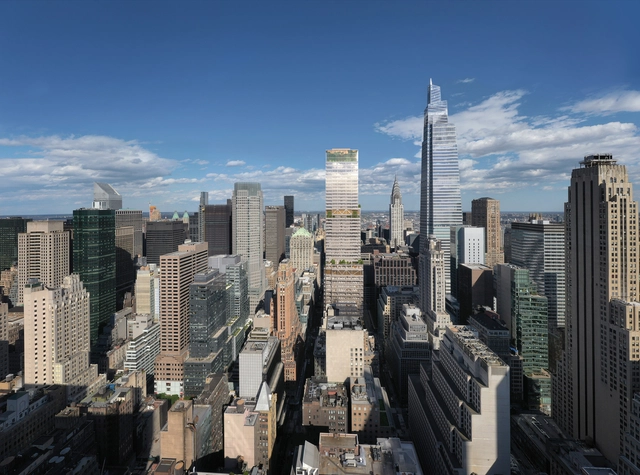
After completing One Vanderbilt, the tallest office building in New York, Kohn Pedersen Fox Associates has unveiled plans for a new skyscraper in Midtown Manhattan. The 320-metre high office tower at 343 Madison Avenue makes the most out of its relatively small plot and the silhouette mandated by the New York City zoning laws, featuring a series of receding volumes that leave a way to gardens and terraces at different levels. When completed, the project will also create an important new transit entrance to the Long Island Rail Road and the Grand Central Complex.
To answer the Biennale's question of "How Will We Live Together", curators of the national pavilions explored what the future would look like in an architectural, cultural, and environmental context. Many saw the future as an entirely virtual environment whereas other highlighted the cruciality of physical coexistence with neighbors. ArchDaily met with Ippolito Pestellini Laparelli, curator of the Russian Pavilion, to discuss how the idea of the pavilion came together throughout the year as a virtual platform for interdisciplinary creative thinkers, the role of cultural institutions across physical and digital spaces, and how digitalization is always part of the conversation.
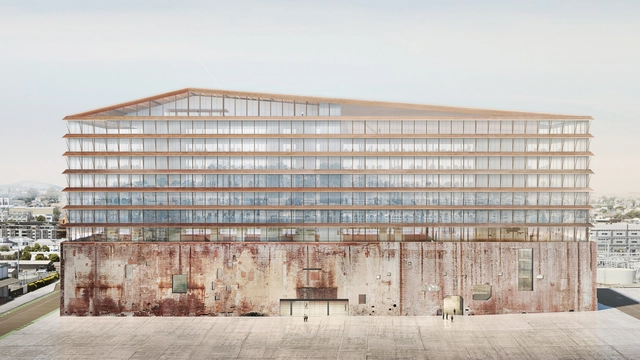
Construction work began for Herzog & de Meuron’s transformation of a former power plant building in San Fransico into a mixed-use project. Designed in collaboration with California-based practice Adamson Associates, the adaptive reuse of iconic Station A is part of the Portrero Power Station project, the redevelopment of a 29-acre industrial site into an extension of the Dogpatch neighbourhood. Herzog & de Meuron’s design retains and repurposes various features of the industrial building while adding a lightweight, steel-framed structure on top, thus giving new life to one of San Francisco’s landmarks.
Industrial architecture usually requires fast installation, low-maintenance components, and flexible spaces that can be used for different purposes. Therefore, modular solutions are very common in this type of construction, also adding a powerful visual language to the building.
https://www.archdaily.com/962662/modular-components-in-industrial-architectureEquipe ArchDaily Brasil
Talking to the Louisiana Channel, iconic Japanese architect Kengo Kuma discusses the many influences that have shaped his work - and also delves into the impact that the ongoing pandemic has had on the architectural field. In the interview, Kuma describes how influential his early upbringing was to his architectural career. Growing up in a small wooden house in the 1950s - originally built in 1942, would go on to guide his architectural perchance of using wood in his projects. Kuma also mentions Japanese architect Kenzu Tange as a key inspiration and cites Tange's Yoyogi National Gymnasium - constructed for the 1964 Summer Olympics in Tokyo - as a project that would influence him towards an architectural career.
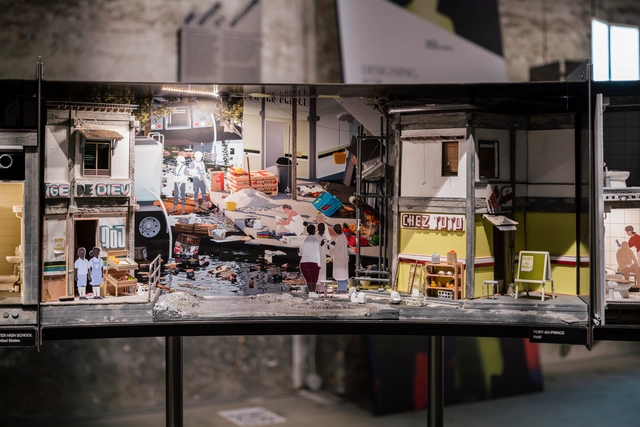
"When we enter the restroom, we are never alone. Instead, we are entangled in a network of bodies, infrastructures, ecosystems, cultural norms, and regulations". Although restrooms are often overlooked facilities that cater to the needs of individuals, they are, however, spaces where gender, religion, race, hygiene, health, and the economy are defined and expressed. For the 17th International Architecture Exhibition at La Biennale di Venezia, Matilde Cassani, Ignacio G. Galán, Iván L. Munuera, and Joel Sanders designed two pavilions that exhibit how restrooms are political architectures, serving as battlegrounds for the world's disputes.
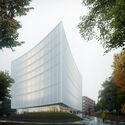
Cobe’s winning design for the new library of the University of Gothenburg proposes a light, clean volume, whose slightly curved facades are a nod to the pages of an open book. The Danish architecture studio translates the concept of knowledge as the heart of a library into the interior spatial configuration of the project, while the architectural image evokes the idea of a lighthouse. Featuring a transparent and open ground floor, the new repository of knowledge creates a strong connection with the surrounding park, becoming a mediator between the city and the university.
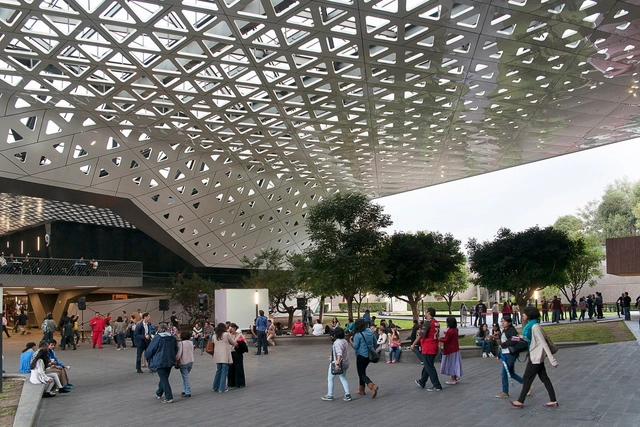
In a Design and the City episode - a podcast by reSITE on how to make cities more liveable – Mexican architect Michel Rojkind talks about running, coming from a musical background, and the responsibility of architects to create buildings that can “give something relevant” back to the community. The interview delves into Rojkind’s philosophy of making sure that architectural conversations are not insular, but instead conversations that take place within a multi-disciplinary context.
A few weeks ago the photographer Aldo Amoretti launched an unusual call inviting his and ArchDaily's followers to share their favorite places so that he could later photograph them, in a sense of a collective perspective and with the objective of discovering places. Last week we showed the finalists and today Amoretti has already chosen the places that he will go to document, which will be published on ArchDaily in the coming weeks.
Courtesy of ZGF Architects, Wexford Science & Technology
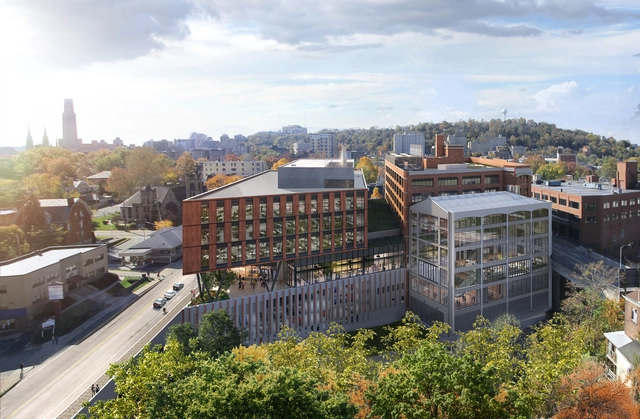
ZGF Architects, Wexford Science & Technology, and The University of Pittsburgh have revealed new details of the Ford Motor Assembly Plant adaptive reuse in Pittsburgh. Called The Assembly, the project aspires to become a hub of university research, entrepreneurial activity, and innovation programming. The six-story crane shed was used to hoist parts unloaded from the Pennsylvania Railroad tracks for assembly.


.jpg?1623397042&format=webp&width=640&height=580)
.jpg?1623397062 "Courtesy of Skidmore Owings & Merrill")
.jpg?1623397056 "Courtesy of Skidmore Owings & Merrill")
.jpg?1623397051 "Courtesy of Skidmore Owings & Merrill")
.jpg?1623397042)







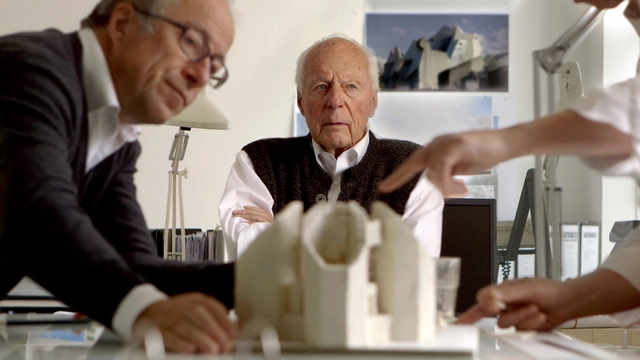
.jpg?1623359381 "Neviges Pilgrimage Church. Image © Laurian Ghinitoiu")
.jpg?1623359479 "Neviges Pilgrimage Church. Image © Laurian Ghinitoiu")