‘La Casa’ Permanent Supportive Housing / Studio Twenty Seven Architecture + Leo A Daly

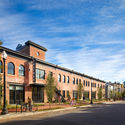
Studio Twenty Seven Architecture, along with joint venture partner Leo A Daly, are continuing to develop their design for the District-owned “La Casa” supportive housing project. The project is an important milestone for the District in their efforts to redefine the concept of housing for the homeless community in Washington D.C. More images and architects’ description after the break.
HUIS-JCMZ / Studio Twenty Seven Architecture

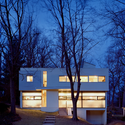
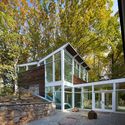
Building on the foundations of a former brick Colonial residence demolished to realize this new pavilion, Studio Twenty Seven Architecture worked collaboratively with owner Johannes Zutt to create a 2,500 sqf house they envisioned as “a city in the garden.” Zutt, a peripatetic Dutch national, desired a modern domestic space with open plan living and minimalist detailing recalling the European architecture of Luigi Snozzi, Rem Koolhaas, and Pierre Chareau. Rooms are arranged within the house to form public and private spaces in the same manner that buildings are arranged in an urban setting to create streets, plazas, and alleys. The result is a contemporary dwelling designed using rigorous programming and critical logic to carefully evaluate the function and efficiency of every element within the home.
Architect: Studio Twenty Seven Architecture
Location: Chevy Chase, Maryland, USA
Project Team: John K. Burke (AIA), Todd Ray (AIA, LEED-AP), Raymond Curtis (Assoc. AIA), Amy Krosnowski, Alexander S. Coll, Jonathan Chung
Contractor: Glass Construction Company
Structural Engineer: Ehlert Bryan Inc.
MEP Engineer: Metropolitan Engineering Inc.
Project Area: 3,000 sqf
Project Year: 2005
Photographs: Maxwell Mackenzie
Howard Road Academy / Studio 27 Architecture

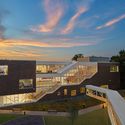
A short while ago, we shared Studio 27 Architecture’s Rincon | Bates House, a contemporary re-conceptualized row house in Washington, D.C. The firm’s latest project, a new charter school for D.C., is designed to accommodate a new approach to teaching. The school has adopted a new pedagogy, known as the Paragon Teaching Method – an interesting choice as the school is situated in the US’s capital. This method replaces the traditional way of learning history and encourages an integrated approach that emphasizes how one idea builds on and evolves into another. “In Paragon, students study history across continents, and gain a profound understanding of the manner in which many ideas develop at the same time in independent cultures unaware of the other’s breakthroughs. Through this, students develop a larger picture of history and the associated interrelationships,” explained a Mosaica Education statement.
More about the school, including more images, after the break.