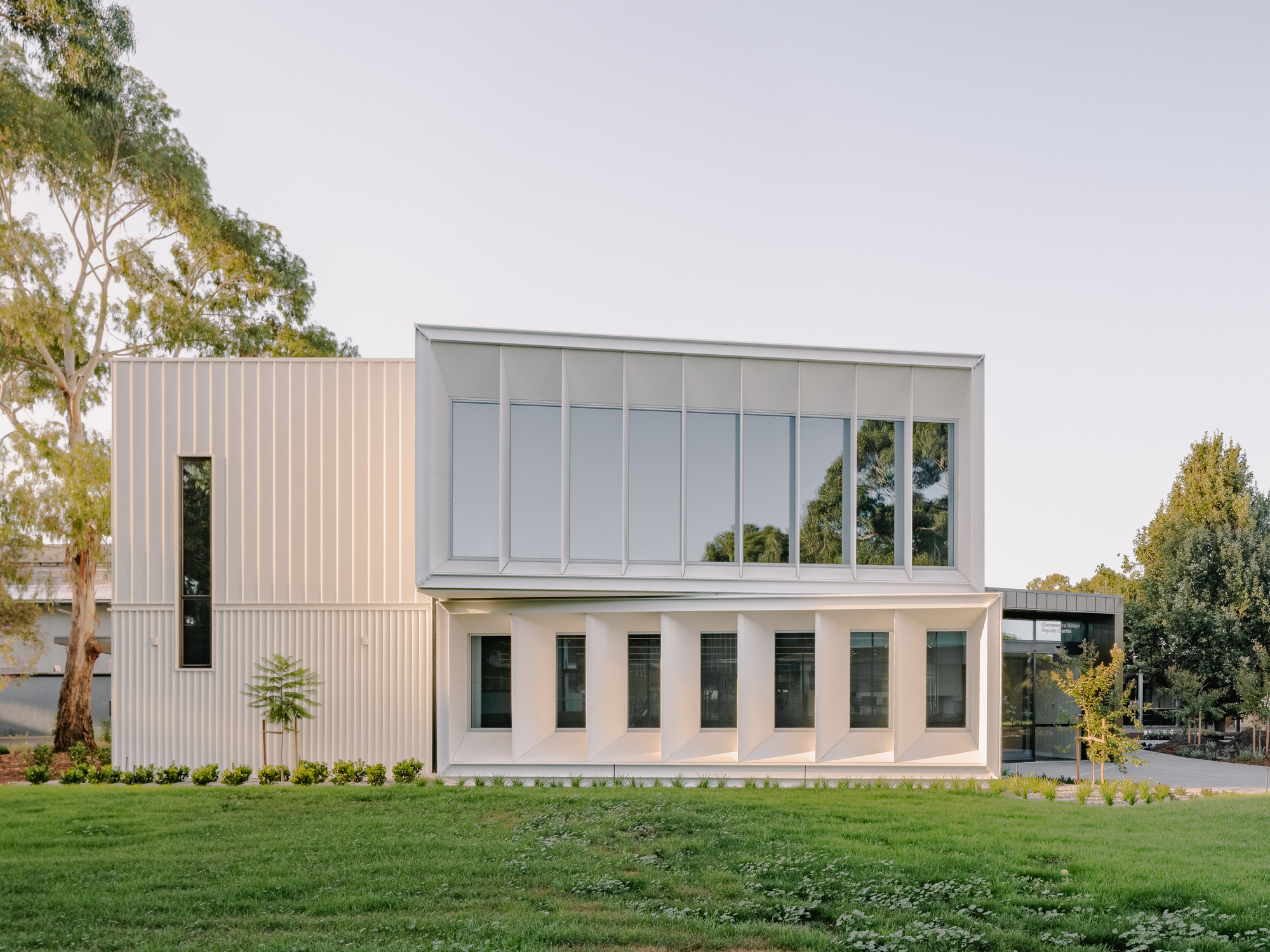
Courtesy of Peddle Thorp Architects
Architects: Peddle Thorp Architects / Antoine Damery – Pat Cutri
Location: Melbourne, Australia
Client: MYER
Project Year: 2011
Project Area: 5,200 sqm
Photographs: Courtey of Peddle Thorp Architects

Courtesy of Peddle Thorp Architects
Architects: Peddle Thorp Architects / Antoine Damery – Pat Cutri
Location: Melbourne, Australia
Client: MYER
Project Year: 2011
Project Area: 5,200 sqm
Photographs: Courtey of Peddle Thorp Architects

Courtesy of Peddle Thorp Architects and Sustainable Built Environments
Peddle Thorp Architects and Sustainable Built Environments received a commendation for their finalist listed entry in the Proposition 2065 design competition. The competition invited all architects and anonymous participants to develop solutions for a specific Australian site in St. Leonard’s in Sydney adjacent to the train station and a major road intersection. The entries were judged according to the balance of the design potential of the site and economic feasibility of commercial development.
More information and images on the entry after the break. read more »
Architects: Donovan Hill + Peddle Thorp Architects
Location: 30 Bamberry Street Fingal, Brisbane, Australia
Project Team: Timothy Hill, Brian Donovan, Damian EckersleyFrank Way, Jeffrey Briant, Brett Hudson, Lucas Leo, Mark Floate, Greg Lamb, Fedor Medek, George Taran, Ron van Sluys, Ines Hallmond, Graham Mudge, Graham Hobbs, Rosario Distaso, David Evans, Mark Damant, Seth Remaut, Tania McLachlan, Phil Hindmarsh, Kevin O’Brien, Michael Hogg, Lisa Matray, Yee Chong, Louise Hamilton, Paul Jones, Michael Moore, Chris Hing Fay, Ceirwen Burton, Ben Killeen, Eden Norris, Stephanie Donigi, Michael Rasi, Gary Cannon
Total Floor Area: Nominally 35,000 m2 gross
Design Period: 2 years
Construction Period: 2004-2006
Completion Date: November 2006
Photography: Jon Linkins, Diana Snape, Shantanu Starick, Donovan Hill
Antoine Damery, sent us his design for the Peddle Thorp Architects submission for the international competition for the thematic pavilion of the Expo 2012 in Yeosu, Korea.
The pavilion is prototypical architecture, drawing from the multidisciplinary source of product design- urban planning-architecture and naval design. The pavilion is resolved as a vessel – a floating exhibition space that can be sailed to other cities. It’s an evolution of architecture- a futuristic adaptable living building that can adapt to suit an unknowable future. Its ingenuity will encourage multidisciplinary problem solving through sustainable solutions.
More images and architect’s description after the break. read more »
“In the more recent past, it is the architecture of minimalism that has provided the most explicit and significant contribution to the reciprocal relationship between fashion and architecture. In many ways the abstraction and literal emptiness of minimalism has…
We recently received KieranTimberlake’s newest book, Inquiry. Instead of listing one project after the next, as in most monographs, this book is organized around ten gerunds: bending, coupling, filtering, inserting, offsetting, outlining, overlapping, puncturing, reflecting, and tuning. This is…
Combinatory Urbanism: The Complex Behavior of Collective Form
Thom Mayne recently sent us his latest book, Combinatory Urbanism: The Complex Behavior of Collective Form. MIT Professor of Urban Design and Landscape Architecture, Alan Berger, hails this book as “nothing short of a tour de force and should be…