Foster, Hadid, Gehry, Nouvel, Piano and more against Prince Charles
A group of ten architects, including Norman Foster, Zaha Hadid, and Frank Gehry, signed a letter criticizing Prince Charles for talking against the construccion of luxury houses in Chelsea Barracks, London.
Prince Charles is against the modern design with glass and steel used by architects in the Chelsea district, and wants them to use a more traditional design using stones and bricks. The Sunday Times also said that Prince Charles showed his concern to Qatar’s royal family, owner of the site.
The design was developed by Richard Rogers, member of the House of Lords and known for projects like Heathrow’s Terminal 5, the Millenium Dome in London and the European Court of Human Rights. Rogers, with the other ten architects, accused Prince Charles of taking advantage of his royalty position to attack the architectural plans of the site.
This isn’t the first time that Prince Charles enters the architectural debate, strong supporter of Leon Krier’s New Urbanism.
Full text of the public letter to Prince Charles:
THE Prince of Wales’s intervention over the design of the former Chelsea Barracks site deserves more reasoned comment. It is essential in a modern democracy that private comments and behind-the-scenes lobbying by the prince should not be used to skew the course of an open and democratic planning process that is under way.
Proposals by Richard Rogers’s practice for the developers Qatari Diar were recently submitted for planning to Westminster city council. The scheme has been adapted and changed in response to comments from Westminster’s planning officers and extensive local consultation. Statutory bodies such as the Commission for Architecture and the Built Environment and the Greater London Authority have also been consulted. Westminster’s planning committee will meet and shortly deliver its verdict.
Its members should be left alone to decide whether the Rogers’s scheme is a fitting 21st-century addition to the fabric of London. The developers have chosen carefully in selecting the best architect for the sensitive project. Rogers and his team have played their part in engaging with the democratic process. The prince and his advisers should do the same. The process should be allowed to take its course; otherwise we risk condemning this critical site to years as an urban blight.
If the prince wants to comment on the design of this or any other project, we urge him to do so through the established planning consultation process. Rather than use his privileged position to intervene in one of the most significant residential projects likely to be built in London in the next five years, he should engage in an open and transparent debate.
Lord Foster, Foster and Partners, London, Pritzker Prize 1999
Zaha Hadid, Zaha Hadid Architects, London, Pritzker Prize 2004
Jacques Herzog and Pierre de Meuron, Pritzker Prize 2001
Jean Nouvel, Jean Nouvel Architectes, Paris, Pritzker Prize 2008
Renzo Piano, Renzo Piano Building Workshop, Genoa, Pritzker Prize 1998
Frank Gehry, Gehry Partners, Los Angeles, Pritzker Prize 1989
Sir Nicholas Serota, Commissioner, CABE 1999-2006
Richard Burdett, London School of Economics
David Adjaye, Adjaye Associates, London
Deyan Sudjic, Director, Design Museum, London
Foster and Partners 5-star Hotel in the UK gets approval
One of the latest projects by Foster and Partners, a 5-star hotel and conference center near the Heathrow airport in the UK, just got the city Mayor´s approval.
The project, developed by Riva Properties, has 60,000sqm aprox distributed among 13 stories. Some of these are sunken, resulting on an exterior height of only 25m.
The rooms are contained within six pavilions above the ground, linked by bridges and wrapped in a unifying glass envelope, which not only acts as a barrier to aircraft noise but also to flood the public spaces with daylight, contributing to a highly efficient energy strategy.
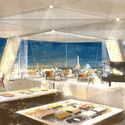
The entrance lobby has a floating glass deck with views down to the sunken restaurant level, shallow pool and waterfall. This restaurant floor is accessed via a timber walkway and incorporates a business centre, as well as a variety of venues to eat and drink. The double-height conference facilities, which have their own reception to allow separate access from street-level, encircle a top-lit atrium that brings natural light deep into the building and down to the lower levels.
More images after the break.
Foster + partners design for UAE Pavillion at Shanghai Expo 2010
Foster + partners decided to base on a sand dune for their UAE Pavillion design for the Shanghai Expo 2010. The pavillion is a reference to the symbolic feature of the desert landscape shared by all seven emirates.
The peak rises to 20 meters in height and it is entered via a glazed lip at the pavillions base. light penetrates the building’s business center and VIP area through glazed vertical strips which illuminate the pavillion from within by night. With a capacity for 450 people and enclosing 3000 square meters of exhibition space, the pavillion is one of the largest structures to be built for shanghai expo 2010.
Seen at designboom. More images after the break.
Finalists for the National Museum of African American History and Culture
The Smithsonian Institute has announced the finalists for the new National Museum of African American History and Culture in Washington D.C. The museum will be located at the end of the Washington Mall, being the latest addition to this location. The design concepts will be on show at the castle building until April 6. The, a jury will select a winner. The museum will open in 2015, at a cost of 500 million dollars.
Finalists are:
Foster + Partners and URS
Diller Scofidio + Renfro in association with Klingstubbins
The Freelon Group, Adjaye Associates and Davis Brody Bond
Devrouax & Purnell and Pei Cobb Freed & Partners
Moody Nolan in association with Antoine Predock Architects
Moshe Safdie and Associates in association with Sulton Campbell Britt & Associates
Seen at designboom. More images after the break.
Harmon Hotel in Las Vegas by Foster and Partners gets cut (and not due to the crisis)
A few weeks ago I went to Las Vegas, and was surprised by the amount of on-going projects in the middle of the crisis. One of those projects was The Harmon Hotel, Spa & Residences at the CityCenter’s gateway to the Las Vegas Strip designed by Foster and Partners, a project that “will push the boundaries of the hospitality industry to new limits with a design strategy that combines a sleek, modern exterior with a highly luxurious interior” according to the architects.
And we just saw the news that the project got “cut”, but in a literal way. It wasn´t because of the economical crisis, but actually due to construction flaws: 15 floors of wrongly installed rebar. This forced the developer to cut down the height -removing the condos portion of the building- resulting on a 28 stories tall building, instead of 49 as planned.
But what´s funny is how the project was -at least on the exterior look, because engineers must been working extra hours redoing shafts, elevators, etc- just scaled down.
In related news (cuts), back in October Foster said recession will not force him to cut jobs, and now his office is going to layoff 300-400 employees.
Seen at: Adaptation or Disaster? – LV Sun
Ernst & Young Headquarters, Amsterdam / Foster + Partners

Foster + Partners just finished the first tower in Amsterdam, at the Vivaldi-park area of the new Zuidas district, south of the city.
The 24-storey building is divided into two twelve metre-wide column free towers with open, flexible floor plates. The blocks are staggered in plan to admit as much natural light as possible, helping this tower to be ten per cent more efficient than the target Dutch environmental standards. Plus, it has a very nice looking lobby.
Beijing Airport / Foster + Partners
After 4 years the Beijing Airport -currently the biggest one in the world- is finished, just in time for the 2008 Olympics. The airport, designed by Foster + Partners, turned out to be a very efficient building in terms of in terms of operational efficiency, passenger comfort, sustainability and access to natural light.
As an interpretation of traditional chinese culture the roof of the airport has a dragon-like form. According to Norman Foster [...] this is a building borne of its context. It communicates a uniquely Chinese sense of place and will be a true gateway to the nation. This is expressed in its dragon-like form and the drama of the soaring roof that is a blaze of ‘traditional’ Chinese colours – imperial reds merge into golden yellows. As you proceed along the central axis, view of the red columns stretching ahead into the far distance evokes images of a Chinese temple.
In Progress: Elephant House / Foster + Partners
If house design is a challenge, imagine designing a house for elephants. Foster + Partners took the challenge and is currently finishing the Elaphant House at the Copenhagen Zoo, for a group of Indian elephants.
The Elephant House is covered with lightweight, glazed domes that enclosure spaces with a strong visual connection with the sky and changing patterns of daylight.
Willis Headquarters at Lime Street / Foster + Partners

Foster + Partners just informed us that the new Willis headquarters at Lime Street in London is complete. As usual, the firm lead by Sir Norman Foster developed a urban piece that integrates with the city at street level and features environmental strategies to reduce its energy consumption and carbon footprint.
This two buildings are developed as a series of overlapping curved shells while its section is arranged in three steps. The roof terraces overlooking the plaza on the lower two steps are directly accessible from the office spaces. Both buildings have a central core to provide open floor plates and maximum flexibility in use.
The entire development is visually unified by its highly reflective façade. The pressed form of the panels and their mica finish give them depth and texture. A dynamic effect is established through the interplay of solid and glazed panels arranged in a saw-tooth pattern, the fins also increase insulation while reducing glare
and solar gain.
Together with the highly efficient services equipment and systems in the building, the façade design is integral to the energy strategy, which is rated BREEAM Excellent. What surprised me is the parking capacity: 42 Cars, 88 motorcycles, 264 bicycles
According to Sir Norman Foster this building has come out of a very different design process, yet continues the practice’s commitment to developing humane, flexible and dynamic workplaces that are both informed by, and woven into, the urban fabric. Foster has some very interesting approaches when it comes to sustainable design and urban spaces. I recommend checking his presentation at DLD we posted last week.
And now, some pictures and facts.
Sir Norman Foster on TED Talks
Well, not exactly on TED Talks but on the DLD (Digital Design Life) Conference in Munich which is being presented at the TED site. Norman Foster discusses his work to show how computers can help architects design buildings that are green, beautiful and “basically pollution-free.”