Governor Cuomo’s Solution for Ravaged Homes in NYC’s Coastal Region

After months of debate, the United States Congress has passed a bill that will allocate $51 billion to Hurricane Sandy relief helping the thousands who lost their homes and businesses to the devastating storm last October. New York Governor Andrew Cuomo announced that $400 million of the aid will be used to fund New York’s buyout program, an initiative to help address the damaged homes and coastline. The program is two-fold; in part it will help reimburse the property damage caused by the storm, but the initiative has a larger goal, which is to address the nature of coastal flooding and create a barrier that would mitigate the damage created to the coast by storm surges in the future. Since the storm, there have been many suggestions as to how to prepare for the type of damage brought on by Hurricane Sandy of 2012 and Hurricane Irene of 2011. These suggestions range from flood gates to barrier reefs. Cuomo’s buyout program, as reported by the Architect’s Newspaper Blog, hopes to encourage residents along vulnerable flood zones to sell their land to the city for the development of a natural coast that would absorb the impact of strong winds and storm surges.
More after the break…
BIG’s West 57th “Pyramid” Wins Final Approval

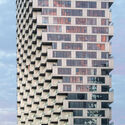
After an “arduous” public review and a heated debate over affordable housing, New York’s City Council has unanimously awarded final approval to BIG’s tetrahedral-shaped West 57th apartment building in Manhattan. As reported by Crain’s New York Business, a compromise has been made to include 173 affordable housing units within the 32-story, 750-unit residential building and the neighboring industrial building that will be converted into 100 additional rental apartments. As you may recall, the community board and Councilwoman Gail Brewer initially threatened to “torpedo the project” if the apartments were only made affordable for a 35 year period. However, Durst apparently won them over by contributing one million dollars into an affordable housing fund.
“The good news, which is the mantra of my office and community board No. 4, is there will be, yes, by law, 35 years of income-restricted affordable housing,” stated City Councilwoman Brewer, who represents the area.
Foster Responds to Kimmelman’s “Offensive” Diatribe Regarding the New York Public Library

When applying “major surgery” to a beloved, 20th century “masterpiece”, you’re going to face some harsh criticism. Such is the case for Norman Foster, as the legendary British architect has been receiving intense backlash from New York’s toughest critics for his proposed renovation to the New York Public Library. First, the late Ada Louise Huxtable exclaimed, “You don’t “update” a masterpiece.” Now, the New York Time’s architecture critic Michael Kimmelman claims the design is “not worthy” of Foster and believes the rising budget to be suspect.
More on Kimmelman’s critique and Foster’s response after the break…
‘The City That Never Was’ Symposium

Organized by Christopher Marcinkoski and Javier Arpa, in cooperation with the Architectural League of New York, ‘The City That Never Was’ symposium will be taking place Friday, February 22, from 9:00am-5:30pm EST at the Scholastic Building in New York. The one day event will use the current economic and housing crisis in Spain as a lens to reconsider how planners, designers, politicians, and financiers conceive of and realize large-scale contemporary urbanization and settlement. It will be organized through four primary themes — infrastructure, waste, landscape, and instant urbanism – in order to explore new possibilities for how future patterns of urbanization can be conceived, financed, planned, deployed, and inhabited. For more details, including the complete itinerary and speaker information, please visit here.
adAPT NYC Competition Announces Micro Apartment Winner and Finalists

In an effort to address housing concerns throughout the city, New York City held the adAPT NYC Competition in search for a micro-unit apartment building that would be developed into a new housing model for the “small household population”. The winner and five finalists were announced earlier this week, revealing a sharp focus on consolidating various living areas to save space and resolving to give multi-functionality where ever possible. There is also an emphasis on community in each of the proposals, making up for the small units with more public amenities within the building. Join us after the break to take a closer look at the projects.
What Cities Can Do with Vacant Lots

The bursting of the housing bubble wreaked havoc on cities across the United States causing widespread blight in once-thriving community economies. Foreclosed, abandoned and condemned homes continue to pockmark neighborhoods and communities, adding to the vacant lots of populous but affected cities like Philadelphia. The Mayor’s Office of Philadelphia approximates that there are nearly 40,000 vacant lots throughout the city of brotherly love, about 74% of which are privately owned, making them virtually inaccessible to rehabilitation. But the city has a strong drive to amend these conditions. With organizations like DesignPhiladelphia’s “Not a Vacant Lot” and the city’s Redevelopment Authority, some of this land is being put to good use.
MoMA presents ‘Le Corbusier: An Atlas of Modern Landscapes’

Mark your calendars! MoMA has plans for the new exhibition, Le Corbusier: An Atlas of Modern Landscapes which will be centered around Le Corbusier‘s worldview of architecture. It explores both his most famous architectural projects, as well as the means by which he was able to realize them. Through a collection of early watercolors, drawings and photographs, curator Jean-Louis Cohen provides a peak into Le Corbusier’s journeys and developments as an architect, revealing how he explored the world and what he drew from his travels and observations.
More on ‘Le Corbusier: An Atlas of Modern Landscapes’ after the break.
Mayor Bloomberg Announces Winner of adAPT NYC Competition

New York City Mayor Michael Bloomberg has announced the winner of adAPT NYC - a city-sponsored competition that challenged developer-led teams to design an innovative micro-apartment that responds to 21st century housing problems. With an all time high of 8.4 million people, and an expected million more by 2030, New York City’s shortfall of affordable one and two person apartments is continuing to grow at a staggering rate. In an effort to solve this imbalance, the winner of adAPT NYC will build an experimental project on a piece of city-owned land in Kips Bay, Manhattan, that has been alleviated from the 1987 density restriction that requires all new apartments to be greater than 400 square feet.
“The growth rate for one- and two-person households greatly exceeds that of households with three or more people, and addressing that housing challenge requires us to think creatively and beyond our current regulations,” said Bloomberg.
So, who won adAPT NYC? Find out after the break!
Brookfield’s Manhattan West Breaks Ground

New York City’s Midtown West will be experiencing a large makeover over the coming years. Shortly after Hudson Yards broke ground in late 2012, Brookfield Properties initiated the first phase of its 5.4 million-square-foot master plan for Manhattan West on the corner of 33rd Street and 9th Ave. Hovering over Penn Station’s Railroad tracks, an engineering feat will support two 60-story towers that will encompass residential and commercial functions, as well as public and community space.
CODA wins P.S.1 with Skateboard Scrap ‘Party Wall’

The Museum of Modern Art and MoMA PS1 has selected CODA’s (Caroline O’Donnell, Ithaca, NY) large-scale, self-supporting Party Wall, made from leftover shreds of skateboard material, as winner of the 2013 Young Architects Program (YAP). Drawn from five finalists, the porous skin of CODA’s temporary urban landscape will shade visitors of the Warm Up Summer Music series with its reclaimed woven screen, while providing water in refreshing cooling stations and seating with its detachable wooden skin on the lower half of the linear structure.
“CODA’s proposal was selected because of its clever identification and use of locally available resources – the waste products of skateboard-making – to make an impactful and poetic architectural statement within MoMA PS1′s courtyard,” said Pedro Gadanho, Curator in MoMA’s Department of Architecture and Design. “Party Wall arches over the various available spaces, activating them for different purposes, while making evident that even the most unexpected materials can always be reinvented to originate architectural form and its ability to communicate with the public.”
Continue after the break for the complete project description.
Artist Antonio Pio Saracino & Salt ‘N Pepa to Unveil Arches of Hope Installation

Created and conceived by Patrick Duffy, the creative director of the OUT NYC, and designed by award-winning Italian designer and architect Antonio Pio Saracino, the Arches of Hope installation will be launched at its opening reception on Thursday, January 17, from 6:30pm-8:30pm at the OUT NYC and be on display until January 24. In collaboration with Lifebeat: Music Fights HIV/AIDS and the MTV Staying Alive Foundation, the stunning and inspiring interactive art installation will be unveiled on the eve of President Obama’s second inauguration as part of a multi-faceted campaign aimed at raising awareness of the rise of HIV and AIDS in young people. More images and information after the break.
Situ Studio to Construct Valentine’s Day Installation with Salvaged Sandy Debris

Situ Studio has been selected from eight competitors as winner of the fifth annual Times Square Valentine Heart Design, cosponsored by Times Square Arts, the public art program of the Times Square Alliance, along with Design Trust for Public Space. The young, Brooklyn-based practice won the jury over with their Heartwalk proposal made of New York and New Jersey boardwalk boards that were salvaged from the aftermath of Hurricane Sandy.
The installation will be unveiled on Tuesday, February 12, 2013, and remain on view until March 8, 2013.
Learn more about Situ Studio’s winning proposal after the break.
Urban Fabric: Building New York’s Garment District

New York’s Garment District, consisting of 18 blocks in the west side of midtown, was the city’s most well known industries in the boom of the 1920s through the early 50s. The influx of immigrants and the geography of New York City made it a natural hub for manufacturing and trading activity. The work began in small workshops and at home in crowded tenements and eventually grew out of these crammed space into factories and warehouses. The industry inadvertently transformed Seventh Avenue into rows of skyscraper factories that faithfully abided to New York City’s zoning regulations. The 125 loft buildings all shared the pyramidal forms due to step-back laws governing design.
Now, The Skyscraper Museum in New York City is celebrating this neighborhood and its influential development of business, industry and architecture and the mark that it left on the city with an exhibition called URBAN FABRIC. It is curated by Andrew S Dolkart, the Director of the Historic Preservation Program, and will be running through February 17th.
Learn more and watch the curator’s lecture after the break.
In Progress: The New School University Center / SOM

Quickly rising on the corner of 14th Street and 5th Avenue in Manhattan, this new, multipurpose facility will soon become the “heart” of The New School – an avant-garde university in New York City. The University Center, designed by Skidmore, Owings & Merrill (SOM), combines all aspects of a traditional campus into a single, 16-story building, offering 200,000 square feet of academic space on the first seven floors and 150,000 square feet for a 600-bed dormitory on the levels above.
The brass-and-glass structure, which is the largest construction project in the university’s 91-year history in Greenwich Village, is scheduled for completion in 2014.
In progress images and more information after the break.
High Line-Inspired Park proposed in Queens

When plans for the High Line were first revealed it made quite an impression on the design community. The converted elevated rail line, long abandoned by New York City, was threatened by demolition until a group of activists fought for its revival and helped transform it into one of the most renowned public spaces in Manhattan. Now Queens, a borough with its own abandoned infrastructure is on its way to redeveloping the land for its own version of the High Line, to be known as the Queensway Cultural Gateway.
In late December, the Trust for Public Land announced that New York Governor Andrew Cuomo has awarded a $467,000 grant to the organization to begin a feasibility study on the 3.5 mile Long Island rail line. Early proposals reveal a new pedestrian and bike path, public green space and a cultural gateway that will celebrate Queens’ diversity in art, sculpture and food, serving the 250,000 residents that live in the neighborhoods along the route, which include Rego Park, Forest Hills, Richmond Hill, Ozone Park and Forest Park.
Join us after the break for more.
North Brother Island School for Autistic Children / Ian M. Ellis & Frances Peterson

Designed by architecture students, Ian M. Ellis and Frances Peterson, their proposal for the North Brother Island School for Autistic Children in New York City aims to provide a necessary resource for the Bronx, which is heavily underserved in terms of school for children with Autism Spectrum Disorder. The project is also designed with the intention that it will dissolve the negative stigma of the island, stabilize its naturalized growth as habitat for the birds, and introduce research and education programs to provide a cutting edge learning environment for the public, parents, and children. More images and architects’ description after the break.
BIG Update: Planning Commission approves West 57th
After months of an “arduous” public reviewing process, BIG’s eye-catching West 57th apartment building in Manhattan has been approved by the City Planning Commission. The atypical design quickly gained international attention with its abruptly sloped, tetrahedral shape that rises from three stories to thirty-eight stories on an awkwardly sized single block site. Cleverly titled W57, the unique project was “born of logic”, as New York Magazine’s Justin Davidson would describe. It features a massive, football-sized courtyard with stunning Hudson River views and outdoor terraces for all 753 residents, along with a vibrant street life and close proximity to the Hudson River Park.
“Our approval will facilitate development of a significant new building with a distinctive pyramid-like shaped design and thoughtful site plan that integrates the full block site into the evolving residential, institutional, and commercial neighborhood surrounding it,” stated City Planning Commissioner Amanda Burden before voting in favor of the project.
Find out what it took to get W57 passed, after the break…
“Ruins of Modernity: The Failure of Revolutionary Architecture in the 20th Century”

Including well-known speakers such as Peter Eisenman, Reinhold Martin, Joan Ockman, and Bernard Tschumi, the “Ruins of Modernity: The Failure of Revolutionary Architecture in the 20th Century” event will be taking place in New York City February 7th from 7:00pm-10:00pm. Free and open to the public, the event is part of a larger series of panels and events centered around the theme of the death of art that will take place during the month of February 2013 in NYC. The modernists’ project consisted in giving shape to an inseparable duality, wherein the role of architecture was deduced as simultaneously a reflection of modern society as well as an attempt to transform it. The event highlights and debates the thoughts proposed by architectural theorists such as Victor Hugo, Colin Rowe, and Reyner Banham while looking at how the the last century influences architecture today. For more information, please visit here.
Chelsea Market Upzoning Approved by NYC Council

Construction has exploded along the High Line ever since it opened: condos hover over the rehabilitated track and look out onto the Hudson, while the new location of the Whitney Museum is making headway on the southern end of the park as Google moves into its NYC headquarters to a building just a few short blows away. Now, the historic Chelsea Market may be looking at a facelift following approval from the New York City Council for increasing density in the building by developers, Jamestown Properties. The proposed vertical extension, which has made a brief appearance on a few architecture blogs, will provide the additional in demand office and retail space in the Chelsea neighborhood.