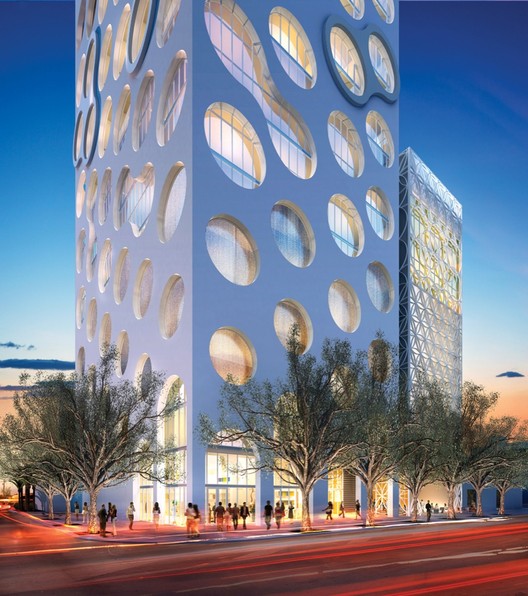
Miami’s Design District will soon be home to not just another building, but to COR. The ambitious project to design the first sustainable mixed-use condominium in Miami has been getting a lot of buzz and rightfully so. At 400′ tall it represents a dynamic synergy between architecture, structural engineering, and ecology. Extracting power from its environment utilizing the latest advancements in wind turbines, photovoltaics, and solar hot water generation COR upon completion will be seeking a LEED Platinum certification. The polka dotted hyper-efficient exoskeleton shell simultaneously provides building structure, thermal mass for insulation, shading for natural cooling, enclosure for terraces, armatures for turbines, and loggias for congregating on the ground. Comprising commercial, office, fitness, live/work, and pure residential spaces (113 residences from studios to penthouses)—COR provides a uniquely flexible platform for lifestyle enhancement.
Last week on ArchDaily we featured our interview with Chad Oppenheim founding partner of Oppenheim Architecture + Design. Below is a portion of the interview regarding the design of COR, and the full interview can be found here.
Follow the break for drawings and renderings of COR, along with a list of environmental design techniques incorporated into the design.
Architects: Oppenheim Architecture + Design
Location: Miami, Florida, United States
Project Team: Chad Oppenheim, Carlos Ramos, Juan López, Carolina Jaimes, Juan Calvo, Hugo Mijares, Jessica Santaniello Barrera, Rodrigo Londoño and Camilo Orozco
Client: Nexus Development Group
Project Area: 480,000 sqf
Project Year: Estimated 2011
Renderings: Dbox


Environmental design techniques incorporated into the design:


- © Dbox
- © Dbox
- © Dbox
- © Dbox
- site analysis
- site plan
- elevation
- elevation
- elevation
- elevation
- mechanical roof plan
- penthouse roof plan
- floor plan
- pool plan
- office floor plan
- parking eleventh floor plan
- parking typical floor plan
- mezzanine floor plan
- ground floor plan


interesting. i can see it working!
I can hardly see any working innovative techniques in this design.
Nearly none of htese wind turbine towers have been realised because they simply don’t work. And do you really want to live in a penthouse with a wind turbine in your garden?
A concrete structural sheer wall for a high-rise building?
Kind of heavy loads, I’m higly interested in the final solution from the structural engineers.
Finally, I just want these circles filled with sunshading elements – either from the otuside or inside.
It’s just another high-rise phantasy running wild.
Tim, you have no imagination at all, and to elaborate on your thought about the exterior wall, what do you think, other high rise buildings are made of? steel can be just has heavy as concrete. Buildings need a thermal mass in order to soak up the suns radiation during the day and release it during the night.
The wind turbines are not in the garden, they surround the gardens along the exterior out of the way of everyday activities. Not only do they create a very interesting look, they provide power to the building along with the other elements that use the natural world to help sustain this buildings power needs.
Mike, thanks for this.
We agree on many points, but I ‘m quite pessimistic that this project will be realized in the described manner.
“Buildings need a thermal mass in order to soak up the suns radiation during the day and release it during the night.”
OK, and I’m keen on having a look at the details to combine structure, mass, sunshading elements and the turbine technology. At the end of the day it will be a steel structure, filled with some massive concrete parts and a metal or cement board cladding to carry all the elements, i promise.
“The wind turbines are not in the garden, they surround the gardens along the exterior out of the way of everyday activities.”
Nope, see image 02, just the garden view. The wind turbines are one floor up, but the flipping shadow will be part of your everyday life.
As said before, there have been a lot designs for highrise building combined with turibines, which haven’t been realized because of structural and last but not least efficiency reasons.
Tim, you’re wrong.
Here’s 2 links to 2 “already built” projects with pretty much the same ideas:
- For the exact same wind turbine:
http://www.archdaily.com/70142/strata-se1-bfls/
-For the exact same concrete shell:
http://www.archdaily.com/22200/in-progress-0-14-tower-by-reiser-umemoto/