
Visit our Products section to learn more about architectural products.

Children’s Center for Psychiatric Rehabilitation / Sou Fujimoto

By Nico Saieh — Filed under: Health , Selected , , ,
 

Architects: Sou Fujimoto Architects
Location: Hokkaido, Japan
Project Team: Hiroshi Kato
Project Year: 2006
Site Area: 14,590 sqm
Constructed Area: 2,536 sqm
Photographer: Daici Ano & Sou Fujimoto


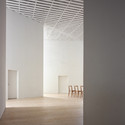
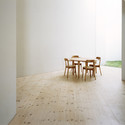
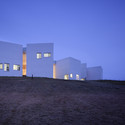
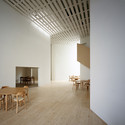
This is the treatment center for mentally disturbed children where they live together to get regaining their mental health. It may be thought that it is a very special building when I write so, but it is truly rich life space that requested in origin like a large house and also like a small city, the intimacy of a house and also the variety of the city. This is a proposal of a loose method.

plan diagram

The method of being random

A precise planning / Accidental landscape

If It was possible to make a building with such a method how something was merely scattered, I thought it was a dreamlike building. And, as for this method, surprisingly precision planning is possible. As opposed to the complicated program called for, moving a box delicately, the plan can be flexibly packed just because it is random.

However, the first feature of this method is over there.
Although, this space is created as a result of an infinite, strict and artificial design process, it stands as a place which is not planned at all, or which has been made automatically with no intention. The place which is vague, unpredictable, filled with unlikelihood. Something that is not meant is produced as a result of an intentional and strict design act. And plenty of a place is achieved because of ambiguity for not being intentional.

Selectivity and contingency / freedom and inconvenient

A surely irregular alcove-place is produced between the boxes placed at random. It is the place of a small scale where children can hide in while they are connected to the living area. Although it is the space with no function in which it can make it avoidable in a simple form strangely, children play with the place like the primitive man who interprets landscape freely and lives very well in it. They hide in a place behind something, show up, relax at back, and run about here and there. By being separated and being connected are compatible, freedom and inconvenient live together in the meantime. Plenty of the place for living is achieved.

It can be said that there is nothing center here and conversely, it can be said that there is a countless center. They are “relative centers” which always interchanges and changes with the consciousness of those who are there or the condition of light. For the staff, a staff room is a functional center. For children, living room, a single room, or an alcove is a center. The occasional center is found out in fluctuation of space.


31 comments »

Musser says:

breathtaking in its implications. a very intelligent project.

 
# November 3, 2008 at 17:02

As Le Corbusier once said: “Architecture is the masterly, correct and magnificent play of volumes brought together in light.”

Amazing work by Sou Fujimoto!

 
# November 3, 2008 at 18:12
visitor says:

Are you going treat those people or make they sick? That is my personal opinion, but this building is complete opposite what is should be. That remind me maze, long curve corridor without windows that is really place where you can get mad, with full respect for author. Scary. Scary. Scary.

 
# November 3, 2008 at 18:37
hedgy says:

Creapy .. ill say. I like the hole idea of the design of this space, but i dont like it’s function. I think this tipe of planning is not suitable fot a Center for Psychiatric Rehabilitation. Cheers for Sou Fujimoto.
P.S. i still admire the japanise architecture

 
# November 3, 2008 at 19:25
Hamster says:

You have to be japanese to recover in a space like that!

 
# November 3, 2008 at 20:55
Andreas says:

To those who call this project ’scary’ and ‘creepy’, but ’still admire japanese architecture’:
The nice thing about showing some interest in other cultures’ concepts of space is that you learn something about the peculiarities of your one. Why not watch some Ozu or Kurosawa movies and then have another look at the project?
I think it is above all your ignorance that scares you.

 
# November 4, 2008 at 06:16
tk says:

would be better as an artists’ community.

 
# November 4, 2008 at 09:28
Berni says:

oh no… why do so many architects don’t think about the »for who do we build« and »what should be the function of it« ?!?
maybe the most inappropriate building for children with that kind of special need!

 
# November 4, 2008 at 09:39
Kamila says:

concept of the space, compossition, ilumination and emphasis of certain areas, are masterfully designed (deep bow for Fujimotosan)It is GREATE work on volumes and geometry, all elements of theory of design are taken under consideration and studied carefully…but I am not sure about “curing” mission of this space – I feel on these pictures lonlyness, alienation, if these people are going to recover, all responsibility lays on sholders of theraphists, space wont heal axious minds…(opinion of the person who was living in japan, not only experiencing the culture from movies, but being inside and between these people)… if we take under the consideration the big impact of selfconsiousness and focus on self development in japanese culture, we might think that this space reflect self control and order of higly develeloped SELF … it might help to understand these spaces and how it can influence personality of ill japanese people…
ockaresamadesu.ka

 
# November 4, 2008 at 12:28
mig rod says:

beautiful, simple, and most importantly fun. this place proposes events of creativity and possibility. this place relates more to the way our hearts feel, than the typical boring pristine hospital.

 
# November 4, 2008 at 14:24
sullka says:

At first I just picked up the word “children’s” in the title, and after looking at the pictures (without reading anything) I thought to myself, beautiful spaces, but pretty sad for kids to be in, it needs life, colors!….then I realized it’s actually a psychiatric Center, and everything made sense.

Contrary to what others have said, I think it’s well done, I might be wrong, but I think a white canvas of a building is exactly what you need when treating people, nothing that disturbs tranquility or keep patients distracted.

Excellent piece of architecture.

 
# November 4, 2008 at 16:15
scarpasez says:

For those who think it creepy: these images are devoid of people: give it the act of life to clutter it up, and this place is amazing for kids. Terrific plan, section…beautiful stuff.

 
# November 4, 2008 at 23:24
Visitor says:

This address more for publisher, but I think all architectural services and beautiful newspapers should also inspect buildings after they have built. Kind of survey with users. That is dark side of all these shine buildings, monuments of architects. Has anyone find this kind of review? why? this is second the most interesting part architectural profession, ‘life of the building’

 
# November 6, 2008 at 07:47
john maher says:

nice, both concept and image.
please tell me what you did to the timber floor.
thanks

 
# November 8, 2008 at 08:34
John Crittenden says:

The box is the part that separates itself from the randomness of the design. The matter of the universe is like that of the mind, of adults, and of children, the loose stuff that is without order. It is kind of like meeting the children on their own turf. Without all the little similar boxes there would not be a context. I am a bit amazed by all the space devoted here to children who it would seem need a bit of nurture and boundary to ease the difficulty of being deranged.

 
# November 21, 2008 at 03:51
zanzi says:

i love it but i’m not sure if this suits of it’s function.Floor plans are very complicated for a child.i don’t know but i love it.

 
# November 28, 2008 at 12:37

Very nice work. Thanks…

 
# January 1, 2009 at 21:58
Ash says:

i like the concept

 
# January 5, 2009 at 07:26
oyun says:

Excellent work. Good Website. Thanks Admin…

 
# February 27, 2009 at 17:01
max says:

For children?
Will any children like these boring spaces?
or it’s only the designer’s will.
if i am a child,i prefer some more interesting and creative
some more easier to understand.

 
# July 2, 2009 at 23:26

I like the way of making children interact through dining rooms and spaces like that.
I also think the double height spaces and hidden skylight will let them feel free to some extend and at the same time they are interacting
I just wanted to know if the site located in a city or located in an isolated area or Moderate?

 
# October 22, 2009 at 17:02
lee says:

我喜欢,心灵触动

 
# November 1, 2009 at 02:49
Tom says:

I love this.

 
# December 8, 2009 at 01:27

Links to this article »

Leave a Reply »

Want to have your own avatar? Get yours at Gravatar.

Latest Comments »

One of the best projects for P.S.1 until now! Great diagram![+]
the first thing I thought: tarantino moment the second thing I thought: tarantino...[+]
Eğitim, kültür, sanat, mizah, tarih ne ararsan nezih ve şeffaf..en iyi yapıtlar...[+]
E somos dois. Boring![+]
and I thought the Postmodernism movement was dead…[+]
i think the basic idea breaking the appartments in puzzle like pieces to form unit,...[+]
love the picts, it has an ethereal quality to it for sure.[+]
From Dusk Till Dawn[+]
David Basulto on Rosa Muerta / Robert Stone:
Why not? If the author wants to decorate it that way, it’s ok. Actually, I...[+]
Haven’t a clue. I was unable to force myself to care enough to finish his novella....[+]
It is good– better than jurgen meyer: simpler...[+]
A pretentious, egotistical blowhard, and in the field of architecture? How utterly...[+]

Browse by category »

Our partners »

Browse by date »

Friends »

Proudly hosted at »