Architects: Lat Forty Five
Location: Central Otago, New Zealand
Project Year: 2010
Photographs: Jamie Cobeldick


Necessity is the mother of invention, so they say – and this applies to architecture as much as any other endeavour.
The designer and co-owner of this house, engineer Guy Shallard of Lat Forty Five, says necessity was precisely the reason he chose to elevate the living area and suspend it like a bridge several metres above the ground.
“The long, narrow site is surrounded by other properties,” Shallard says. “And although the site is parallel to the lake, the living areas needed to be elevated to maximise the views and provide privacy.”

The decision to suspend the living area within a bold bridge element was also influenced by Shallard’s engineering background.
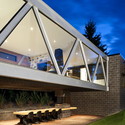
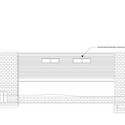
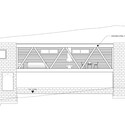
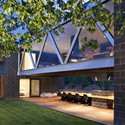
“In terms of the building structure, I like to push things a little,” he says. ”The bridge is heavily engineered – it could literally take the weight of a train. But the huge steel trusses provide the charac- ter, both inside and out. On the northern side the bridge is fully glazed between the trusses, while on the south side, cedar boards fill in the gaps between the steel.”
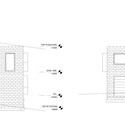
The bridge is supported at either end by symmetrical cube-like volumes clad in charcoal concrete block with rusted Corten steel window boxes.

“The heavy window surrounds bring a sense of depth – an added dimension – to the two structures, which are essentially very simple,” says Shallard. “The protrud- ing steel also helps protect the house from the harsh Central Otago sun.”
Shallard says the area beneath the bridge was developed as an alfresco living area, complete with barbecue and extractor hood. The kwila-clad terrace is completely open on two sides.

“We didn’t want to enclose this space as it would have made the house far too large and it would have detracted from the drama of the bridge.”
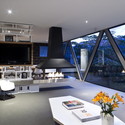
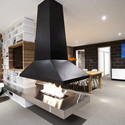
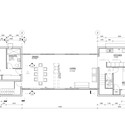
Individual steel stairs bolted into the block wall lead up to the living area, which is one large open-plan space. A decorative white-painted shelving unit, which incorporates a cantilevered stain- less steel fireplace plinth and a television cabinet, serves as a room divider. The cabinet is designed as a cedar box that frames the television, just as Corten steel frames all the exterior windows.
“At 2.4m, the ceiling height in this room is not especially high, but the pro- portions work with the length of the bridge, particularly when it is viewed from below,” says the designer.

A galley-style kitchen is housed in one of the concrete block volumes. Stainless steel benchtops are paired with grey-toned Bestwood Melamine cabinets. These are positioned so the owners can enjoy the view while preparing meals.
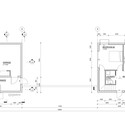
Other rooms in this part of the house include a second stairwell, bedroom and family bathroom, with a guest suite on the lower level.
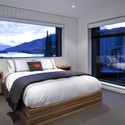
The opposite volume, on the west side of the house, accommodates the main stairs and master suite. To provide visual continuity, the master bathroom is lined with 600 x 300mm charcoal tiles that replicate the look of the exterior blocks. A study is located on the ground floor.
Products in this project
Bathroom Equipment: Edward Gibbon
- Bathtub and basin by Edward Gibbon
- Bathroom vanity: Bloc by Edward Gibbon
- Shower enclosure, tapware and fittings: Kiri by Edward Gibbon
Construction materials, Semi-finished materials: ViBlock, Site Steel
- Cladding: Charcoal block by ViBlock
- Cladding: steel by Site Steel
Floor: Flooring Xtra, Tile Centre
- Carpet by Flooring Xtra
- Tiling by Tile Centre
Joinery: Ellison’s Aluminium, Knobs & Knockers
- Doors and windows by Ellison’s Aluminium
- Door and window hardware by Knobs & Knockers
Kitchen Equipment: Fisher & Paykel, Miele, Bestwood Melamine, Formatt Kitchens
- Oven, cooktop and dishwasher by Fisher & Paykel
- Refrigerator by Miele
- Kitchen cabinetry by Bestwood Melamine
- Kitchen manufacturer by Formatt Kitchens
Roof: Straightline Roofing
- TPO membrane by Straightline Roofing
Walls: Pringle Decorating
- Paints and varnishes: Dulux by Pringle Decorating
- © Jamie Cobeldick
- © Jamie Cobeldick
- © Jamie Cobeldick
- © Jamie Cobeldick
- © Jamie Cobeldick
- © Jamie Cobeldick
- © Jamie Cobeldick
- © Jamie Cobeldick
- © Jamie Cobeldick
- ground floor plan
- first floor plan
- north elevation
- south elevation
- west & east elevation
Text taken from an interview on Trends Idea Magazine that the architect shared with us.


Very interesting concep….but I think has a functional problem at the entrance….
$$$$$$$$$$$$$$$$$$$
I just see that steel truss and all I can see are dollar signs. Not opposed to it ideologically but just can’t imagine a client that would spring for that kind of engineering overkill.
I like this kind of project, so interesting engineering solution enrich project so much!
reminds me of shigeru bans window house
http://www.shigerubanarchitects.com/SBA_WORKS/SBA_HOUSES/SBA_HOUSES_26/SBA_Houses_26.html
nice though
I think the kitchen is too far from the dining table!
Like Aquipablo and Milan, I figure there’s a lot to be excited by about this project- but the plan makes no sense!
It’s truly pointless to build a giant truss like that. It would be one thing if they were spanning a stream or an arroyo or something, but they’re not.
Also unacceptable is the fact that all those windows are fixed and there’s no opportunity for a cross breeze through the space.
awful materials
awful plans
awful relationship with the enviorment
awful distribution of spaces (the main bath in floor plant???)
think that this project starts with a lot a of potencial but had a bad and hurried development
This is a very interesting concept. I like the concept, but two things stand out that I would not place in a home. The fireplace is more of a show piece than a smart choice utility. The majority of the heat would be lost in such an open space. Two sides open…maybe. Never three or four. The other is the stairs. Call me traditional, but I believe the standard stair construction is more wise and safer. If this were to be used, each step would have to have more support from beneath and some type of railing. Safety first…art second.
what’s the point of solving a problem that you created yourself in the inception of the design? Makes no sense…
It’s goog, good, but not enough, although the middle block’s structure nice.
Nice structure
“The decision to suspend the living area within a bold bridge element was also influenced by Shallard’s engineering background” THIS IS EXACTLY THE PROBLEM
This house has so many planning falts
1. to suspend the living area, detached, above the garden
makes no sense
especially when the house is on a flat plot
2. there isn’t a sufficient way to ventilate the living area
3. why not a least make a balcony next to the living area
(first floor)
4. the second bed room guest or dweller needs to travel
down the stairs and up again every time he/she wants to
take a shower.
5. what kind of an entrance is this? when a guest knocks
the poor owner has to stop everything and go
down&up. or have a tv screen in order to figure out
who he buzzes in.
6. the heavy truss could have easily been replaced by
two almost invisible steel Columbus.
7. the dining area is toO far from the kitchen.
some one mentioned shigeru ban’s house well LOOK AND LEARN!
This house demonstrates exaclty what happens when a planer falls in love with a rediculas idea. too bad this house is not just a very good 3D Model.
Daniel, you must be an idiot.
I would love to know if some of the people that make comments have ever done anything of substance themselves. There are clearly people that comment that have no idea!
Hi Simon – I was realy impressed by your reply
I just took my time and carefully studied the house layout
the photos can be very nice but you actually have to use the house. and i suggest you read the coments above mine the majority of us must be real idiots by your standards
you know “bad argument – yell like hell”
Hi everyone,
I would just like to address some of the faults that you seem to be finding with this structure:
Firstly the suspended lounge, I don’t know if any of you studied the plan and the site plan, but clearly since its a flat site, why wouldn’t you raise the living space to maximize the view toward Lake Wakatipu.
“Andrew K” finds a problem with the dollar signs in regard to the client- as stated in the spiel the designer is also the owner, so he is using his own money.
I don’t know if any of the detractors are familiar with the concept of an “architectural statement”, but to criticize the architect’s aspirations and boldness, and try to bring him back to the box is eyebrow raising, and maybe you are on the wrong site.
Try http://www.gjgardner.co.nz/cms/
Wes, check this as well, more your style I think.
Thanks everyone, just my 2 cents.
Gary.
Gray
I think non of us have a problem with an “architectural statement” but it has to be justified other wize it is nothing but a statment. take a look at Ban’s house. it is clearly a staement. a bridged house on a hill side allowing the surrounding landscape to freely flow threw the house. the living area is at the ground level with a fully unscaved panoramic veiw.The layout makes a lot of sense and is gorgeous
And architecture is firstly to provide a practical solutoin and not just to satisfy the architects ego. if it is Practical and good looking well shapo !