
Seabank Cottage / Manalo & White

Uploaded by — Filed under: Houses ,Refurbishment ,Selected , , ,
 

© David Grandorge

Architect: Manalo & White
Location: Cley Next The Sea, Norfolk,
Project Architect: Brian Greathead
Project Team: Brian Greathead, Stephen Beasley, Ashley Seaborne, Paola Marra
Contractor: Green Building Solutions
Structural Engineer: Adam Power Associates
Project Year: 2008-2009
Construction year: 2009
Text: David Grandorge
Photographs: David Grandorge

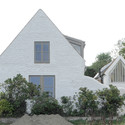
Cley Next The Sea is a small village on the north Norfolk coast. A group of houses faces the hostile North Sea, separated from it by a salt marsh. The condition of this settlement is fragile. Though sea defences have been intermittently upgraded, rising sea levels threaten its existence in the medium term.

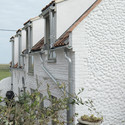
Barry Till (a former head of Morley College) bought a house here in the 1950s as a holiday home and retreat. The house was formerly two cottages with a shared chimney stack that had been knocked into one. It is now owned by Till’s four children, one of whom, Jeremy, is dean of the school of architecture at the University of Westminster and a well-known architect, writer and thinker. Jeremy Till, along with his siblings and parents, commissioned Architects to undertake its refurbishment.

© David Grandorge

The original brief was direct: there would be little ‘architecture’ in it. Roof timbers plagued by rot were to be replaced; a continuous layer of insulation would be applied to the whole envelope; the ground floor was to be made as resistant and adaptive to the effects of flooding as could be; and the energy use of services would be minimised. Construction should be cheap, and prioritise the use of salvaged materials where possible.
Also importantly, a thesis was developed for the re-organisation of the spaces of the building and its material expression. The resulting composition is analogously a boat on a rock. A new highly-insulated timber roof, wall and floor structure sits on a new brick wall that is built inside the existing thick flint walls. A robust tanking membrane and layer of insulation separates the brick from the flint, though they are tied together with straps. The brick walls in the centre that enclose a bathroom are partitions only, allowing for modification if necessary in the building’s future life.

© David Grandorge

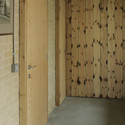
Till did not want to see the architect’s hand when he saw the space; the detail of the building should be relaxed, even casual. This is evident on entering the large hallway, which the clients think of as a ‘sorting space’. Leading off it are a bathroom, a cupboard, a stair and two bedrooms. The walls, of an inexpensive but textured brick, have been carefully laid with a flush lime mortar.

This language of brickwork is extended to a plinth made for the beds and the interior of the bathroom. Here, tiles whose adhesion would be compromised by flood water are replaced by glazed bricks, sourced cheaply as leftovers from another construction site. This material choice is pragmatic but also gives a vital character to this space, augmented by a shaft of light that drops into the open shower from a narrow but highly reflective light tube.
The bedrooms relate to the sea and the garden. The stark, exposed quality of their walls is relieved by curtains, fabrics and the inhabitants’ clothes that hang openly on pegs and hangers. This motif acknowledges the temporariness of occupation and is a rejection of the hotel-like quality of closets for something closer to the attitude of a Shaker house.

© David Grandorge

The soffit throughout the ground floor is defined by exposed, oversized timber joists running from front to back and fixed to doubled-up joists coupled with steel that span between the brick walls. The meeting of the joists with the brickwork required a timber wall plate. The awkward junction that results from this deliberately matter-of-fact construction is concealed by a galvanised box section carrying services. It acts as both conduit and cornice. The lighting elements are articulated in a standard aluminium channel that is threaded through the joists and serves to further articulate the ceiling.

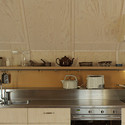
The tight stair at the centre of the house leads up to the homelier upper floor through a structure that could only be called a hut. This figurative element has an open roof that, allows light from above to illuminate both the stairwell and the larger space it feeds into. Separating the dining and kitchen and living spaces, it is constructed from reclaimed floorboards and contains a toilet and cupboards. The upper floor can be separated from the space below with a sliding door and hatch. When moved these reveal a perfectly ordered broom cupboard.

© David Grandorge

The walls of the living spaces are articulated in cheap spruce plywood that travels the length of the upper storey, fire-treated and finished with a white translucent water-based varnish. The battens that conceal the joints between boards are a cheap solution that allows for movement but also gives a sense of measure and grain to this long space. The end walls and reveals to the large existing dormer windows are constructed from Fermacell board on studwork and finished in a warm clay paint.

Brian Greathead, principal of Manalo & White, was taught by Jeremy Till at the Bartlett in the mid-1990s. This patronage of a former student displays a sense of generosity and has led to a client/architect relationship characterised by collaboration and improvisation. This has been reinforced by the thoughtfulness and skill of the builder, Mike Walker, who made a significant contribution to the project’s detail.

© David Grandorge

The result might be described as ‘bucolic brutalism’ – architecture that is both robust and pleasurable. The language of austerity is employed humanely and delivered with wit and the scheme is a model of architectural and environmental adaptation to the severity of the natural forces that this site – indeed all global coastlines – might face in the future.

* Location to be used only as a reference. It could indicate city/country but not exact address.
 
 
Thumb up Thumb down 0

【archi info】 Seabank Cottage / Manalo & White http://dlvr.it/2Khcj #Houses (archdaily) #rental_archiinfo

 
# July 5, 2010 at 13:07
Thumb up Thumb down 0

Seabank Cottage / Manalo &White via ArchDaily – © David Grandorge Architect: Manalo … http://tinyurl.com/2dbydqq

 
# July 5, 2010 at 13:08
Thumb up Thumb down 0

Seabank Cottage / Manalo & White: © David Grandorge
Architect: Manalo & White
Location: Cley Next The Sea, Norfolk… http://bit.ly/9NUGhI

 
# July 5, 2010 at 13:31
Thumb up Thumb down 0

#architekt Seabank Cottage / Manalo & White: © David Grandorge
Architect: Manalo & White
Locat… http://bit.ly/cSPc5p #in http://dy.cx/c03

 
# July 5, 2010 at 13:31
Thumb up Thumb down 0

Seabank Cottage / Manalo & White | ArchDaily: Architect: Manalo & White Location: Cley Next Th… http://bit.ly/9h7ltb http://www.cubestudio.info

 
# July 5, 2010 at 13:42
Thumb up Thumb down 0
Kenny says:

Why are we looking at this?

 
# July 5, 2010 at 15:07
Thumb up Thumb down 0
me says:

because it´s beautiful!
and not overdesigned.

 
# July 5, 2010 at 16:09
    Thumb up Thumb down 0
    fco says:

    I’m not sure but I think this house is very overdesigned

     
    # July 5, 2010 at 16:40
    Thumb up Thumb down 0
    Os says:

    Overdesigned!

     
    # July 6, 2010 at 11:00
Thumb up Thumb down 0
A. Corner says:

The exterior is awful, but the interior is even worse.

 
# July 5, 2010 at 17:05
Thumb up Thumb down 0
Dan says:

Awful project, visually, from people who should know better. It might perform well in other aspects but thats no excuse for detailing that would look at home in the worst kind of commercial housing developments.

Can we please see more work from some decent British architects on this site, there are plenty of them and we dont seem to see any. If i see one more project from Slovakia or Estonia or Serbia etc….

 
# July 6, 2010 at 04:22
    Thumb up Thumb down 0
    Os says:

    I agree

     
    # July 6, 2010 at 11:01
    Thumb up Thumb down 0
    Cylinder says:

    I find it hard to qualify your argument on the basis of ‘detailing akin to a commercial developer’, surely if your education was architectural, you would clearly see the level of precision in the setting out of the glazed bricks in the bathroom alone (note none of the bricks are cut).

    It seems your position on what qualifies as good architecture is rather monocular.

    Stick to Heat Magazine

     
    # July 21, 2010 at 09:22
Thumb up Thumb down 0
op says:

I like ruffnes of this building. It is strange object, but I am happy that it shows how different people are. Usualy architects are the same bastards and think that values from arch school is the only ones you can trust.

Soory for bad English

 
# July 6, 2010 at 14:39
    Thumb up Thumb down 0
    Omikey says:

    Your point is well made. However no one needs to pay money to a college educated architect to get this for a result.

     
    # July 6, 2010 at 23:29
Thumb up Thumb down 0
eili says:

i agree with OP.
can´t say its awful just because it´s not like all the class-a stuff that we´re used to see on archdaily.
maybe they shd combine all the industrial basics with some cosy furniture and a few gimmicks, stuff like these cute little warmwhite noguchi paper lamps or something like that..

 
# July 6, 2010 at 15:41
Thumb up Thumb down 0

Its such as you read my mind! You appear to know so much approximately this, such as you wrote the guide in it or something. I think that you just can do with some % to force the message home a bit, however other than that, this is great blog. A fantastic read. I will certainly be back.

 
# September 30, 2011 at 04:12
Thumb up Thumb down 0

1:31 PM Jul 5th

Seabank Cottage / Manalo & White http://bit.ly/cSPc5p (via @archdaily)

Thumb up Thumb down 0

11:12 AM Jul 6th

ADU (Accessory Dwelling Unit) inspirations. http://fb.me/B1shsjQh

Thumb up Thumb down 0

8:11 PM Mar 21st

Seabank Cottage / Manalo & White | ArchDaily http://t.co/4SZKrQ0 via @archdaily, Presence and and genius loci

Leave a Reply »


Upcoming Architecture Events »

got events? invite us! click here

Architecture Books & Magazines »

Work Environments / DETAIL

Work Environments / DETAIL

We recently got to preview the newest addition to In DETAIL’s typological series, Work Environments: Spatial concepts, Usage strategies, Communications. It will be available next month (August 2011), and it is great for anyone who is interested in improving…


Reverse Effect: Renewing Chicago’s Waterways / Jeanne Gang

Reverse Effect: Renewing Chicago’s Waterways / Jeanne Gang

Our friends from Studio Gang Architects recently sent us their new book Reverse Effect. ”The culmination of a yearlong collaboration between Studio Gang Architects and the Natural Resources Defense Council (NRDC), Reverse Effect is dedicated to exploring the importance of


MARK Magazine #35

MARK Magazine #35

As you well know already we love MARK Magazine, and this issue fails to disappoint. It has projects from many of the architects we have featured here on ArchDaily such as, StudioGreenBlue, Heri&Salli, Clavel Arquitectos, Kengo Kuma, Colboc Franzen, Studio Velocity, Takeshi Hosaka, Fuhrimann Hachler, Toyo Ito, Nieto Sobejano, L3P…


Our partners »

AD on iPad via Pulse

Browse by date »

Browse by category »

Friends »