“The house is a machine for living in.”
- Le Corbusier
With this statement, Le Corbusier acknowledges the relation between technology/mass production and the new ways of living that the modern movement tried to materialize. For him the house was a static car, a designed functional object that could be mass produced. When the Villa Savoye was completed in 1929, 5.3 million cars were produced in Detroit.

From this point forward, architecture and car started a long lasting relation, with examples such as Albert Kahn’s buildings for Ford, Giacomo Matte-Trucco’s FIat Factory in Turin, Archigram’s Drive-In House concept, the Mecedes Benz Museum by UN Studio and the recent Lincoln Rd 1111 parking by Herzog & de Meuron.
Along this line we find the new Nanjing Automobile Museum by 3Gatti Architecture Studio, which was awarded with the first prize on an international invited competition. The project not only shows the car in an unusual way, but it also lets you to experience the museum by car:
“Car Experience” is a project for a building to be dedicated to the automobile: the car as an object of desire, a world to explore, a technology to study, an article to display and a means to travel around the building.


¬Here the world of the automobile intersects with the human and organic world creating a new tectonic structure with methods differing from the usual flat open spaces, squares… all on a human scale. Here everything is geared to the automobile – the car is the point of reference.
Here one will not find stairs to different floors, walls and elevators, but ramps which wind sinuously upwards creating a fluid conception of space, and where the flux of cars can move freely and reach the different levels of the building.

On an overall scale the area tectonically resembles a road, with a structure similar to that of an elevated motorway or a car park, but on a more human scale, the structure is as complex, ergonomic and sophisticated as the interior of a car.

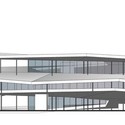
The principal structure of the building is a spiral ramp with a glass partition dividing the exterior from the interior. In the internal part, reserved for pedestrians, the incline is more gradual, whereas the exterior and steeper side is for the transit of cars.
The building’s typology develops sequentially, its structure similar to that of a film where the undisputed protagonist is the automobile. In fact the visitor, as the spectator of a film, is obliged, frame by frame, to follow the physical and psychological route as dictated by the museum’s architect.

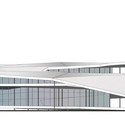
The visitor enters the museum with his own car and initiates the exhibition’s journey as on a safari, going up the external spiral and experiencing a rather “extreme” sensation – as the ramp consists of rapid ascents and descents which create an undulating, uneven surface facilitating the exhibition of cars from different angles and enabling the visitor to observe them from either above or below. This alternating movement with its practical yet amusing function creates a corresponding visual effect on the outer façade of the building, which appears as a fanned sheet of paper, folded and refolded, and where each fold is an opportunity to exhibit at a suitable angle the cars which are attached to the inclining floor.

The route through the museum for the visitor who arrives by car will thus start at ground level and will ascend via the spiral ramp to the top of the building. Here he can park his car and enter into the museum on foot following the exhibition’s descent to the ground level via the more gradual spiral. He can then take an elevator to return to the top of the building to collect his car; should he have arrived in a car with a driver who is awaiting him at the short-term car park at ground level, he can go there directly from below and leave from there.

In this way visiting the museum is divided into two types of experience:

The first is the experience of going up in one’s own car. As one ascends one advances chronologically from the more modern cars down below to arrive finally at the vintage cars on the top level. With this route one starts from a ground display level where the ceiling is 9 metres high and one arrives gradually at the highest display at the top of the spiral where the ceiling is only 4.5 metres high.
During this route the car ramp is uneven and the abrupt ascents and descents as well as the inclination of the cars exhibited, encourage the observer to frequently change both focus and view point; this generates a versatile experience which is rich in visual and perceptive stimuli.


The second is the experience of going down on foot. Contrary to the previous experience the descent starts chronologically from the display of vintage cars at the top and arrives at the more modern cars on the ground floor. The descending spiral ramp has an incline which alternates gradually from 0 to 7%, and thus the flooring slopes imperceptibly and takes the observer to the ground level with minimum effort, as on a slide. In this way it becomes possible to appreciate fully the exposition and not be distracted by steps, elevators or other obstacles; the visitor’s vision is free to wander, unencumbered.


Along the surface of the ramp there are occasional glass blocks or “prisma” which protrude from the flooring and ceiling. Their size, depth and type depend on their function as each one is intended for something different, for example if the area is intended for open space functions, or if it is intended for functions that require greater privacy such as offices, meeting rooms, conference rooms, laboratories, bathrooms or kitchens.
The outer façade of the building is completely permeable and reveals on sight the interplay of the different levels and the fluidity of the internal and external spirals. The building could seem to appear as an urban car showroom, with its corners and angles filled with tempting shining automobiles.


The objective of this project is to become an international point of reference in the world of automobiles and an unmistakable landmark for the territory of Nanjing, immediately recognizable by whoever transits the surrounding roads but also visible from the sky and, why not, even from the satellites from which an increasing number of internet-nauts explore the sights of the globe.
This post is part of a sponsored series highlighting details of modern life and architecture. The content is sponsored by Gillette, but curated, selected and presented independently by ArchDaily.
Program: Automobile and car components exhibition, educational installations, design centre, office, workshops laboratories, technical laboratories, conference rooms, space for special events, restaurants, retail, sales office.
Competition: International invitation competition first prize Architect: 3GATTI ARCHITECTURE STUDIO Chief architect: Francesco Gatti Project manager: Summer Nie Collaborators: Nicole Ni, Muavii Sun, Jimmy Chu, Luca Spreafico, Damiano Fossati, Kelly Han.
Client: Jiangsu Head Investment group CO.,LTD Location: Jiangning area, high-tech zone, Nanjing, China Total floor area: 15000 sqm Design period: May 2008 Intended construction period: 2009 Materials: Steel structure, resin coating, glass partitions